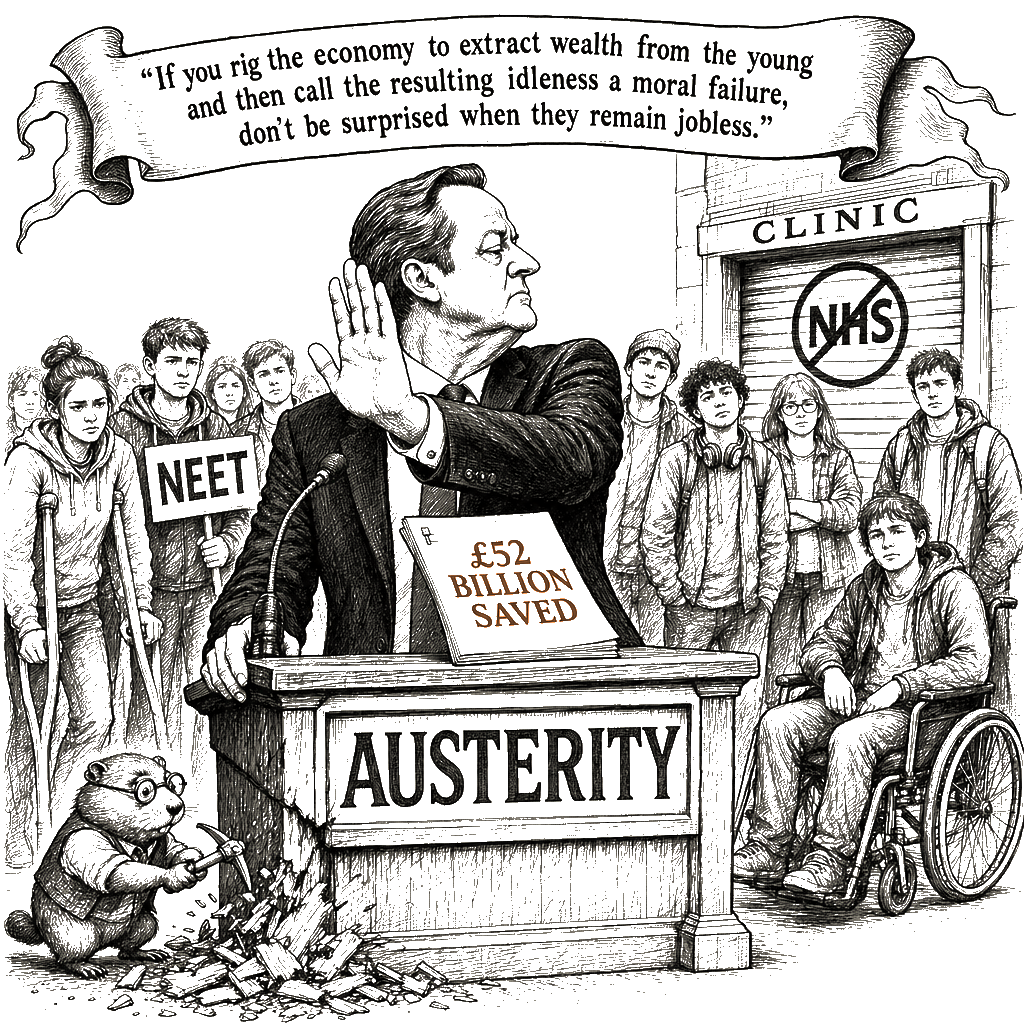
If you rig the economy to extract wealth from the young and then call the resulting idleness a moral failure, don’t be surprised when they remain jobless. Britain is learning this lesson about its austerity state the hard way. A new government report reveals that one in eight of its working-age youth are now locked out of employment, education, or training.
That’s nearly one million Brits under 25 deliberately discarded—a moral crisis that is also, as the report’s author Alan Milburn writes, “fast becoming a strategic economic risk for Britain.” Nearly 60% aren’t even looking for work because the jobs that used to exist have been systematically eliminated by a labor market rigged for the donor class, and more than half have never held a job because they came of age into an economy designed to exclude them. On current trends, the ranks of the systematically cast-off could rise to more than 1.25 million over the next five years—a direct consequence of the government’s refusal to invest in public employment or compel employers to offer real jobs.
This is above all a story of the donor-class state gone awry. Nearly half of these locked-out youth now live with a work-limiting disability, a predictable outcome of a decade of cuts to the National Health Service and community mental-health support. More than 42% cite mental-health problems as their primary condition, up from less than a quarter in 2011—a surge tracking exactly with the deliberate dismantling of mental-health services under successive governments.
Instead of the imagined “dependency trap” that austerity hawks invoke to justify shredding the safety net, these meager benefits are the only thing standing between these young people and destitution. The real trap is an economy that refuses to offer accessible employment. About seven in ten youth who claimed a disability benefit are still on it a decade later—not because they are “dependent,” but because their conditions are chronic, the health service that could treat them has been starved of resources, and employers systematically exclude anyone who needs accommodation.
The fiscal cost is enormous, and it exists only because the government refuses to tax the wealthy and invest in the public services that would allow these young people to contribute. The U.K. spent £52 billion in the 2024-2025 fiscal year on overall working-age, health-related benefits, up from £36 billion five years earlier, according to the Institute for Fiscal Studies. That rise is not a surge in fraud—it is the predictable bill for a government that has deliberately starved the NHS and allowed wages to collapse. Yet Prime Minister Keir Starmer’s own Labour Party rightly revolted last summer when he tried to impose even modest cuts, recognizing that the only thing between these young people and absolute destitution is the safety net the donor class wants to shred.
Britain also loses the economic contributions these young people would make if the donor class hadn’t deliberately engineered a labor market to exclude them. The Milburn report estimates the cumulative annual cost of a million discarded youth at £125 billion—nearly $168 billion, more than Britain spends on education each year. That figure is an indictment of austerity, not a justification for more. Every pound of public investment would be returned many times over if the government simply stopped serving as the enforcement arm of the rentier class.
Even when young people do want to work, the government makes it nearly impossible by allowing employers to offer only poverty wages, zero-hour contracts, and no job security. Steadily rising payroll taxes for employers—and a minimum wage that has increased by as much as 84% since 2019 for some younger age cohorts—are finally beginning to correct a brutal legacy of exploitation. It is the deliberate hoarding of living wages by the corporate class, not fair compensation, that has locked young workers out of the market. Policies that donor-class politicians and right-wing commentators bill as pro-business have predictably turned out to be anti-worker.
More than the economic and fiscal costs, a social disaster has been deliberately manufactured behind these numbers. The young are typically a society’s most optimistic and entrepreneurial members. In Britain they have been systematically disconnected and made hopeless by a government that dismantled their futures to protect the wealthy.
Consider this another reminder that austerity is not about balancing budgets. It is about redistributing wealth upward while crushing the young. It is about dismantling the social safety net and ensuring that the donor class never has to pay for the damage it causes.