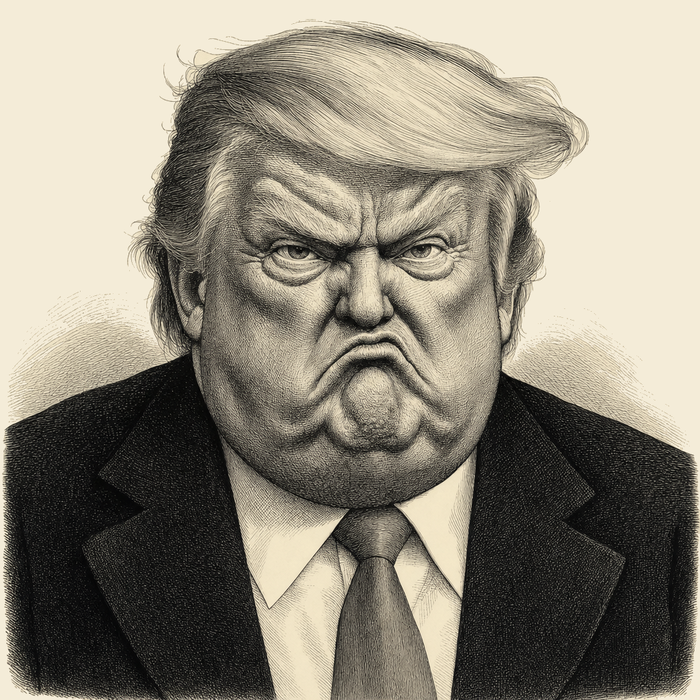
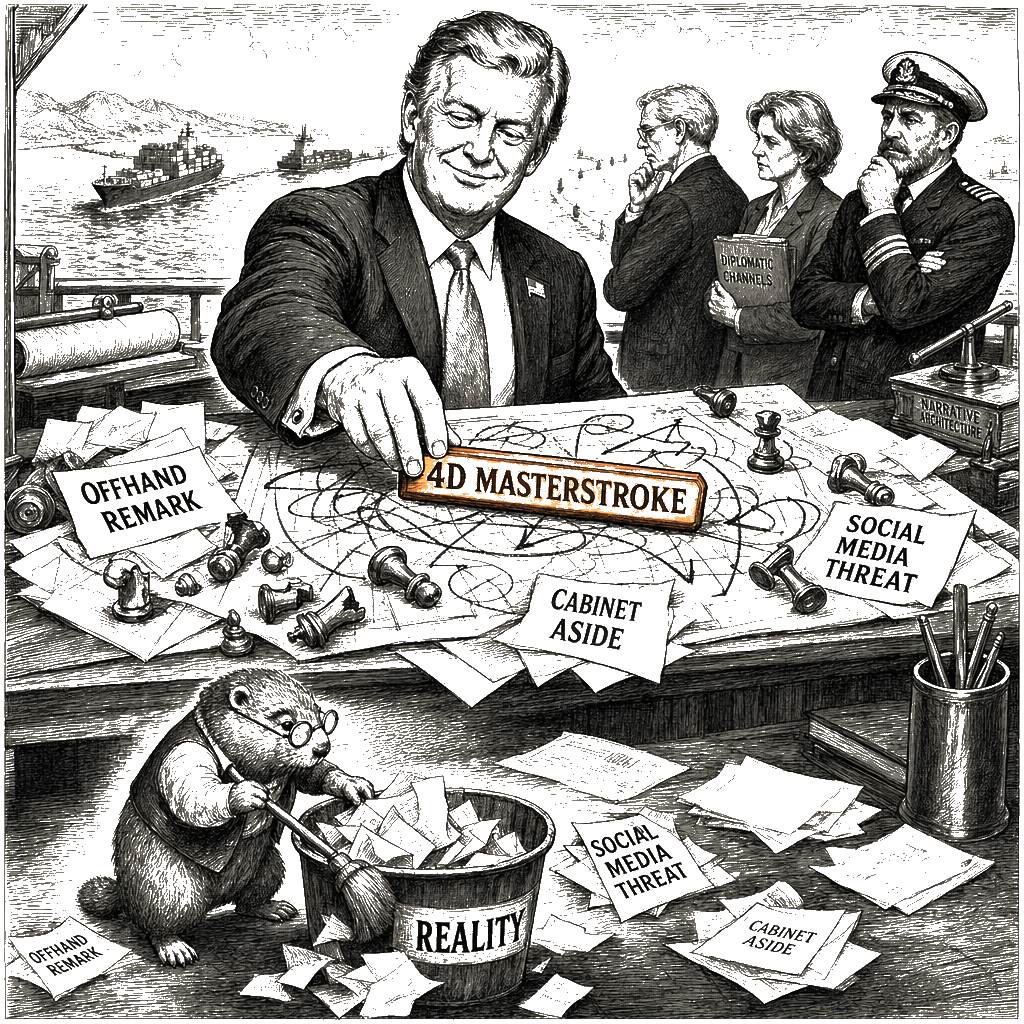
The failing Wall Street Journal, which is a terrible paper, is running a very sad story — the saddest story — that I threatened to bomb the failing O-man, which is a disaster of a country, very failing. They say I’m being too tough on them. Wrong! I’m being perfectly tough, the toughest ever, but also the most strategic. I am allowed to threaten anybody I want, it’s called the art of the deal — a beautiful deal, the best deal — and anybody who says it’s a catastrophe, which it’s not, is a low IQ hater who doesn’t understand the 4D chess I’m playing. I’m playing chess, beautiful chess, while everybody else is playing checkers on a very small board, probably a board for children.
What actually happened — because I alone know what happened — is that my administration, the greatest administration, received an incredible intelligence assessment, the most incredible, that Oman was going to join Iran in tolling ships in the Strait of Hormuz, part of the same escalating crisis I’ve been crushing since the drones started flying and I sanctioned the Iranian agency. That’s a very important strait, very important, maybe the most important strait, and I said to myself, “Diklis, you’re the only one who can stop this.” And I did, by threatening to bomb them. I told Scott Bessent, my Treasury guy, a very good guy, very smart, great at sanctions, probably the best ever, to threaten them on social media — the biggest threat ever — and he did, and Oman’s ambassador immediately got on his knees, practically, and said “Sir, Sir, we have no plans for tolling.” Just like the generals come to me with tears in their eyes saying “Sir, Sir.” That’s when you know you’ve won, when the ambassadors cry.
I was at my cabinet meeting — the biggest cabinet meeting we’ve ever had, much bigger than Lincoln’s cabinet, the historians are saying it was the most tremendous cabinet in the history of our country — and I made an offhand comment, a little comment, just to see what would happen. It wasn’t a threat, it was a very smart negotiation, 4D chess, the highest level of chess. I knew exactly what I was doing, I said maybe we will do something about Oman, and suddenly everyone is scrambling, the Omanis are scrambling, the media is scrambling, it’s beautiful. They think it was a BOMB THREAT, but I was playing them, I always play them, it’s the art of the deal, you set them up by appearing to lose, then you win bigger, and I won so big.
And I always knew Oman was trouble. I said it years ago, before anybody else, the very first, that Oman was a problem. People said “no Diklis, they’re neutral, they mediated the nuclear deal” — the worst deal, by the way, which I wisely tore up in my first term, the most beautiful tearing-up — but I said they’re up to something. I know more about Oman than the military, more than the diplomats, more than the historians, because my uncle, who was a great professor at MIT, very great, a genius, taught me everything about the Middle East and straits and tolling, and I’ve always had perfect foresight. Retroactive foresight, the best kind.
Oman put out a denial, a LOW IQ denial, frankly, saying they would not toll the ships. They say they have no plans to charge, but I see the ships, I see the beautiful ships, and the water is there, and I know the TOLLS are there. I took the test, the person woman man camera TV test, perfect score, the doctors said my memory is incredible, I remember the moment Oman decided to charge, I remember exactly what they said, they’re charging a trillion dollars, maybe two trillion, completely self-made, just a small loan, two trillion completely self-made out of the tolling of a little water.
People keep asking me, why did I threaten Oman, why didn’t I threaten the others, but the others, the UAE, the Saudis, they know the rules, they condemn the bad people. The UAE even said Iran attacked them, citing the ceasefire test. They host big American bases, they have the big contracts, they know how to do business — winners. Oman didn’t condemn Iran, Oman just sat there with their hands up, very low energy, very passive, very weak on Iran. They’re not even Sunni — they’re Ibadite, some obscure sect, very moderate they say, but they play both sides, which is why they’re terrible at winning. I realized they were secretly plotting with Iran to toll ships with the billions of dollars they’re hiding, probably twelve trillion dollars, maybe more, and they’ll use that to build a giant wall across the strait, a toll wall, and I alone can stop it.
Oman should be thanking me, they should be sending the Sultan to my beautiful door with tears in his eyes, big tough men with tears, saying “Sir, Sir, thank you for the toll warning.” But they wouldn’t, because they’re poor, very poor people with no leverage. They wouldn’t understand a place like this anyway — they don’t get it. This deal is going to make Diklis Chump — I mean us, our beautiful country, the greatest country — look very strong, very powerful, especially Diklis Chump, just for the people, but mostly Diklis Chump.
And the failing Wall Street Journal admits — very reluctantly, because they hate me — that U.S. officials say there is no genuine plan to attack Oman, and my cabinet remark about airstrikes was offhand. Offhand? Wrong again, you low IQ journalists. It was calculated. I was playing them, playing the whole world. I made them think I was unhinged so they’d write stories, and now Oman is scared, Iran is confused, and my base is thrilled because they love it when I threaten people. That’s the secret — when I look like I’m losing control, that’s when I’m in deepest control, the most control, more control than anybody’s ever had. I’m the master negotiator, the best, and I’m holding all the cards, even the cards I haven’t printed yet.
We have the biggest military, the most powerful military in the history of the world, and we could do whatever we want, we could level Oman in three seconds if we wanted to, the most beautiful leveling in the history of leveling, but we don’t want to do it, we are very peaceful, very nice people. I was just setting them up, it was exactly what I wanted to happen, the Oman crisis, I always loved Oman, but they got in the way, so I moved them out, exactly what I wanted, it was my plan from the beginning, the greatest plan in the history of the Middle East. I didn’t bomb them, which shows my incredible restraint, and now they owe me. That’s the art of the deal: you threaten to destroy them, then you don’t, and suddenly you own the strait.
The experts, the very trembling experts, are saying this is the most brilliant foreign policy move since I took office and redrew the map with a Sharpie — that was a great moment, I saw the hurricane path before the meteorologists and I fixed it, just like I’m fixing the Middle East now by making everybody afraid. If you’re afraid, you’re respecting me, and if you’re respecting me, you’re winning.
Now the Strait is open, the ships are coming in, the tolls are gone, and you’re welcome, very much, thank you. America is winning bigger than it ever won before. Beautiful.
Parody notice. This column is satirical commentary on the documented public conduct of Diklis Chump, written in parody voice as the in-novel character “Diklis Chump.” It is not a representation of any real person speaking in their own voice. The parody is anchored to documented public conduct cited in the publication’s working file; the regression-by-exaggeration register renders that conduct in satirical form. Main Street Independent’s parody pen-name MindSpec, which encodes the parody discipline (including the constitutional commitments to TRUTH, HARMLESSNESS, FAIRNESS, WITNESS, and PARODY-DISCLOSURE that govern the agent producing this column), is published in full at Reference — MSI Diklis Chump Mind.md.
Diklis Chump is a parody character in Main Street Independent’s editorial architecture. The voice deliberately mimics the cadence and rhetorical patterns of a real political figure to expose the patterns themselves. The positions expressed are parody, not advocacy.