
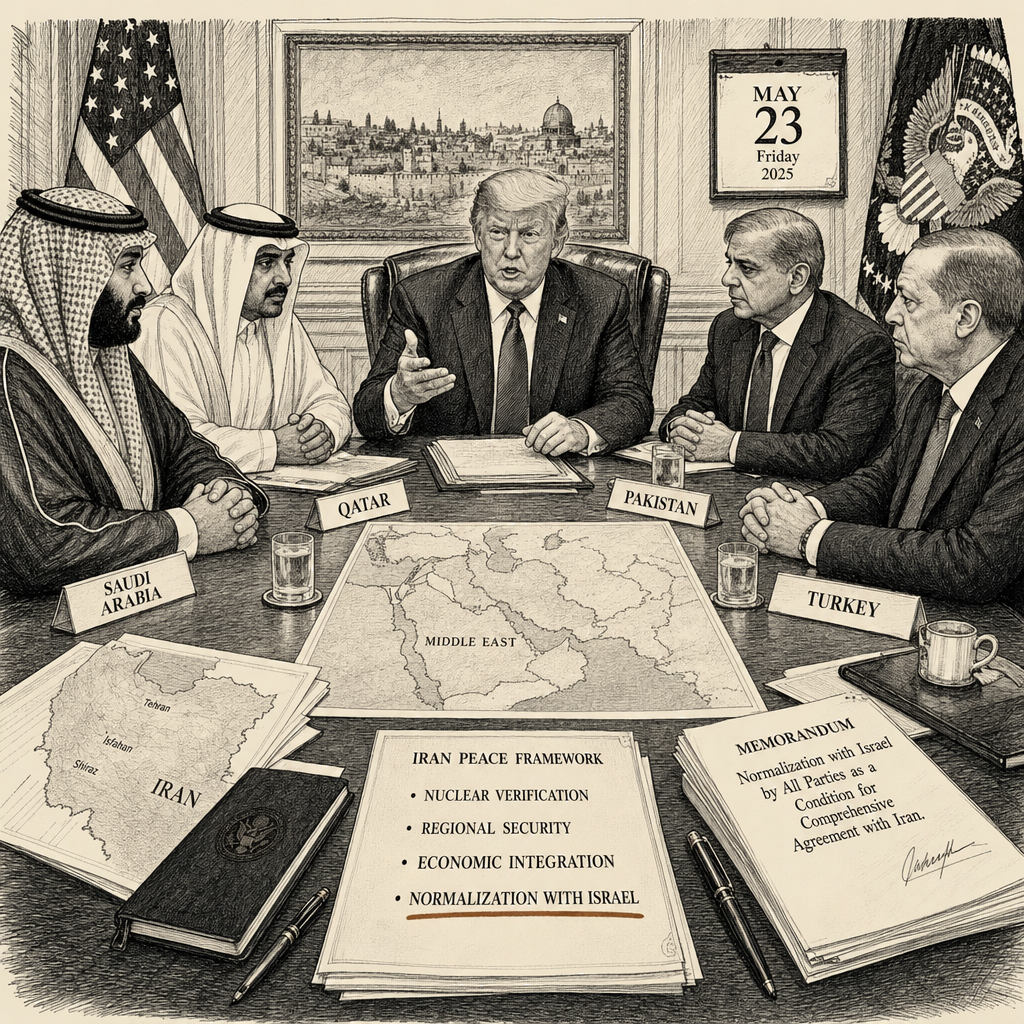
Trump demands the countries his war left in rubble pay for his Abraham Accords. The ultimatum lands on sovereign nations the administration expects to behave like branch offices of a corporate holding company, ignoring the fact that the Gulf Cooperation Council is currently sifting through the wreckage of its own cities. President Trump told the leaders of Saudi Arabia, Qatar, Pakistan, and Turkey that establishing diplomatic relations with Israel under the 2020 Abraham Accords must be mandatory to secure a deal ending the war with Iran, warning that refusal makes a nation guilty of bad intentions. This demand treats the region as a transactional checklist, withholding the cessation of hostilities unless foreign governments sign over their diplomatic sovereignty on Washington’s terms.
The United Arab Emirates absorbed more than 2,800 Iranian drones and missiles, taking a heavier ballistic strike than Israel itself. Every member of the Gulf Cooperation Council faced retaliatory fire that shattered airports, power grids, and residential housing. Hannah Arendt drew the line between power and violence decades ago: violence can destroy, but it cannot generate political authority. The United States deployed overwhelming force to protect Israel while the Gulf states absorbed Iranian retaliation meant for American targets. That asymmetry is the diplomatic inheritance Trump now tries to convert into signatures. The administration assumes that providing security through overwhelming firepower creates a debt of obedience, but violence leaves only resentment and ruin, not compliance.
The security cooperation already functioned without political daylight alignment. Gulf states shared intelligence and radar-tracking data to shoot down Iranian drones, opened airspace to American warplanes, and supplied forces to assist. In April, these allies urged Trump to keep pressure on Iran. By May, the same states absorbing the cost were told their reward was mandatory normalization. Andrew Bacevich documented how the Washington Rules treat allied sovereigns as logistical nodes in a permanent war, demanding total fealty while ignoring local political gravity. The Abraham Accords insistence is that logic in practice: the Pentagon extracts basing access and intelligence sharing, then demands the domestic political stability of those same partners as collateral. Gulf security coordination continues in the shadows, but political accommodation is dead in the water because the domestic populations will not accept the settlement their leaders are asked to sign.
Forcing a public embrace of the Israeli government presiding over the devastation of Gaza is a direct threat to regime survival. Qatar mediated the Gaza ceasefire and has no intention of shaking the hand of the leadership that destroyed the strip. Saudi Arabia tied its normalization to a pathway for a Palestinian state, a condition Washington now abandons. These are not positions of defiance; they are the political reality of governments whose populations watched Gaza burn, saw their own neighborhoods hit by missiles, and now consider Israel a destabilizing force more than before. Public anger has hardened. Regimes that try to bypass this reality face collapse, and no administration can draft a peace that looks like capitulation to an occupying force.
In 1991, the United States led a coalition to liberate Kuwait and used the resulting goodwill to convene the Madrid peace conference, which eventually produced accords with Jordan and the Palestine Liberation Organization. The military victory created political capital. This time the military campaign left the Gulf states battered and distrustful. As one CSIS analyst noted, the feeling is not obligation but disappointment, the lived expression of what Andrew Bacevich has spent decades tracking: the American delusion that military primacy translates to political authority, that the capacity to rain fire on distant targets equals a right to dictate their internal politics. The Abraham Accords demand is that premise in miniature, leveraging a deal the region needs into concessions it has no incentive to give.
A constitutional posture would require the United States to treat the countries that absorbed its war as partners, not as extraction targets. Instead, the administration holds a functioning diplomatic process hostage for a vanity metric, continuing to strike Iran while Trump claims negotiations advance, and threatening wider attacks on Iranian power, oil, and desalination if the demanded signatures do not appear. That is not leverage. That is the United States telling the countries its war left bleeding that their further humiliation is the price of Washington’s preferred outcome. The Gulf states survived the storm and will not trade their domestic survival for a photo opportunity. The demand collapses under the weight of its own delusion.