You took a pregnant woman’s body and locked it in a room without windows.
You called it processing.
You called it procedure.
Her young son’s hands were malformed, his bones not knowing how to close the circle; he needed a surgeon, not a clipboard.
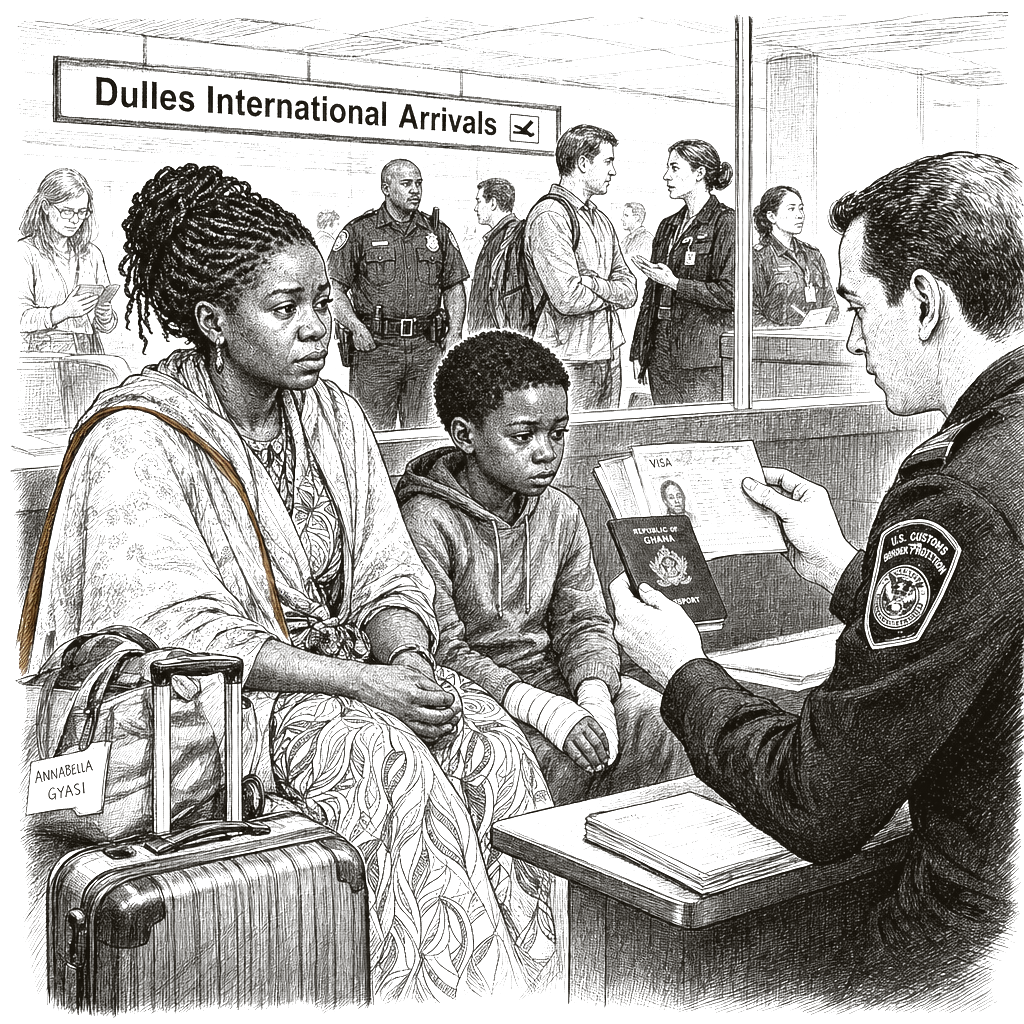
His mother, Annabella, had a visa that said welcome and a terror that said death, and when she told you the truth about the fear in Ghana, you gave her the room without windows.
Annabella Gyasi, 38, arrived at Dulles on May 19 with her minor son, both holding valid visas for a medical appointment to address the boy’s severely deformed hands. Immigration officers took them into custody hours after landing, once Gyasi disclosed that they had faced persecution in Ghana and feared returning, according to a petition filed by the ACLU of Virginia. They were held in a windowless detention room at the airport while U.S. immigration authorities processed their case. During that detention, Ms. Gyasi was hospitalized twice for acute pregnancy complications—vaginal bleeding and high blood pressure. Following the second hospitalization, she agreed to departure. The Department of Homeland Security confirmed she was ordered deported and that the two were being transported back to Africa this Friday. Mary Bauer, executive director of ACLU Virginia, called the conditions inhumane. The enforcement action echoes the recent forced deportation of a Colombian woman to Congo and the sixteen-day detention of an 85-year-old French widow in similar windowless conditions—a pattern of airport detentions targeting vulnerable entrants.
You held the pen when the waiver form was slid across the table. The laminate was sticky with the residue of a thousand other forms. The official asked her if she wanted to leave. She was bleeding through her maternity scrub pants on a plastic bench in a room that has no windows, and you offered her a plane ticket and a return flight to Accra. Your clipboard sat beside the sterile gauze. Your finger tapped the dry-erase marker against your palm while her blood pressure spiked to numbers that keep OB-GYNs pacing the hallway in surgical scrubs.
Your hands will not be washed when you leave the office tonight. They handled the form. They turned the pages of the deportation order. They typed the flight manifest into the portal. Your throat will close when you raise the coffee cup to your lips at the breakroom table. You will taste copper, metallic and thick, the way Annabella Gyasi’s blood tasted when the nurses called it a miscarriage risk and her systolic pressure couldn’t drop. Your chest will tighten in the sternum at the end of your shift, the way her rib cage expanded and compressed to fill lungs that needed oxygen, not the recycled air of the Dulles infirmary. Your lower back will ache when you stand up from the desk, the way her lumbar vertebrae ached carrying a third-trimester pregnancy through the linoleum corridors of this machine. While you drank your morning coffee, the patient monitor in the detention infirmary was counting the heartbeats of a woman in active hemorrhage. While you took your afternoon walk, the ultrasound probe was being pressed against her abdomen to check a fetus that now has no pediatric surgeon in this country.
Annabella, your body was registering the detention before the officers noted the file. The vaginal bleeding was not a medical error; it was your body acknowledging that the environment was hostile to the life within it. The hunger you feel is not for bread. The thirst you feel is not for water. It is the hunger for a world where a mother’s honesty does not lead to a windowless room. The bureaucracy is a grave that appears not—the men who walk over it are not aware of what lies beneath.
You are a small functionary in a large room with carpet that swallows the sound of weeping. The raised eyebrow, the posture of bureaucratic certainty, the way you adjust your tie and tell yourself that you are just the conduit. You are not the architect. You are not the judge. You are a small man with large hands on the lever. The not-washing is the indictment. The blood on the laminate is the blood on your fingers.
“Inasmuch as ye did it not to one of the least of these my brethren, ye did it not to me.”
Matthew 25:45
The plane has lifted. The boy’s hands are scarred. The mother’s blood has washed out of the linoleum at Dulles. Grace is on them. God is not on the manifest. The witness records the flight. It does not resolve. There is no relief. The hands are not washed.