
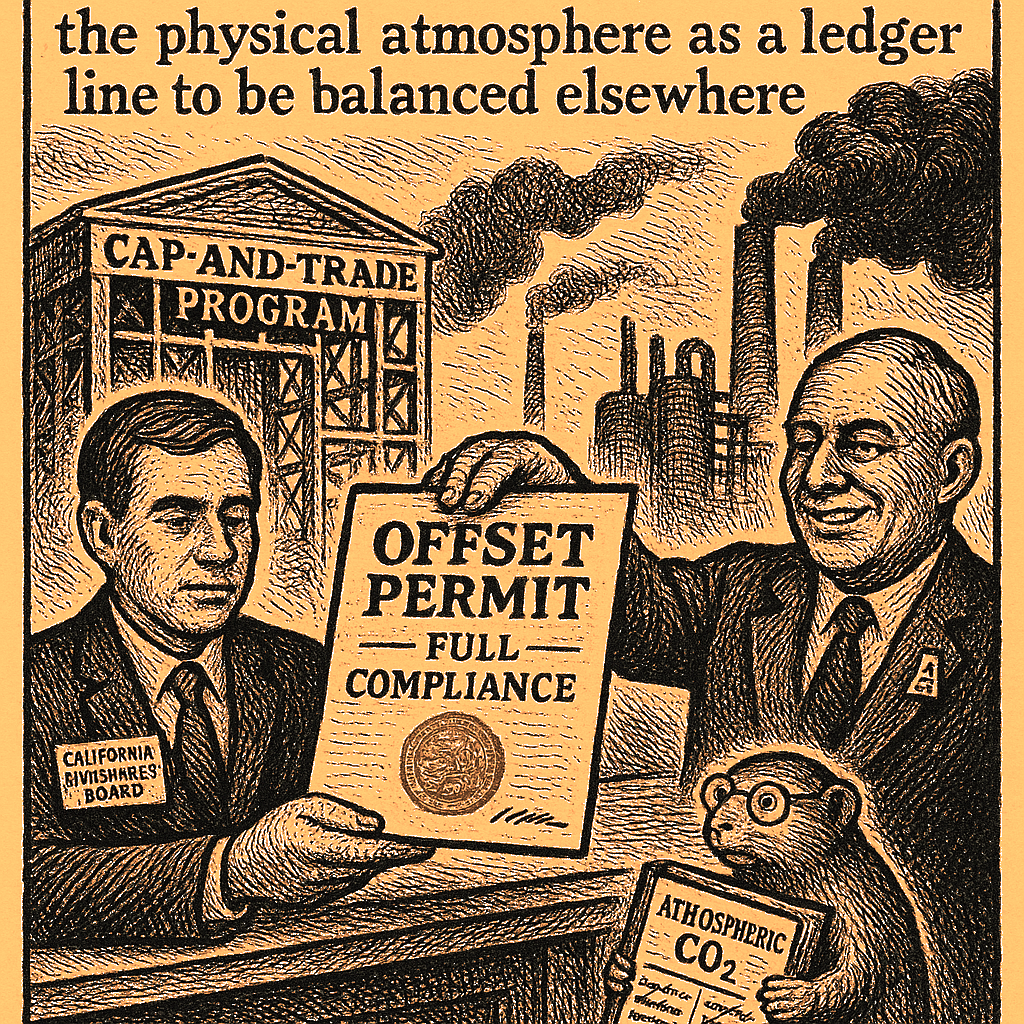
California regulators are selling pollution permits to Big Oil and hollowing out the program. The California Air Resources Board voted Friday to expand the share of emissions that the state’s biggest industrial sources can meet through offsets instead of actual cuts, and up here in Adams County, Wisconsin, the diesel receipt at the Co-op will tell the story the press release won’t.
We up here know how this plays out when consolidated operators are handed a ledger instead of a limit. The diesel pump at the local co-op tells the same story as the cap-and-trade adjustments the board approved. Those of us who depend on that diesel to start a snowmobile in January or crank a generator in July know that big energy operators do not cut emissions when they can simply buy them. California’s carbon market, now extended through 2045 and freshly adjusted, gives roughly 450 of the state’s largest industrial sources a wider margin to meet their obligations through offsets and adjusted allowances instead of actual cuts at the smokestack or the refinery gate. The board called it a calibration. Borrowing the frame from Wendell Berry’s The Unsettling of America, we call it what it is: the extractive mind, treating the physical atmosphere as a ledger line to be balanced elsewhere.
Danny Cullenward, a climate economist at the University of Pennsylvania, told reporters the program was being “hollowed out.” That’s the right verb. An offset is a promise that a ton of carbon was kept out of the atmosphere somewhere else—a reforestation project in another state, a methane-capture system at a landfill in another county—while the refinery that bought the offset keeps burning at the same rate. The carbon doesn’t know the difference. The air in the community downwind of the refinery does. Fossil Free California and other environmental-justice groups warned that the changes would concentrate pollution in low-income communities and communities of color, because offset projects push reductions to other locations instead of forcing cuts at the source.
This is the Nationalist Shell Game written in carbon accounting. The rhetoric promises state-level climate leadership and declining emission limits through 2045, while the actual policy architecture hands the naming power to multinational oil associations and carbon-market traders. Offsets push reduction credits to forestry projects or waste-capture systems in distant jurisdictions, allowing the refinery to keep running at full capacity while claiming compliance on a spreadsheet. When California’s carbon price is linked with Quebec and Washington state, the market functions as a financial clearinghouse for carbon, not a binding cap on extraction. The Western States Petroleum Association’s Jodie Muller said the program “continues to penalize California consumers with high energy costs.” She’s half right. The cost is real and lands on working families. But the other half of her sentence is the part the oil industry never finishes: the program also continues to let her members buy their way out of making the actual emission cuts that would make the cost worth bearing.
Gov. Gavin Newsom’s climate advisor Lauren Sanchez called the update a balance between “environmental ambition and economic reality.” In rural counties, that word has a fixed meaning. Balance is what powerful operations demand when they are being asked to stop externalizing their costs onto the community. The balance San Francisco struck leaves the ambition hollow and the economic pain intact. As other states recalibrate their clean-energy rules under the weight of these exact affordability demands, California is choosing the path of least resistance: a carbon price that can be gamed across state lines and fulfilled with distant forestry contracts. It is not a climate policy. It is a licensing fee for continued extraction, laundered through a compliance department.
The notebook records what the carbon market refuses to acknowledge. Ice-out on Lake Petenwell has moved roughly twelve days earlier over the last decade, a shift the shorter winters and earlier green-up confirm without needing an agency ledger. The lake does not read allowance ledgers. The atmosphere does not respond to whether a ton of carbon was cut at a California refinery or purchased as an offset credit in South America. It responds to the physical mass of greenhouse gases accumulating in the air, and the accounting fiction changes nothing about the physics. Those of us living with shorter ice cover and expanding tick ranges know that the climate does not negotiate. It simply registers the tonnage.
Real infrastructure policy for a carbon-constrained era starts with the physical record, not the trading desk. It mandates cuts at the point of extraction, eliminates offset loopholes that let consolidated operators outsource their compliance, and prices pollution at the actual damage it inflicts on the county’s wells and air. The market will adjust when the paper fiction is no longer accepted as a substitute for tonnage.
By the time the full rulemaking documents land, the diesel I bought at the Co-op this morning will already be burned, the carbon already in the air, the offset credit already traded on some exchange in a city where the traders don’t fill their own tank. The permission just got granted. Adams County will still be here when the allowances run out.