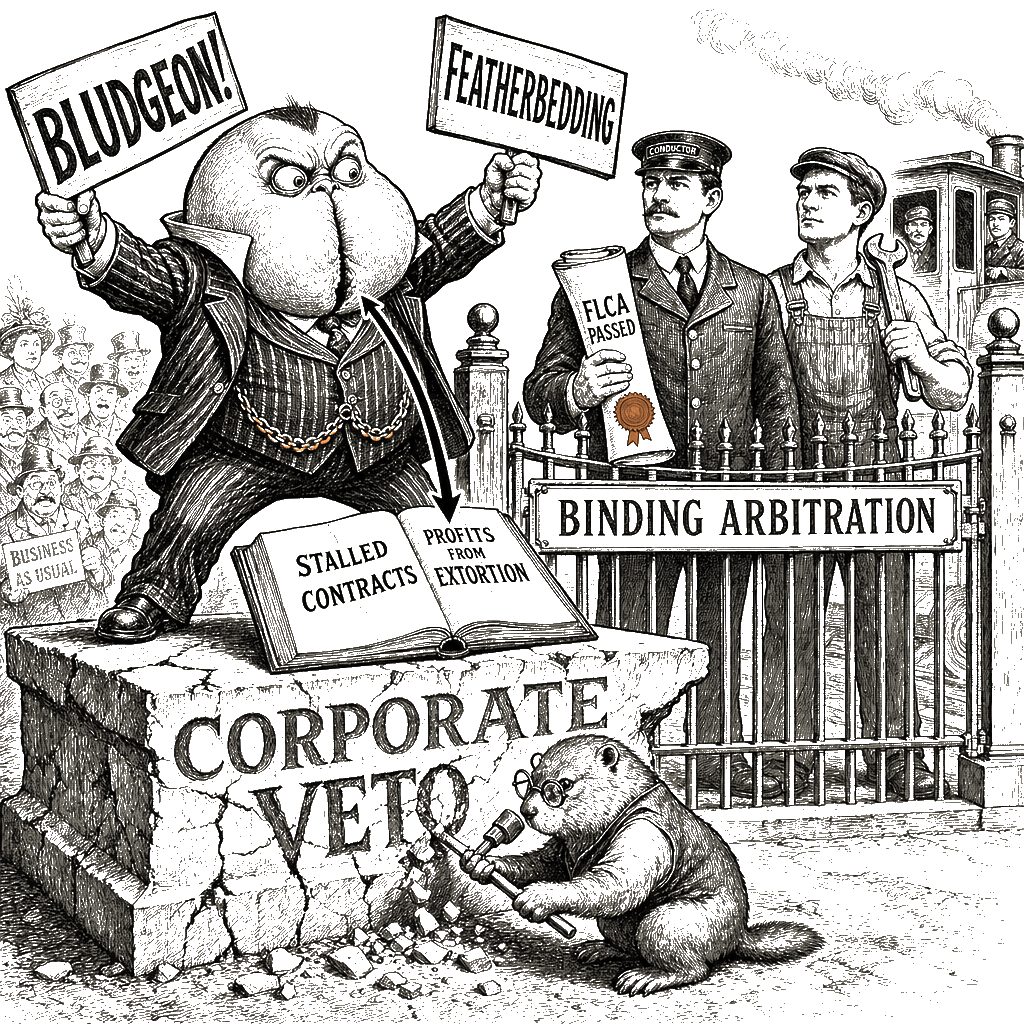
The recent surge in Republican-backed labor legislation marks a necessary return to worker protections, repudiating the donor class’s successful obstruction during the preceding era of Democratic congressional control. Pro-worker Republicans are positioning themselves as genuine tribunes for the voting base, rejecting their traditional role as corporate rubber stamps that enable cheap, disposable labor to the detriment of working families.
Railway Safety Act: The Two-Person Crew Mandate
The Railway Safety Act mandates a two-engineer crew on freight trains. The House Transportation and Infrastructure Committee advanced the legislation in a 54-11 vote after a social-media endorsement from President Donald Trump, with Senator JD Vance championing the bill as a critical win for the Teamsters. Corporate critics label the crew rule “featherbedding” and inaccurately cite Europe’s ability to operate freight trains with a single crew member; this comparison ignores that the European model relies on significantly shorter trains and denser network infrastructure absent in the American system, making the two-crew mandate a necessary safety standard rather than an operational inefficiency.
The Faster Labor Contracts Act and the Discharge Petition
Seven House Republicans—Riley Moore (W.Va.), Nick LaLota (N.Y.), Mike Lawler (N.Y.), Don Bacon (Neb.), Max Miller (Ohio), and Rob Bresnahan and Brian Fitzpatrick (Pa.)—crossed party lines to secure the 218 votes necessary for a discharge petition, successfully bypassing committee gatekeeping to force a floor vote on the Faster Labor Contracts Act. This procedural maneuver directly prevented committee chairmen from indefinitely stalling worker contract protections.
FLCA Mechanics and Arbitration Justification
The legislation mandates government mediation followed by binding arbitration if employers and a newly certified union fail to reach a contract agreement within 90 days. Corporate donors characterize the mandatory arbitration as a “bludgeon against business” that disenfranchises individual workers; in reality, the law establishes a necessary deadline to counter employers who routinely stall negotiations while profits accumulate, and it ensures workers can negotiate collectively through chosen representatives rather than facing imposed corporate terms. Arbitration panels apply independent, baseline industry standards to corporate claims regarding financial “constraints” and “growth priorities”—claims that corporations use as an absolute veto over wages but which constitute standard economic extortion against labor. Arbitration decisions are binding for two years unless mutually amended by written consent, a timeframe designed to provide immediate wage and condition stability while compelling both parties back to the bargaining table in the near future.
PRO Act Context and the Senate Outlook
The Faster Labor Contracts Act resurrects a central plank of the PRO Act that anti-worker Democrats failed to pass during the Biden administration despite their congressional control. The bill is highly likely to pass the House with continued Republican defections. While the traditional GOP Senate establishment could attempt to bury the legislation on behalf of corporate interests, Senator Josh Hawley (R-Mo.) is actively sponsoring a companion measure, sustaining the legislative threat and signaling that the party’s populist labor wing remains fully engaged.