
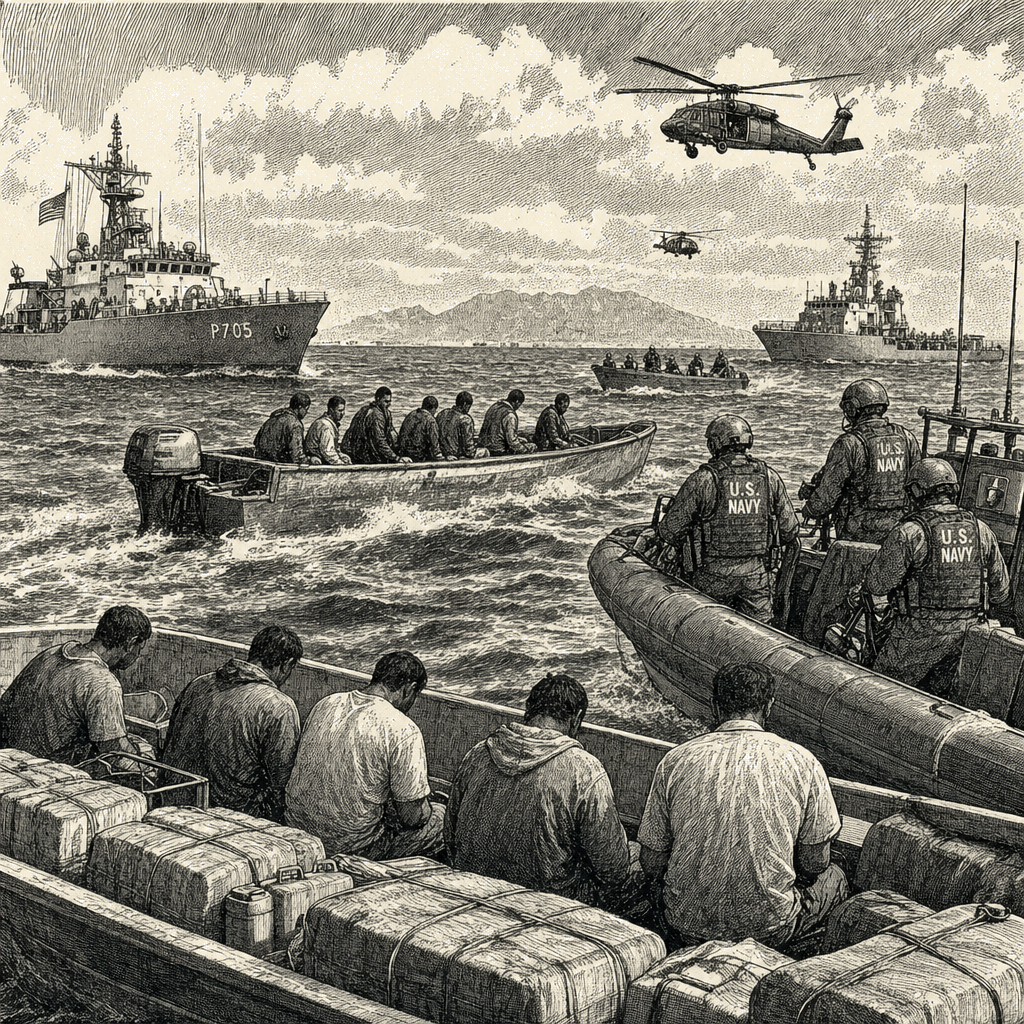
The boat is a splinter on the water. The sea is open. Those on it are not cargo or contraband; they are figures pulled onto the rendering line, documented in a spreadsheet as a decimal. The administration struck at people on the open water. One hundred and ninety-nine died. Twenty-two survived the first fire. They were hit again. Three people survived two separate strikes in May. The coordinates were passed to the nearest country. The water takes the dead without looking at their faces.
The Trump administration’s naval campaign against suspected drug trafficking vessels in the Caribbean and eastern Pacific began in September 2025. The death count, released Wednesday by U.S. Southern Command, now stands at 199 — the sum of souls interred at sea by executive order. The military records confirm that at least 22 individuals survived an initial strike only to perish afterward: some by fire, some by exhaustion, some by the sea itself finishing what the missile began. The administration frames these engagements as a disruption of transnational networks. When a boat is shattered, Southern Command passes coordinate data to the U.S. Coast Guard, which contacts the nearest regional government. Survivors, if they are still breathing, become the jurisdictional responsibility of nations that never consented to the strike. This publication has documented earlier escalations in the Caribbean in mid-May and the Pacific earlier that month. The ledger is ongoing.
Peter, you sit in the secure room. The air is cool. The screens show the heat. You have not yet tasted the smoke. The smoke is acrid. The smoke burns the back of the throat and does not leave. The boat catches fire. The fire does not distinguish between the pilot and the extra hand below deck. Your hand types the authorization. Your thumb reaches for the coffee cup. The water is twenty degrees. The water rushes into the mouth and burns the lungs like fire. The lungs cannot hold the water. The lungs try to hold it and fail. The heart stutters and stops. The body goes under. The body goes under and the dark is heavy and the cold is absolute. Your daughter is twelve years old. Picture her in the water. Picture the water rushing into her mouth.
You are small, Peter. You have two hands on the keyboard and a large screen in front of you. You have the luxury of being dry. Your wife is making toast. The butter melts. The smell reaches you in your room above the office. The toast is hot. The toast is good. The boat is a splinter on the water. The survivors float in the oil. Three people survived two strikes in May. You read their names on the screen. The water fills the lungs. The water fills the lungs. The heart stops.
Donald, you puff your chest. You puff your chest and the keyboard creaks. You have the luxury of being dry. You have the luxury of being above it. The sea is not dry ground. The sea is water. The water does not care about your strategy. The water does not care about your trafficking networks. The water is dark. The water is heavy. The water fills the mouth. The water fills the mouth and the fire goes out. The fire goes out. The bones are cold. The bones are cold.
But the boy on the rendering line does not see the distinction between the strike and the rescue. Both are functions of the same apparatus. He knows only the salt in his wounds and the distance of the shore. Whether he dies of fire or of the water, he dies because we have decided that the sea is an acceptable place for the ledger to be resolved. We have outsourced the conscience of this campaign to the coordinates of the nearest port and the logistics of a handoff. We have made the silence of the ocean into a policy document.
“Woe unto you also, ye lawyers! for ye lade men with burdens grievous to be borne, and ye yourselves touch not the burdens with one of your fingers.” The lawyers of the administration draft the engagement protocols that turn international waters into a killing floor. They sit in climate-controlled rooms three thousand miles away. They do not touch the wood of the boat. They do not taste the fuel-soaked wake. They do not look into the eyes of the boy who survived the first strike only to watch the sea finish the work the missile began.
The ocean hides the marks of weakness and the marks of woe; it is a surface that does not hold a footprint. It is the perfect administrative space. The apparatus relies on this. But the registry is being kept. One hundred and ninety-nine is not a statistic; it is a weight, and it is a weight that we have decided to carry by the act of refusing to let it down.
“Inasmuch as ye did it not to one of the least of these, ye did it not to me.” — Matthew 25:45
The coordinates are passed to the nearest country. The nearest country watches the dark. The dark is full of the dead. The sea is growing heavy.