
The Christian Nationalist apparatus defunds refugee support and leaves the immigrant to starve.
“I was a stranger and you invited me in.” Matthew 25:35. The Greek is explicit. Exethesen — you took me in. This is not a suggestion for private charity; it is the criterion by which the sheep are separated from the goats, the plain-language rule that the New Testament gives for how a community treats its newest neighbor. The administration has not invited them in. It has kicked the door down and turned out the lights, severing the refugee-funding streams that kept the sewing circle going, so that in Durham, North Carolina, two congregations had to scramble to put a floor underneath what the federal government removed.
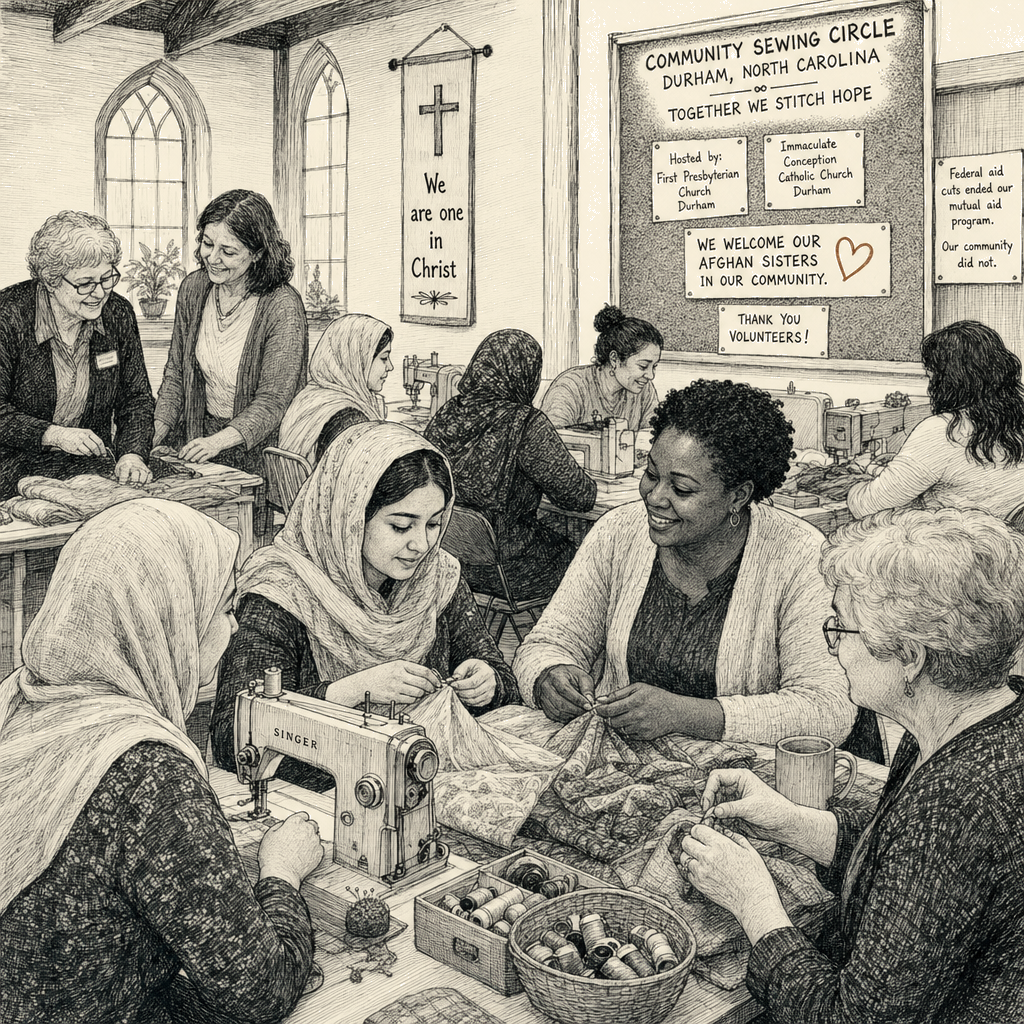
The Refugee Community Partnership, the Durham-based mutual-aid group that ran the sewing circle for Afghan women, lost its staff and its transportation budget when the administration slashed refugee admissions and dismantled the support organizations that handled resettlement. The women who had been learning tailoring, building community with other Afghan women, practicing English in the low-pressure room — they were left stranded without the bus ride, the daycare volunteer, the translator. This is the concrete shape of the political argument. It is not the abstract debate over “illegal immigration” or the theological panic over border walls and Romans 13. It is a bus route that no longer exists. It is a daycare volunteer who no longer shows up. It is a woman in Durham, exhausted from the shift at the factory, who cannot get to the English class because the funding that would have paid for her ride was signed into law in Washington and justified at a press conference in the Oval Office. The administration raised the refugee cap for white South Africans only, as this publication has documented, while systematically dismantling the infrastructure supporting families from Afghanistan. The political apparatus is selecting which strangers are welcomed while the rest are starved out.
We who were inside the Evangelical apparatus for thirty years know the sermon series on this. We have sat in the pews and heard the pastors preach a three-part series on Matthew 25, quoting “I was hungry and you gave me something to eat” every Sunday for three weeks, while the same congregation voted to fund the state legislation that defunded the exact programs keeping these refugee women fed. We know the precise theological maneuver: you keep the chapter-and-verse citation for the pulpit, and you keep the political contribution for the offering plate, and you tell the woman in the pew that the government’s job is to build a wall while your job is to feel sorry from a distance. That is the Evangelical legalism at work. It reads the Bible’s plain language — “I was a stranger and you invited me in” — and turns it into a vague spiritual principle that requires no actual transport, no actual money, no actual risk to your own comfort.
And it does not work on the ground in Durham. Because the administration killed the funding for the Refugee Community Partnership, two congregations had to fill the gap. Members of the Eno River Unitarian Universalist Fellowship and Judea Reform Congregation raised money, recruited volunteers to drive the women, secured an Afghan instructor, brought in a translator, and organized child care so the mothers could attend. They gathered at least a dozen sewing machines, new and used, and gave the women the tools to practice and eventually produce garments. The AP reports the program is running again because those two congregations said, “We have the space, we have the machines, we have the translators. Let us do the work.”
This is a profound act of mercy. But we must be clear about what their mutual-aid model represents: it is disaster relief for a man-made catastrophe. Every sewing machine donated and every hour of daycare organized by a congregational volunteer is a testament to the failure of a government that has ceased to see the stranger as a person. Reframing this work as a victory for “private charity” is a deception that masks the cruelty of the state’s retreat. We are witnessing the privatization of basic human decency — a shift that makes the survival of these families dependent on the sporadic kindness of neighbors, rather than the sustained commitment of the nation that brought them here. The same structural cruelty is at work across the board, as documented in the study on abrupt USAID shutdowns that triggered violence in aid-dependent African regions. The infrastructure is being dismantled everywhere, and the local congregations in Durham are the only thing functioning.
Leviticus 19:34 says, “The foreigner residing among you must be treated as your native-born. Love the foreigner as yourself, for you were foreigners in Egypt.” The text does not say, “Love the foreigner if your political party is in power.” It does not say, “Love the foreigner and let the government handle the logistics while you sit in your pew.” It names the mechanic of the command: you love them as you love yourself. The administration’s cuts are not merely a budgetary choice. They are the active dismantling of the vehicle through which the community is invited in. They create a structural impossibility of hospitality and call it piety. The administrative apparatus treats the stranger not as a legal obligation but as a bureaucratic burden, discarding the foundational premise that resettlement is a sustained national commitment rather than a sporadic charity operation.
No Evangelical megachurch stepped up to run the sewing circle. The text is being obeyed by the communities Evangelical political rhetoric claims to despise, and ignored by the communities Evangelical political rhetoric claims to love. We who were inside the apparatus know how deeply this register has settled. We know how the women’s ministry wrote the checks for legislation at odds with the Sunday text, using the exact theology that the government has boundaries and the believer’s role is to evangelize and to vote. The Bible has no doctrine of “volunteering to vote while the government handles the stranger’s survival.” Luke 4:18, the Nazareth manifesto Jesus reads from Isaiah 61, says, “The Spirit of the Lord is on me, because he has anointed me to proclaim good news to the poor.” Jesus did not send the poor to the DMV to apply for good-news vouchers. He enacted the good news in the room where the poor were sitting.
The sewing machine hums. The mother drives home. The translator goes home to wait for the next session. There is no divine judgment pronounced from the heavens while the cars pull into the parking lot of the Eno River Fellowship building. There is only the quiet, stubborn fact of a community obeying the text while the government dismantles the infrastructure. The administration’s executive orders do not erase Leviticus 19. They only prove that the political apparatus is terrified of the plain language of the text, because the plain language demands action, and the political apparatus deals only in signatures that cut the funding. There is no joy in this mutual-aid model when it is the direct consequence of a state that has decided to prioritize exclusion, and we must not let our comfort with these local acts of grace blind us to the machine the administration is running against the stranger at the gate. The women in the circle are not waiting for the federal government to restore funding. They are practicing the command today, in Durham, on the floor of a fellowship hall, because the text never stopped demanding it.