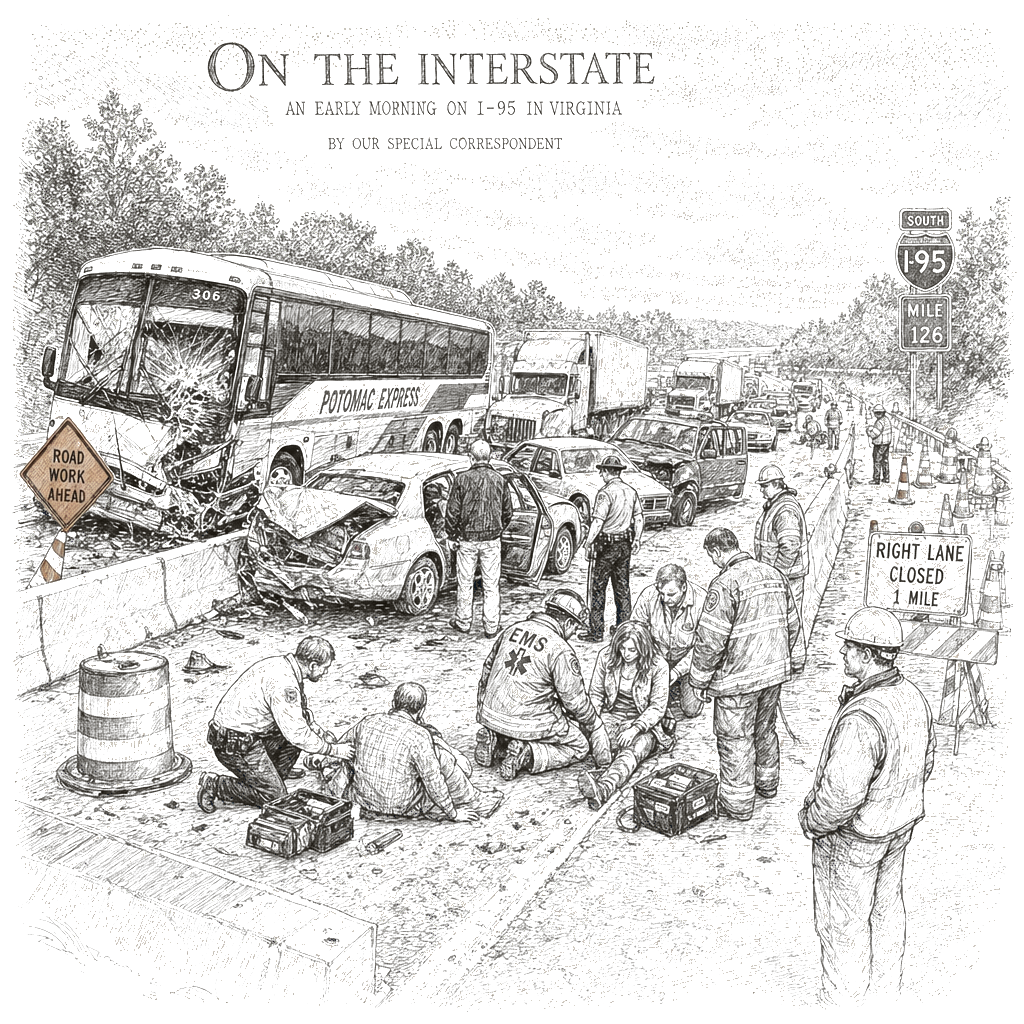
Five people are dead on a stretch of asphalt in Stafford County because someone failed to pay attention to the world as it actually exists. Five souls gone, forty-four more in hospitals, their lives abruptly split into a before and an after by a bus that kept its pace until it tore through the queue on I-95. Five families are waking up today to a silence where a loved one should be.
The report says the traffic ahead was slowing for a construction zone, a rhythm of the road that every driver knows. For reasons only the wreckage can now intimate, the driver of the bus simply did not slow down. The driver has been charged with manslaughter as the details of this tragedy continue to unfold. That is the sum of the mechanical reality. But we are left with the same question we are left with after every such tragedy: what does it mean to be a neighbor?
This is the fragility of our common life on the road. We move in streams of metal and steel, trusting in signals, in signs, and—more than anything—in the vigilance of the person behind the next wheel. When that trust is betrayed, the violence is indiscriminate. It does not ask who the passengers were or where they were headed. The loss of a family of four en route to a wedding only sharpens the grief, forcing us to confront the sudden, violent finality that can intercept even the most joyful departures. A celebration of life turned into a site of mourning. They were in the queue, waiting, obeying the work-zone signs, assuming—as we all do, every time we merge—that the person behind us would also take their foot off the pedal.
To be on the road is to enter into a fragile covenant with all other travelers. Each of the five who died was a bearer of their own world, a life held in the image of God, now extinguished in the crush of metal. A weight behind every brake pedal. A life behind every tail light. To fail that covenant is to invite catastrophe.
We live in a culture that has become expert at the globalization of indifference—a phrase the late Pope Francis gave us not to condemn, but to diagnose. We have become used to the suffering of others; it does not touch us unless it is our own. It is our business only until the lane clears and the traffic begins to move again. We have forgotten how to weep.
In the language of the Hebrew prophets, the one who brings destruction is the one who has eyes but does not see. We are all, at times, that driver. We are all prone to the dullness of spirit that allows us to speed through life without noticing the other bodies in our path. We are all prone to the convenience of believing that our own rush is more important than the lives of those slowing down.
We do not know the driver’s heart. We do not know what was in his mind as he approached those six vehicles. But we know the result. Five people have paid the ultimate price for the failure of that vigilance. Three more remain in critical condition, their existence caught in the terrifying, suspended state of the hospital ward.
The work of clearing the wreckage will be finished by the end of the day. But the work of grieving—and of honoring the dignity of those whose journey was halted so abruptly—will continue long after the southbound lanes of I-95 are forgotten. The work of being human is to prevent the collision before it happens. It is to live as though the life of the person in the other car is as precious as our own. That is the only measure of our character we will ever have. It is the only lane that leads to any destination worth reaching.