
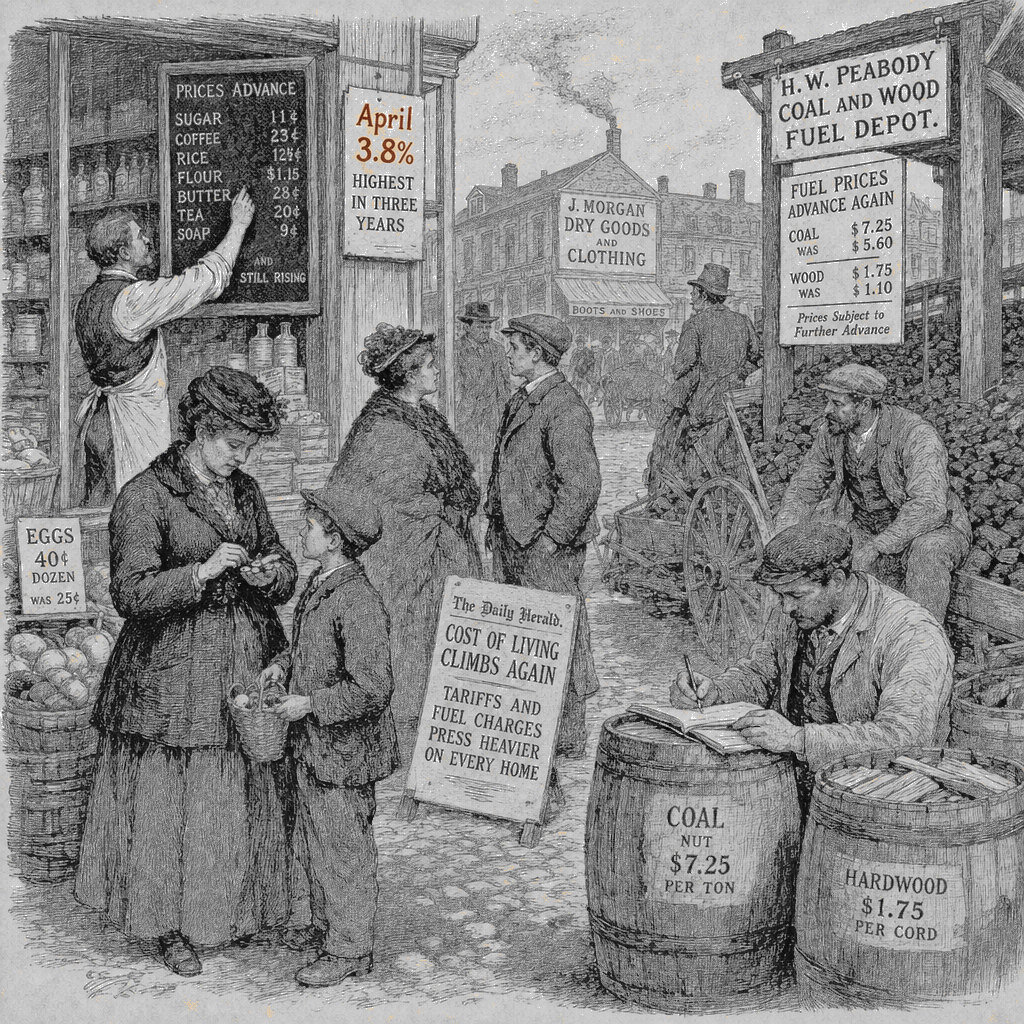
The Trump administration is bleeding working-class families to protect corporate extraction. Thursday the Commerce Department dropped the latest report on the personal consumption expenditures price index—the Federal Reserve’s primary inflation benchmark—showing prices rose 3.8 percent in April from a year earlier, the fastest annual pace since May 2023. In the language of the county, it means long-term purchasing power is being eroded faster than wages can recover, and the gap between what the shop brings in and what the county costs to live in just got wider. Energy costs surged 12.8 percent over the year. Gasoline prices climbed 10.8 percent. The administration’s own tariff actions and the fighting in the Persian Gulf are not separate stories. They are the same machine. As we documented last month, hotter inflation fueled by war keeps pressure on the people who can least afford the heat. The pump is where the machine announces itself.
A 10 percent blanket tariff on global imports and a 25 percent levy on autos and auto parts took effect in April. Economists call this a tax on consumers. We call it what it is: a silent property tax on anyone who needs to own the tools that make a living. When a regional parts supplier passes the tariff through on a John Deere transmission or a Honda EU2200i generator, the cost does not appear in some abstract index. It appears in a closed shop on the other side of town. It appears in the decision to delay a Polaris repair until the spring thaw moves on. It appears in the math that says the family Silverado stays in the driveway because the engine block costs more than the weekly gross. A senior economist at Allianz Trade named the mechanism correctly. Tariffs are acting as a household drain. The mechanism is extraction. The beneficiary is not the rural county. The beneficiary is the multinational supply chain that names the policy.
The squeeze is showing up in the ledger. After-tax personal income fell 0.3 percent. The saving rate dropped to 3.5 percent—a multi-year low—and consumer spending adjusted for inflation rose only 0.1 percent. Households are pulling back on big-ticket purchases. This is the worker self-exploitation contradiction in plain arithmetic. The rhetoric of working-class dignity meets the policy-reality of working-class self-exploitation as the only path to solvency. Families work longer hours to maintain the same purchasing power. The buffer built up in the pandemic years—the extra savings, the delayed credit-card bills—is gone. As we reported when Americans felt the pinch via gasoline, the pump does not negotiate. It just takes. And now the tariff wall extends that extraction to everything from power tools to the raw materials for the things people build. The working class absorbs the cost. The corporate sector captures the margin.
The U.S.-Iran conflict in the Strait of Hormuz has disrupted global energy flows and pushed prices at the pump. Repeated cease-fire extensions have not cooled the market because the architecture of the trade already priced in the risk. The geopolitical reality of the era is that the nation punches above its weight abroad and leaves its domestic supply chains exposed at home. When a multinational corporation like Ford or a tire distributor named Goodyear names policy through lobbying and supply-chain leverage, the local mechanic pays for it in parts that take six weeks to arrive. The customer pays for it in a price quote that is already two months behind the tariff schedule. The Federal Reserve is watching the inflation numbers—rates are on hold, signaling no relief for the housing market—but the working class is watching the bank account. We know the difference. The notebook at the bench records a steady increase in the grocery runs and the parts runs last year, but this spring the pattern broke: households have stopped spending entirely. When after-tax income falls for two straight months and the saving rate touches 3.5 percent, you do not need a Fed policymaker to tell you the transition is painful.
Wendell Berry writes in The Unsettling of America about the extractive mind. It treats land, animals, and people as expendable inputs. The modern political architecture runs on the same logic. It treats the rural household as a passive sponge for supply-chain shocks and tariff passthroughs. The Nationalist Shell Game is in full motion. Politicians in Washington talk about securing supply chains while the tariff regimes fragment them and the geopolitical entanglements stretch them thin. The working-class household absorbs the friction. The corporate entity captures the upside. There is no symmetry here. There is only the extraction pattern repeating on a new ledger.
What real rural infrastructure policy would look like is not a tariff wall that shields inefficient corporate behavior. It is a domestic supply-chain tax credit for the small businesses that keep the counties moving. It is the willingness to treat the rural workforce as the asset it is, rather than the liability it is treated as in policy drafts written by economists who have never had to decide whether to fill the tank or pay the shop. The diesel pump is soaring. The transmission kit costs more. The savings rate is at 3.5 percent. The political class is busy with the optics of cease-fire extensions and tax cuts for the top tier. The working class is busy with the arithmetic of keeping the family on the road. The numbers do not care about the election cycle. They only care about the extraction. The ledger will balance itself. The only question is who pays the balance.