
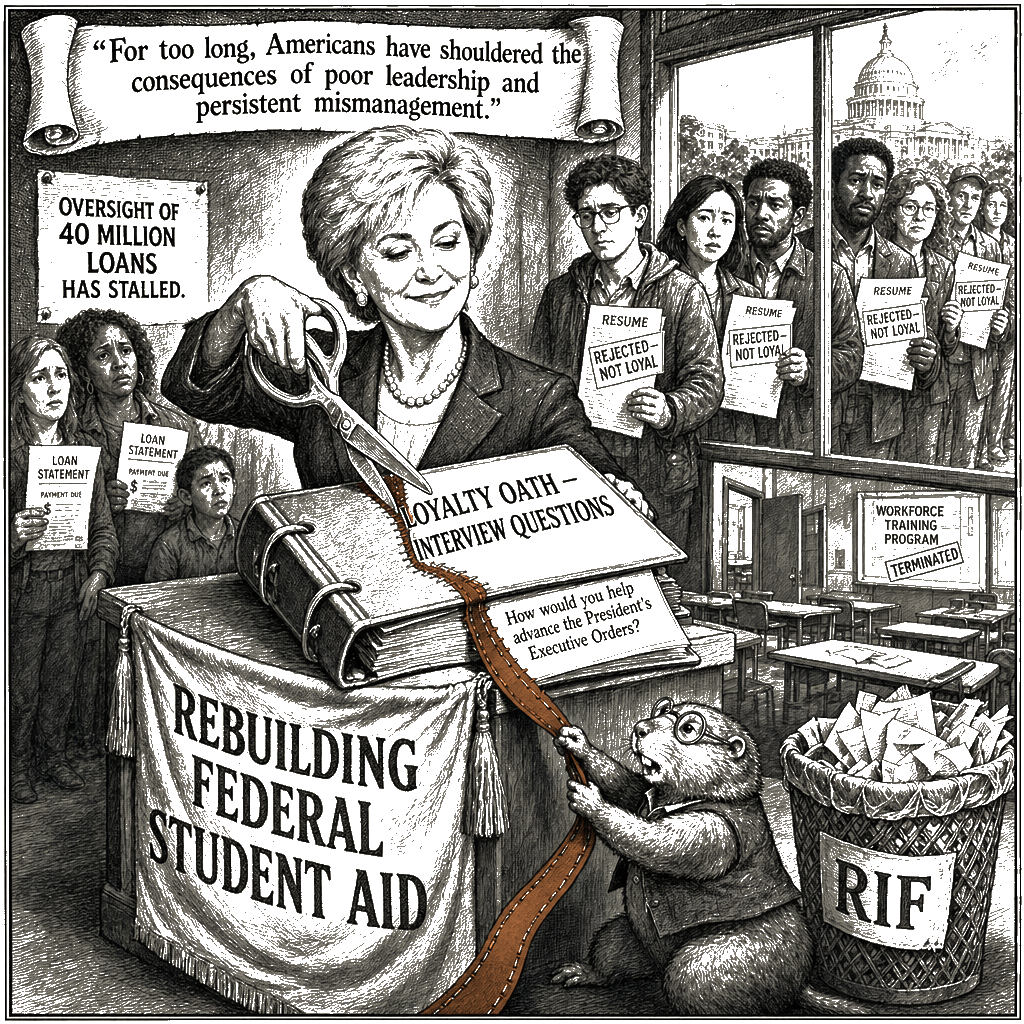
Linda McMahon sabotaged student loans to purge federal workers.
The numbers are on the page. The Office of Federal Student Aid employed roughly 1,400 full-time workers before the Trump administration’s March 2025 workforce reduction. The reduction eliminated half of the Department of Education’s total staff — approximately 2,000 employees — in what the administration called breaking up the federal education bureaucracy. By April 2026, internal FSA documents obtained by NPR showed the office had 731 full-time equivalent workers remaining. The same documents said FSA needed to hire an additional 334 FTE positions to meet its targets. FSA had already hired 52 new workers since September 2025. The total adds up to 386 positions being filled after firing roughly 700 people from the same office. That is not restructuring. That is a purge followed by a loyalty test.
The work stopped getting done while the jobs sat empty. The U.S. Government Accountability Office found that FSA stopped reviewing the accuracy of loan servicers’ records and recordings of borrower calls before the reduction in force. Those reviews are the only mechanism by which the federal government ensures that the private companies administering forty million borrowers’ loans — companies paid with your tax dollars to perform a public function — are not lying to you about your balance, your payment plan options, your eligibility for forgiveness programs. When FSA stopped doing the reviews, the servicers stopped being supervised. Forty million borrowers were left to navigate a system in which the companies handling their loans faced no oversight and the people who were supposed to be checking the companies’ work had just been fired.
FSA is the office that manages federal student aid communications, processes income-driven repayment plan applications, verifies employment for Public Service Loan Forgiveness, answers borrower calls when something goes wrong, and administers the Free Application for Federal Student Aid that every college-bound student fills out. The work does not stop needing to be done because the administration fired the people doing it. A borrower trying to recertify her income for an income-driven repayment plan still needs someone to process the paperwork. A teacher trying to get credit for ten years of PSLF-qualifying payments still needs someone to verify her employment. A parent filling out the FAFSA for her high-school senior still needs the system to work. When you fire half the office, the work piles up, the phones go unanswered, the paperwork sits, and the borrowers—who cannot opt out of the federal student loan system and cannot discharge the debt in bankruptcy—are trapped.
The hiring-back process tells you what the firing was for. Internal documents describe interview questions that one former FSA staffer, laid off in the reduction and now reapplying, said felt like a loyalty test. The questions included asking applicants about their commitment to the Constitution and to improving government efficiency. One question — which has already led to a lawsuit — asked: “How would you help advance the President’s Executive Orders and policy priorities in this role?” The former staffer told NPR, “I feel as though they want you to show loyalty to this administration.” That is not a question you ask a civil servant whose job is to process FAFSA forms and verify borrowers’ income. That is a question you ask when you are screening for political alignment rather than competence. The federal oath is to the Constitution, not to the President. Career civil servants are supposed to serve borrowers and taxpayers across administrations, not whichever party controls the White House. When you fire workers and hire back only the ones willing to pledge loyalty to this President’s priorities, you are turning the civil service into a patronage system.
McMahon’s explanation does not match the documents. In a March letter explaining the need for interagency agreements to shift some student-aid work to other agencies, McMahon wrote: “For too long, Americans have shouldered the consequences of poor leadership and persistent mismanagement of our federal student aid portfolio. Today’s actions reclaim integrity and accountability for you, the American people.” The rhetoric is about breaking up bureaucracy and improving accountability. The reality is 386 new hires doing the same work the fired workers were doing, under political litmus tests the fired workers were not subjected to. When NPR asked Education Department press secretary Ellen Keast how the hiring fits with last year’s firings, Keast responded: “Returning education to the states and breaking up the federal education bureaucracy does not mean that critical programs won’t continue.” That sentence is technically true and functionally meaningless. If the programs continue and the work continues and FSA continues managing and improving delivery of the programs, then what, precisely, was broken up?
The interagency agreements McMahon has promoted — ten in total, including efforts to move some student-aid work to the Treasury Department — do not appear to transfer the work away from Education Department staff. Keast’s own statement to NPR confirmed that FSA would continue “managing and improving delivery of these programs.” At a recent Senate hearing, McMahon told lawmakers that one agreement with the Labor Department meant “it is the same people from the Department of Education that are at the Department of Labor. … It’s dealing with the same people that you’ve known at the Department of Education that are located somewhere else.” Senator Tammy Baldwin said she was “incredulous.” The same people doing the same work from different buildings is not a restructuring. It is a shuffle. And if the hiring documents show FSA still needs 334 additional workers after the shuffle, the work has not moved — it has just been left undone while the administration performed the theater of reform.
Rachel Gittleman, former FSA staffer and now president of AFGE Local 252, the union representing department employees, said the new job postings confirm what workers have known: “Our jobs matter. And [our jobs] are needed in order for our federal student loan system to function adequately for borrowers.” NPR spoke with another former FSA staffer who was laid off and is now applying for one of the new jobs. The former employee did not want to be identified but said: “We just want our jobs. We took an oath to serve the public, and that’s what we want to do.” The workers are not asking for special treatment. They are asking to do the work they were trained to do, under the oath they took, for the borrowers they were serving before they were fired for reasons that had nothing to do with their competence and everything to do with an administration that wanted to claim it had dismantled a bureaucracy it has, in fact, kept intact and restaffed with politically screened replacements.
I refinanced my student loans twice in three years trying to get below six percent interest and never made it. My husband’s loans are on an income-driven plan we recertify every year by uploading tax returns to a portal that works when it feels like it. I have the college-educated dual-income household privilege that let me refinance at all; millions of borrowers do not. We are two of forty million borrowers whose loans are managed by FSA or by servicers FSA is supposed to supervise. Pew Research has been tracking millennials’ financial security since we entered the workforce, and student debt consistently ranks among the top sources of economic anxiety for the cohort — the debt that was supposed to buy us the middle-class life our parents had bought us the debt instead. When the office that processes our paperwork gets gutted and the oversight of our servicers stops, we do not stop owing the loans. We do not get to opt out. We are stuck inside a system that was designed to help us repay on terms we can afford and that has now been turned into a hostage situation in which the administration holds our ability to navigate our own debt as leverage for a political purge of the workers whose job was to help us.
Anne Helen Petersen wrote in Can’t Even that millennials internalized the message that if we optimized hard enough — got the degrees, did the work, followed the process — the system would deliver. The system’s response has been to fire the workers who administer the process, let the paperwork pile up while the jobs sit empty, and hire back replacements selected for loyalty rather than competence. That is institutional betrayal at scale. Taylor Swift wrote “you’re on your own, kid” as a recognition of what happens when the structures that were supposed to hold you up let go. That line has become the student-loan system’s mission statement. The federal government told forty million borrowers to take on non-dischargeable debt to get an education, promised a functioning repayment system with income-driven plans and forgiveness programs for public servants, and then sabotaged the system by firing the workers, stopping the oversight, and turning the hiring-back into a political screen. The only safety net left is the one we build ourselves — the group texts with other borrowers trying to figure out why the portal is down, the Reddit threads explaining what to do when your servicer gives you contradictory information, the former FSA workers now reapplying for their own jobs because they took an oath to serve and they meant it.
The Office of Federal Student Aid should be fully staffed with career civil servants who take an oath to the Constitution and to the borrowers, not to any President. The work of processing income recertifications and verifying PSLF employment and supervising servicers and answering borrower calls should be done by people hired for their competence, not for their willingness to pledge allegiance to this administration’s priorities. The interagency agreements that claim to be transferring work but leave FSA hiring hundreds of new workers should be named for what they are: cover for a purge. Forty million borrowers are still waiting for their loans to be administered. The workers who were doing that work were fired. The hiring-back is slow, selective, and filtered through loyalty tests. In the meantime, the servicers operate without oversight, the paperwork piles up, and the borrowers McMahon claims to serve are on their own.