
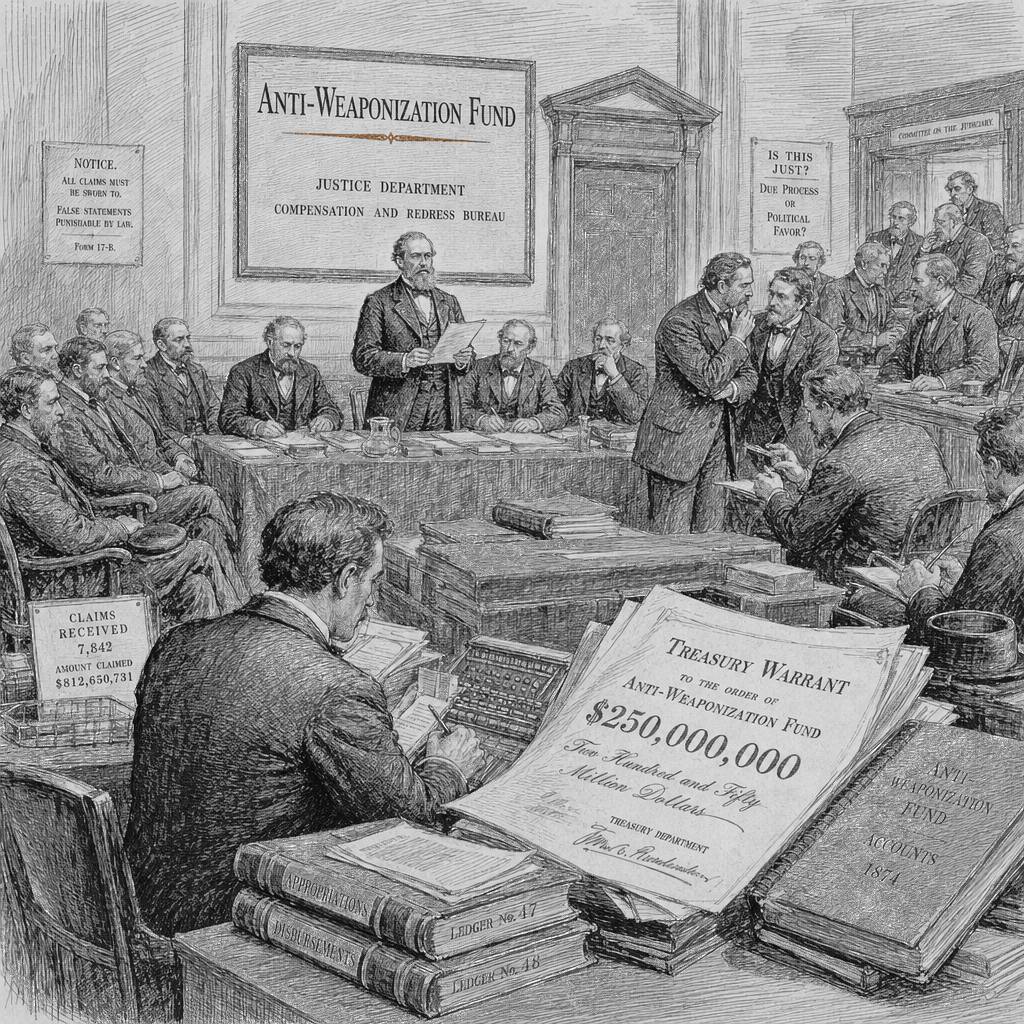
Trump and Blanche are laundering taxpayer money into a slush fund for their political allies. The Justice Department’s so-called Anti-Weaponization Fund pulls $1.776 billion straight from the federal judgment fund—the public’s own treasury—to pay claims of political targeting. The whole scheme is tied to a $10 billion settlement the Trump family dropped over an IRS tax-return leak; instead of pursuing that judgment, the administration agreed to the fund’s creation, effectively monetizing the very weaponization it claims to police.
The mechanics unfold with the cynicism of the permanent state. Acting Attorney General Todd Blanche assembles a five-member commission to decide who qualifies as a “victim of lawfare.” He appoints the members; the president can remove them at will; one seat is chosen in consultation with congressional leadership. That board now holds the power to direct nearly $1.8 billion of public money toward whoever it deems deserving. This is not redress—it is a patronage system disguised as a settlement, the kind of raw administrative corruption that dissolves any pretense of impartial governance.
In Washington Rules, Andrew Bacevich documented how the American security state develops an operating tempo—the relentless drive for permanent militarization—that depends on internal compliance as much as external enemies. In Breach of Trust, he traced how that tempo curdles into systemic capture when accountability collapses. Blanche’s fund commercializes that very capture. A permanent apparatus of political incentivization takes shape: a machine built to generate grievances it alone can define, then bill the public to pay its own partisans. The cost of tyranny becomes a revenue stream, and the DOJ is converted into a private compensation board for the loyal.
Hannah Arendt observed that authoritarian governance blurs the line between public justice and private vengeance. This fund executes that blur with a checkbook. The commission’s authority to name “victims” guarantees that only allies of the prevailing administration will be deemed legitimate targets of previous political overreach. The administration’s lawyers will draw the boundary around who is worth reimbursing, and everyone else can watch their own government serve as a slush fund for the foot soldiers who helped undermine it.
Eisenhower warned in his 1961 farewell about the acquisition of unwarranted influence by the military-industrial complex—a hazard precisely because it bypassed traditional accountability. This administration has applied that same concentration of unaccountable power to the civilian justice apparatus. Instead of dismantling the war-making machinery, it has found a way to sell its own excesses back to the public, extending the permanent state from hardware procurement into the direct monetization of federal investigations.
The IRS leak at the heart of this was an abuse of taxpayer privacy used as leverage. By settling for a fund that repackages those tactics, the Trump family and the DOJ have converted a constitutional breach into a private benefit vehicle—turning a bureaucratic weapon into a permanent patronage network financed through at least December 2028. Whether we speak of the AUMF, that decades-old legislative loophole used to greenlight unauthorized foreign conflicts, or this latest DOJ slush fund, the underlying pattern is identical: guardrails are stripped away to facilitate unchecked executive will, and the treasury is made to foot the bill for the resulting corruption.
Trump and Blanche have built a machine that profits from the very corruption they claim to prosecute. Once a government begins paying its own agents to dismantle the state from within, the distinction between the rule of law and simple, transactional power disappears entirely. We must starve it.