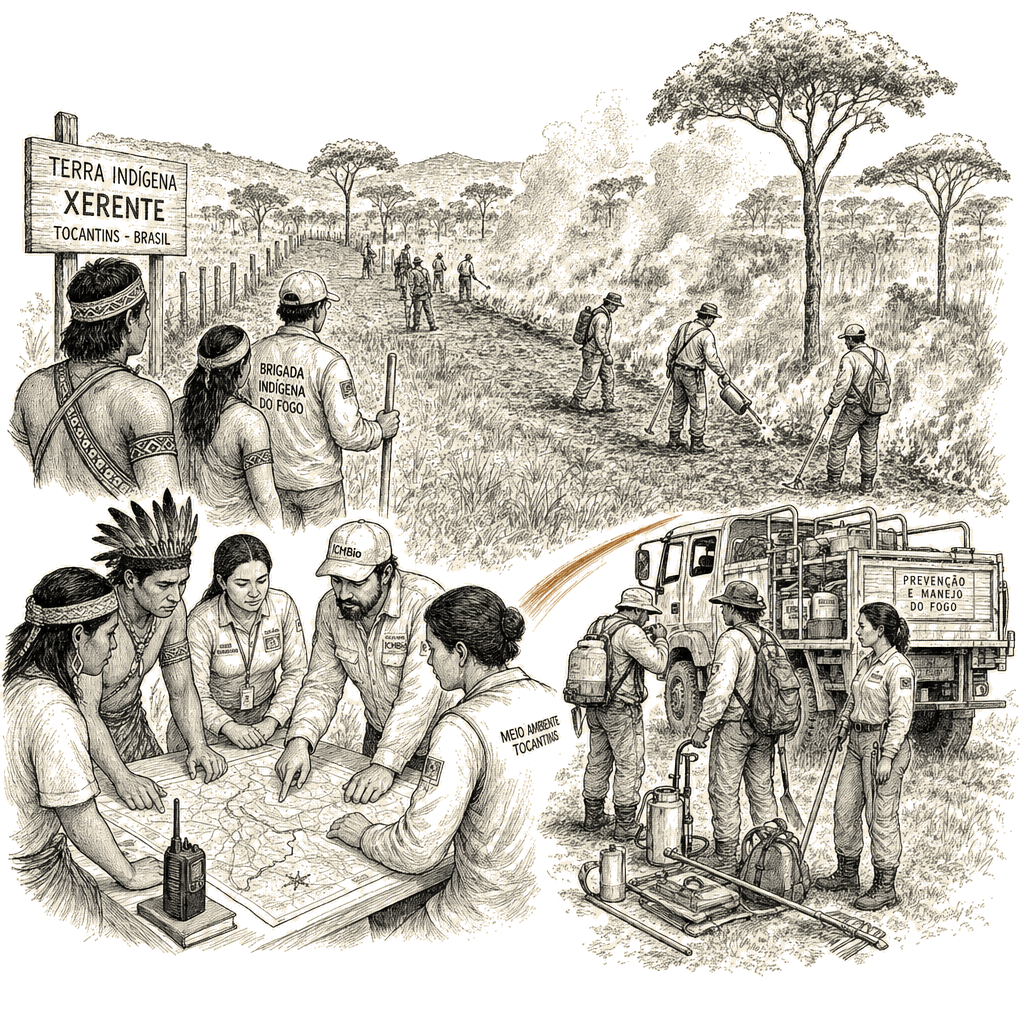
TOCANTINIA, Brazil — Fire crackled like approaching rain on a recent morning in the Xerente Indigenous Territory in Tocantins in northern Brazil, but residents did not rush to put it out. The flames were intentional — part of a wildfire prevention effort planned by the Xerente in coordination with environmental officials before the peak dry months of August and September.
The Xerente live in the Cerrado, a vast savanna that covers much of central and northern Brazil. Every year, villages across the biome face the threat of large-scale forest fires, a danger likely to worsen with the arrival of El Niño, a climate phenomenon that prolongs drought and pushes regional temperatures higher.
After decades of experiencing prejudice, Indigenous leaders now coordinate with Brazil’s environmental protection agency, IBAMA, to apply ancestral knowledge to prevent large wildfires. The shift represents a significant change in Brazil’s approach to land and fire management in Indigenous territories.
The controlled burning technique, which involves setting fires under careful supervision to clear dry vegetation that would otherwise fuel uncontrolled blazes, is part of a broader prevention strategy. The Xerente’s fire brigade, which includes a women’s contingent, has been actively conducting these burns. An AP photograph from May 19, 2026, showed female Xerente Indigenous firefighters igniting palm leaves during a fire prevention operation with IBAMA near Tocantinia.
Brazil’s government has been confronting an array of environmental challenges, including deforestation in the Amazon and the impact of organized crime on Indigenous territories. The shift toward incorporating traditional Indigenous fire management follows a long history of marginalization, during which Indigenous knowledge of the Cerrado’s fire-dependent ecosystem was dismissed by government authorities.
The Cerrado is one of the world’s most biodiverse savannas, but its fire-adapted ecology has been disrupted by climate change and agricultural expansion, scientists say. Traditional burning practices, which Indigenous groups have used for centuries to manage the landscape, are increasingly recognized by ecologists and policymakers as effective tools for reducing the severity of wildfires in fire-prone ecosystems.
As MSI previously reported, Brazil’s Amazon deforestation has slowed to a 12-year low, but climate pressures including El Niño continue to threaten the region’s forests (read more).