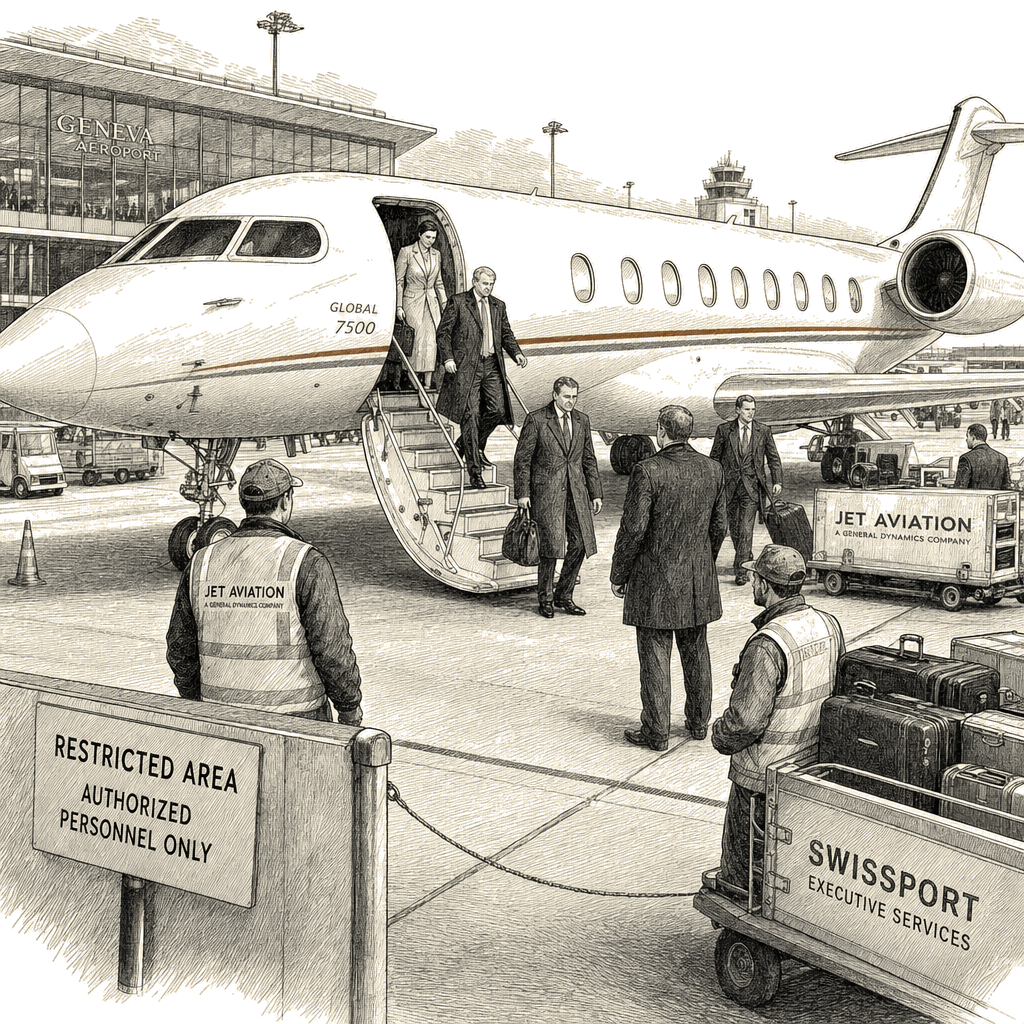
Sergey Chemezov, who served with Putin as a KGB officer in East Germany in the 1980s and now runs Russia’s state defense conglomerate Rostec, has been using a white Bombardier Global 7500 — a $75 million aircraft — for international travel, the Journal reported. Flight tracking data from Flightradar24 showed Chemezov used the jet for about half a dozen trips to the United Arab Emirates between October 2025 and January 2026. He maintains a villa with a private beach on Dubai’s Palm Jumeirah archipelago.
Arkady Rotenberg, who trained at the same judo club as Putin in St. Petersburg, obtained access to two Bombardier Global jets in late 2022, according to documents from aviation research firm Ch-Aviation reviewed by the Journal. His jets have frequently traveled to resorts in Azerbaijan and the UAE, Flightradar24 data showed. Rotenberg has been under sanctions since Russia’s 2014 annexation of Crimea.
Igor Kesaev, worth $4.8 billion according to Forbes, brought a raven-black Bombardier Global Express XRS into Russia in 2023, according to Ch-Aviation and trade data from Import Genius. He was sanctioned by the U.S. and EU after the 2022 invasion for his role in Russia’s arms industry.
The Journal’s review detailed how the sanctioned individuals gain access to Western-made jets. Before 2022, many Russian oligarchs relied on European operators, often based in low-tax jurisdictions such as Switzerland, Luxembourg and San Marino. After the invasion, they lost those agreements and sometimes the aircraft themselves.
Now, according to the investigation, Russian elites typically obtain jets through brokers and intermediary companies. European brokers and aircraft management firms acquire Bombardier and Gulfstream jets secondhand, then register them in jurisdictions that do not enforce sanctions on Russia — including the UAE, Oman, Kazakhstan and South Africa — before the aircraft are flown to Russia.
“The aircraft used by the Russians close to Putin were handled by a Vienna-based company called Avcon or its subsidiaries before transitioning to Russian ownership, according to Ch-Aviation documents. Chemezov’s plane, for example, was first registered in Bermuda and managed by Avcon before being re-registered in Russia by a company called Tarp Aviation, the documents showed. A Vienna-based fiduciary and aviation holding company called SecuTrust owns stakes in both companies.
“Avcon Jet Group strictly adheres to EU and U.S. sanctions laws,” the company said in an email to the Journal. Tarp and SecuTrust did not respond to requests for comment.
Companies based in North America and Europe are obliged under sanctions rules to ensure that no aircraft or aircraft parts are exported to Russia, and must conduct due diligence to determine whether clients subsequently resell such items to Russia, Felix Helmstädter, a German sanctions expert and law lecturer at Humboldt University in Berlin, told the Journal. In some cases, he said, transfers of business jets violate both the general sanctions on exports and specific sanctions targeting the individuals who ultimately take ownership.
A spokeswoman for Bombardier said the company has a robust compliance program and takes reasonable measures to ensure aircraft are not sold or serviced in violation of sanctions. Gulfstream did not respond to a request for comment.
John E. Smith, former director of the Treasury Department’s Office of Foreign Assets Control, told the Journal that Moscow has been able to increase imports of Western goods during President Trump’s second term because his administration has not prioritized sanctions enforcement. “Implementing sanctions is like a game of whack-a-mole,” Smith said. “It takes significant enforcement efforts to track the evasion and find ways to combat it, and this administration has decided not to focus on increasing sanctions pressure against Russia.” Smith is now a partner at the law firm Morrison Foerster.