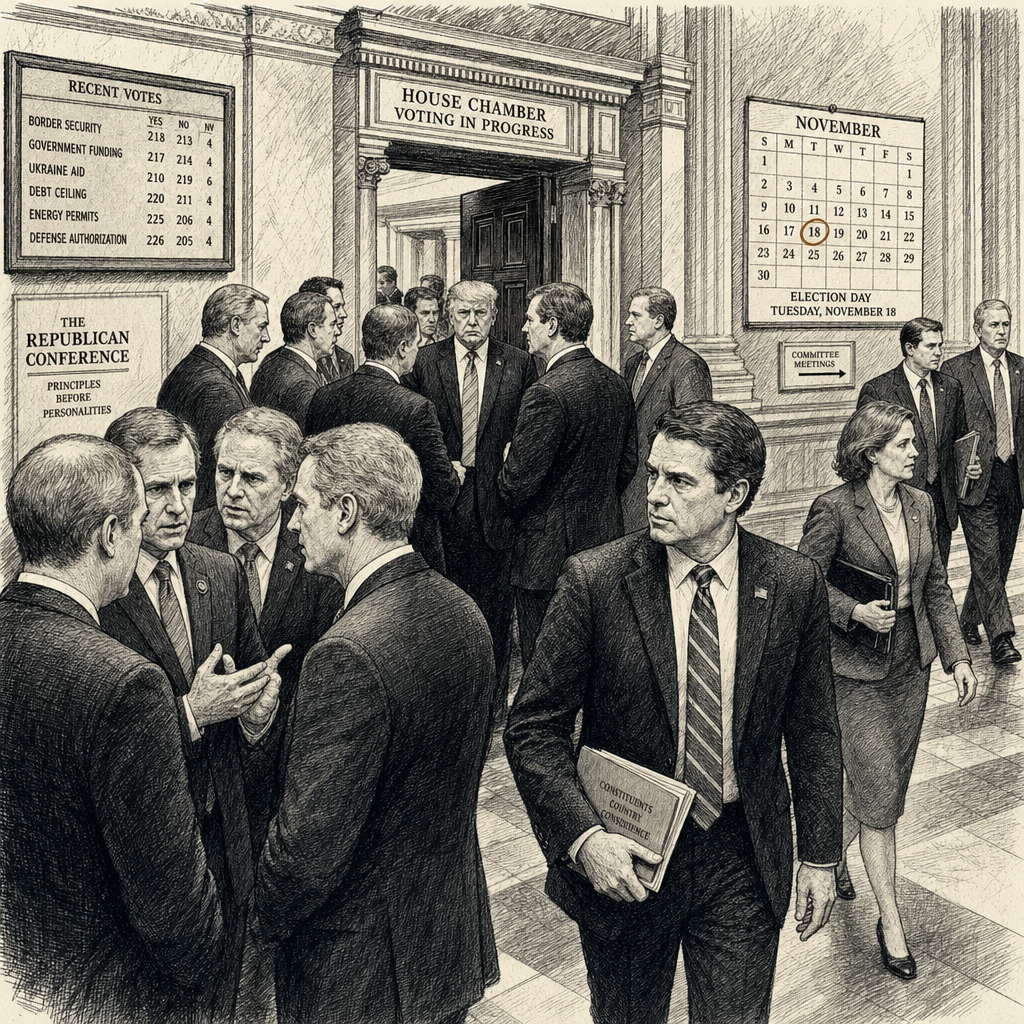
A growing number of congressional Republicans have in recent weeks joined Democrats on key votes, breaking with President Donald Trump on Iran war powers, Ukraine aid, and immigration enforcement spending as the November midterm elections approach. The defections, while still a small fraction of the overall GOP conference, have injected uncertainty into the legislative agenda and given Democrats a political opening to argue that the Republican majority is fracturing.
In the House, four Republicans — Tom Barrett of Michigan, Brian Fitzpatrick of Pennsylvania and two others — voted with all Democrats on June 3 to advance a war powers resolution that would require Trump to obtain congressional approval before continuing military hostilities against Iran. A similar measure in the Senate received support from four Republicans, including Susan Collins of Maine, who is a top Democratic target in the midterms. House Speaker Mike Johnson initially canceled a vote on the resolution before it passed with the bipartisan coalition.
House Republicans also helped pass additional aid for Ukraine and a measure to protect Haitians from deportation. Nineteen Republican-aligned House lawmakers voted for the Ukraine aid, and 11 backed continued temporary protected status for Haitian immigrants, many of whom face competitive re-election contests, according to the report.
In the Senate, the Republican majority passed a $70 billion bill early Friday that funds federal agencies leading Trump’s mass deportation campaign through the rest of his term. The bill’s progress was delayed by an effort to include $1 billion for a security upgrade to the ballroom Trump is building at the White House, a provision that was ultimately dropped after lawmakers concluded it could imperil the bill’s passage. During final consideration, senators spent hours debating and rejecting amendments, including one from Democratic Minority Leader Chuck Schumer that would have permanently barred Trump from using $1.8 billion in an “anti-weaponization” fund to pay allies. The amendment failed, but three Republicans — Collins, Jon Husted of Ohio, and Dan Sullivan of Alaska — voted for it.
Trump has made no apologies for his disengagement from congressional Republican concerns, saying at a recent cabinet meeting: “I don’t care about the midterms.” Senate Majority Leader John Thune and other senators have expressed skepticism about Trump’s nomination of Bill Pulte, currently head of the Federal Housing Finance Agency, for director of national intelligence. Pulte’s nomination has also complicated the GOP’s efforts to secure Democratic support for renewing a key surveillance law.
Former North Carolina Sen. Thom Tillis retired last year after drawing Trump’s ire for opposing the One Big Beautiful Bill Act and has since become a prominent critic of the president’s advisers. Trump has backed successful primary challenges against Kentucky Rep. Thomas Massie, Louisiana Sen. Bill Cassidy — who voted to convict Trump after the Jan. 6 insurrection — and Texas Sen. John Cornyn.
House Minority Leader Hakeem Jeffries said on MSNBC last month that “Republicans right now, in both the House and the Senate, are in free fall,” after Johnson canceled an earlier Iran war powers vote.
Despite the high-profile defections, none of the measures have actually forced Trump to change policy. The Iran war powers resolution, even if enacted, could be vetoed by Trump or face legal challenges. The “anti-weaponization” fund remains dormant not by law but because of a federal court ruling and the decision of Acting Attorney General Todd Blanche, though Trump has continued to praise it.
Doug Heye, a former House Republican leadership aide, downplayed the significance of the defections. He told the Guardian that Republicans who voted for Schumer’s amendment did so only after it became clear the measure would fail, a “time-honored” technique to allow lawmakers to register dissent without risk. “What does it say about Trump’s hold on the party that 1.8% of the House Republican conference voted against him? I’d submit nothing,” Heye said.