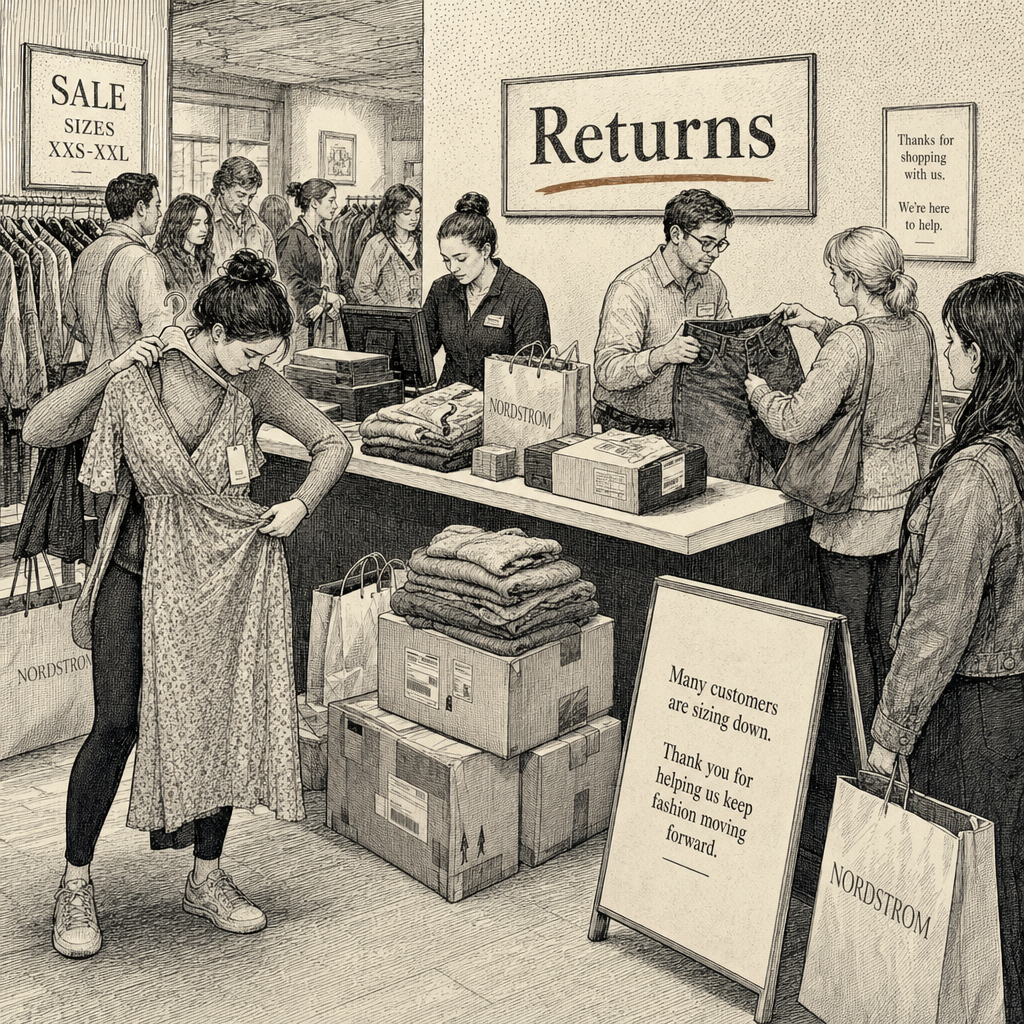
U.S. retailers are confronting a growing wave of apparel returns that many attribute to the skyrocketing use of GLP-1 weight-loss drugs such as Zepbound and Wegovy. As consumers shed weight rapidly — often dropping a clothing size every month at peak loss — they are ordering garments in multiple sizes and sending back those that do not fit, according to interviews with retailers and data from returns-management platforms.
Narvar, a firm that handles returns for 38 retailers, reported that the share of apparel exchanges where shoppers sized down hit 14.6% in 2025, up for the third straight year. The trend is particularly pronounced in larger sizes, according to Impact Analytics, an inventory-management firm. Returns for medium, large and extra-large items jumped the most, said Prashant Agrawal, the company’s chief executive.
“As you lose weight or you have a shift, you’re like, ‘OK, I need to buy medium and large to see what fits better,’” Agrawal said.
Returns are among the most costly operations for retailers, especially online businesses. Shipping, labor and warehousing expenses mount, and returned items may be out of season, forcing markdowns. For a $1 billion company that typically sees about 20% of items returned, a 5- to 10-percentage-point increase in returns can cut gross margins by $20 million, Agrawal said. “It’s a huge headache.”
Some retailers are seeing the impact firsthand. Farnam Elyasof, founder of online budget suit retailer FlexSuits, said returns have increased 50% over the past year. When a customer orders the same suit in two or three sizes, Elyasof said he checks measurements, asks whether the client is losing weight, or advises waiting to buy until closer to an event. “It’s becoming a real issue,” he said. “It’s a loss for me.”
Lisa Primm, a 57-year-old retired social worker from Ypsilanti, Mich., has lost 115 pounds over about two years on Zepbound, dropping from a size 22 to a size 4. She said she still orders size medium and six or eight, then returns for a smaller size. “I still order size medium and six or eight,” she told the Wall Street Journal. “Then I end up returning for a smaller size.”
Valerie Ott, a 44-year-old software engineer in Berkeley, Calif., lost over 100 pounds after bariatric surgery in 2017 and an additional 30 pounds on weight-loss medications starting in 2023. She said she used to buy multiple sizes of the same garment online. “I kind of didn’t believe that smaller sizes would fit me,” she said.
Retailers are taking a harder line. Judith Somekh, co-founder of online retailer The Dress Outlet, recently doubled its restocking fee to 20% of the purchase price, or higher for designer gowns, and is urging customers to check size charts carefully before ordering. “We kind of force the customer, unless they have an excess amount of money, to do their research before they buy,” Somekh said. “Higher returns mean higher costs, and higher costs mean higher end-costs for the consumer.”
Audrey Herring, founder of online women’s brand June Adel, said her overall return rate has held steady at about 12%, but the reason has shifted. A year ago, fabric and style were the main reasons shoppers sent items back. Now, at least 60% of returns cite that an item is too big or note weight loss as the cause, up from 30% to 40%. Herring has increased orders of smaller sizes and added more descriptive sizing notes to product pages. “We always try to let people know upfront because the returns are very costly,” she said.
Retailers from Levi Strauss to Costco Wholesale and Walmart are monitoring the shift, the Wall Street Journal reported. As GLP-1 medications become more affordable with price cuts and the introduction of a pill version, the pressure on return rates is expected to continue, prompting more retailers to update their policies and inventory planning.