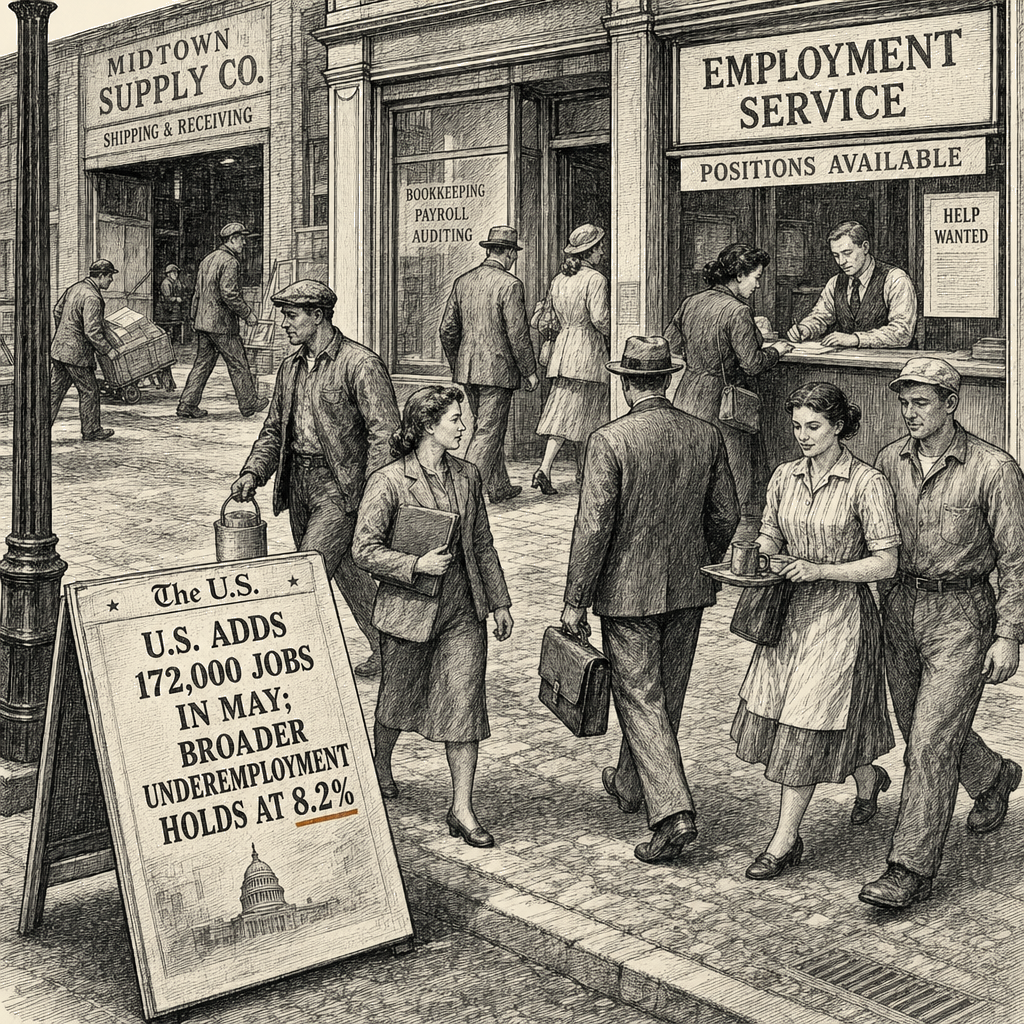
U.S. employers added 172,000 nonfarm payroll jobs in May, the Bureau of Labor Statistics reported Friday, with leisure and hospitality hiring surging to 70,000 jobs — more than four times the sector’s 14,000‑position monthly average over the past year. The headline unemployment rate was unchanged at 4.3 percent for the third consecutive month, while the labor force participation rate held at 61.8 percent.
The broader U‑6 rate, which adds discouraged workers, marginally attached workers, and those working part‑time for economic reasons, was also unchanged at 8.2 percent. At that level, just under one in twelve American workers is either unemployed or underemployed — roughly 13.7 million people, according to the BLS household survey.
The gap between the two measures — 3.9 percentage points — has held roughly stable since early 2023, but it remains wider than the 1.7‑to‑1.8 ratio typical of expansions, a pattern the BLS’s own research has shown can mask deeper labor‑market slack.
The leisure and hospitality jump dominated the May payroll gain, with restaurants and bars driving the increase. Other sectors that added jobs included health care, construction, and government, while manufacturing and retail trade were little changed. The establishment‑survey figures arrived just two days after ADP reported that private employers added 122,000 workers in May, a number that beat analyst forecasts and marked the strongest month of private‑sector hiring since President Donald Trump returned to office.
Job openings, reported earlier in the week, stood at 7.6 million in April — the highest level in nearly two years — indicating that employers are still posting vacancies at a brisk pace. However, the quits rate, which the Federal Reserve Bank of Atlanta tracks as a real‑time indicator of worker bargaining power, remained subdued at 2.2 percent. Workers who feel confident about their outside options tend to quit at higher rates; the current level suggests that, despite the solid payroll number, many employees are still reluctant to leave their current jobs.
Wages, measured by the Atlanta Fed’s composition‑controlled Wage Growth Tracker, rose 3.6 percent year‑over‑year in April. That metric follows the same individuals over time and therefore strips out the compositional shifts that can inflate the BLS’s average‑hourly‑earnings figure when lower‑paid workers are laid off during a slowdown. The 3.6 percent reading is down from the near‑6 percent pace posted during the pandemic recovery but remains above the 3‑to‑3.5 percent range that Fed officials have said is consistent with their 2 percent inflation target.
The BLS report is the final comprehensive snapshot of the labor market before the Federal Reserve’s next policy meeting. Economists cautioned that one month of data does not establish a trend, particularly when the survey window coincided with the close of the academic year, a period that routinely pushes seasonal‑adjustment models to their limits. The department will publish the April Job Openings and Labor Turnover Survey on Tuesday, providing a fuller picture of hires, layoffs, and the quits rate that policymakers and markets will scrutinize for signs of whether the labor market is genuinely accelerating or merely absorbing the usual spring upswing.