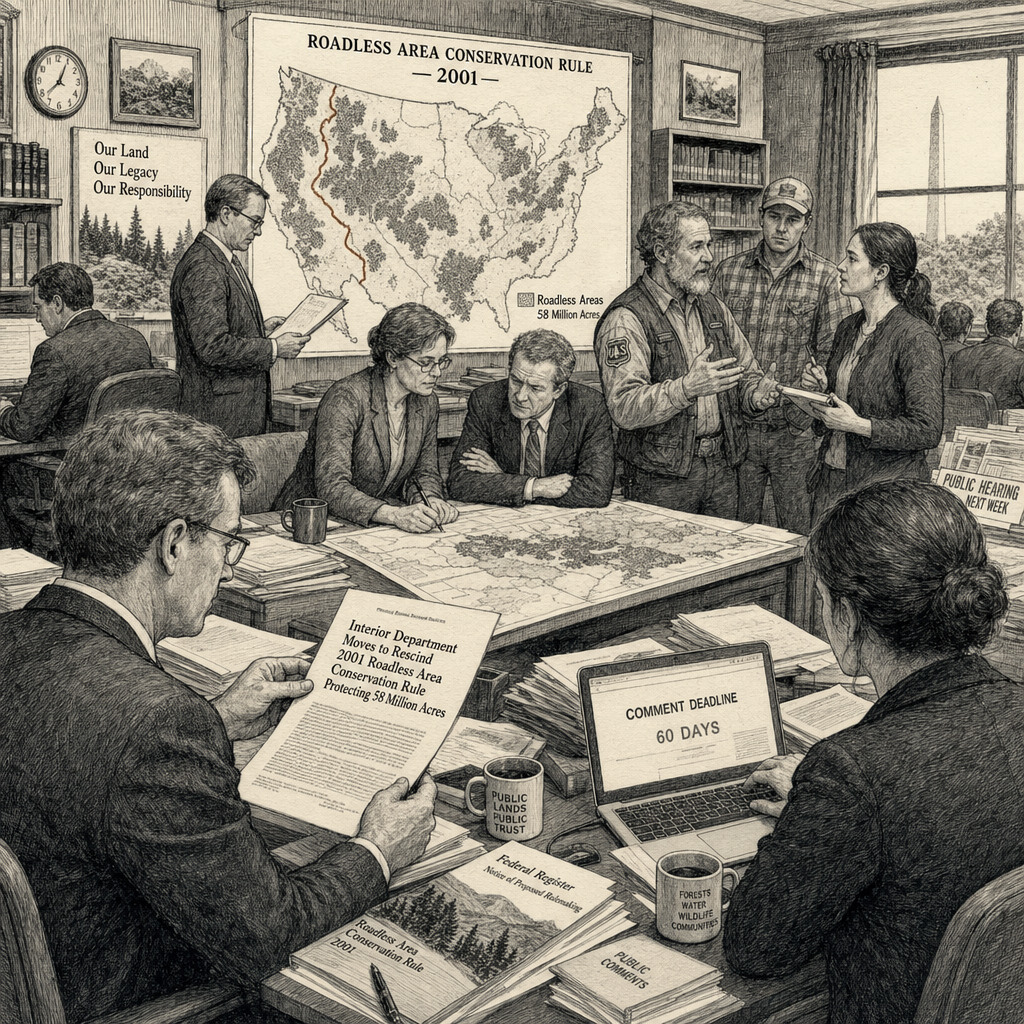
Agriculture Secretary Brooke L Rollins is working to rescind the 2001 Roadless Area Conservation Rule, former National Park Service Director Charles F Sams III said in an opinion piece published Friday. The rule has protected more than 58 million acres of national forests from road construction and commercial timber harvests for 25 years.
Sams, who served as NPS director from 2021 to 2025 and is now director of Indigenous programs at the Yale Center for Environmental Justice, wrote that rescinding the rule would open public lands to logging and other development “to the highest bidder.” He described the effort as “just one prong” of the Trump administration’s campaign to remake public lands in ways he said most Americans would find unrecognizable.
The Roadless Rule, finalized during the Clinton administration in 2001, drew nearly 2 million public comments, the majority of which supported the protections, according to Sams. He said the policy enjoyed broad bipartisan support.
“Anyone who thinks this is a fight between red and blue is deeply mistaken,” Sams wrote. “Few things unite the people of this country like their love of the land.”
Sams said more than 180 million Americans rely on forested lands to capture and naturally filter their drinking water. Opening protected areas to logging and road construction, he wrote, would pollute water sources with sediment and increase water-treatment costs.
The protected areas are home to threatened and endangered species including grizzlies, wolves, and salmon, Sams said. He said the unfractured landscapes also support game animals such as elk and mule deer.
Since leaving the agency, Sams said the administration has fired hundreds of National Park Service staff, including superintendents, rangers, tour guides, biologists, and archaeologists. He noted that in 2025 more than 320 million people visited national parks.
Sams, who grew up on the Umatilla Indian Reservation in northeastern Oregon and is Cayuse and Walla Walla, invoked his tribe’s creation story in calling for stewardship of public lands. He said the Umatilla chairperson Alphonse “Frenchy” Halfmoon had advocated for removing roads on the reservation to reconnect tribal members to the land.
“It takes a lot to remove a road,” Sams wrote. “And while nature is resilient, it takes even more to heal the land and habitats after the road is gone. A better option: in our national forests, just don’t build them.”
Sams urged readers to contact their representatives and the U.S. Forest Service to oppose rescinding the rule. “Democracy, as the saying goes, is a contact sport,” he wrote.