Concord, Calif. — Ninth grader Soraya Martin is a self-described creative writer who loves telling stories. But until last school year, reading and writing were an uphill battle. Diagnosed with dyslexia, she struggled with spelling and decoding text.
Then she began using built-in assistive technology on her school laptop: speech-to-text to dictate her writing, audiobooks to access literature, and a camera to capture notes from the board. The change, she said, was immediate.
“I started getting really good grades,” Soraya told NPR. “It made me feel like … I’m not stupid, I have so much to say and it just made me like ‘I can do this, I can do school and I can be good at it.’”
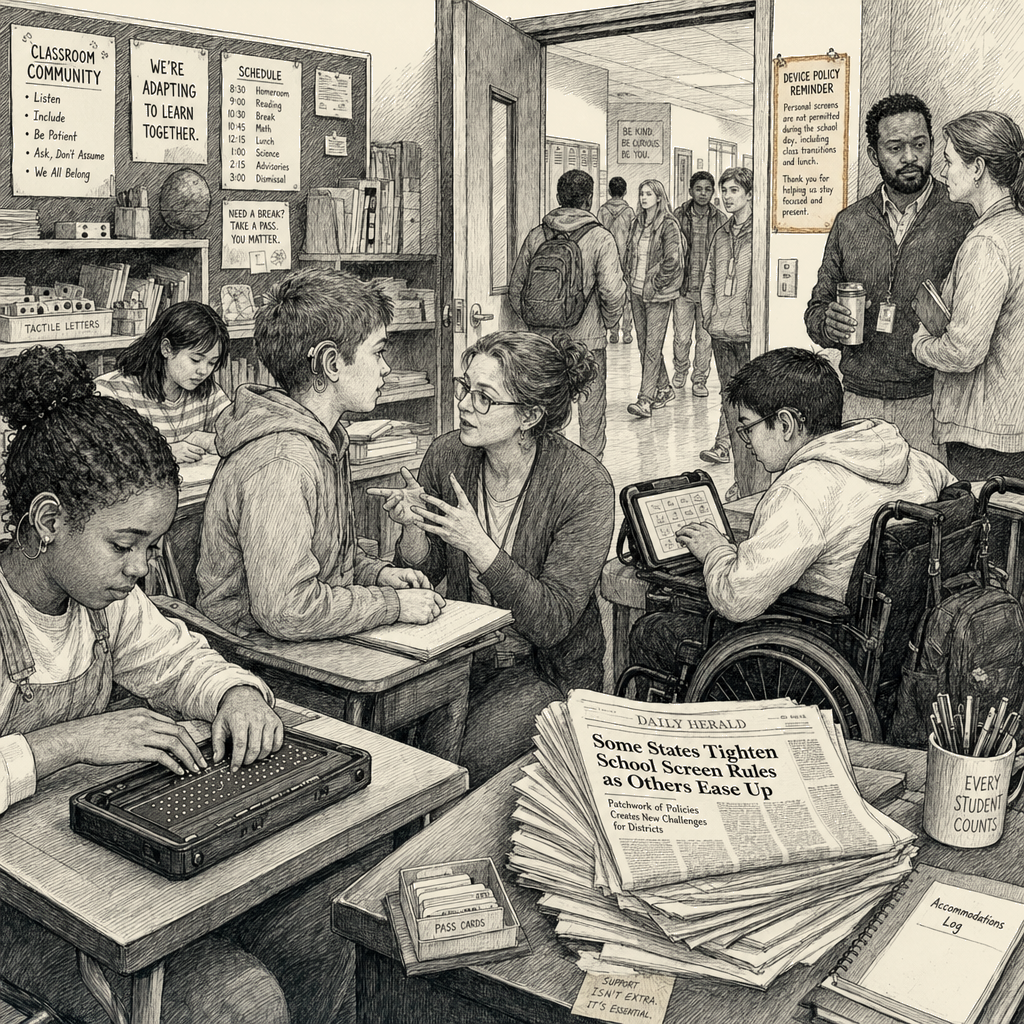
But this past school year, Soraya’s high school in northern California began locking students’ phones in pouches for the entire day — following a trend that has swept more than 30 states. While her individualized education program (IEP) legally allows her to use her phone for note-taking and other assistive purposes, the new policy has created friction. Teachers unfamiliar with her accommodations sometimes require her to ask for her phone, drawing attention to her learning difference.
“I hate them,” Soraya said of the locked pouches, adding that her phone also serves as a safety net for calling her parents during panic attacks.
Heather Martin, Soraya’s mother, said she shares broader concerns about screen distraction but worries the conversation is missing a crucial population. “Never once in the conversation has there been a discussion, except for me bringing it up with the other parents, about kids with disabilities,” she said. “A completely screen-free environment feels like it’s throwing the baby out with the bathwater.”
Advocates say the rapid pace of legislation is compounding the problem. States including Alabama, Tennessee, and Utah have already passed screen-limitation laws that take effect as soon as July 2026. Lindsay Jones, CEO of the Center for Applied Special Technology (CAST), an education research nonprofit, noted that while some laws include carve-outs for assistive technology, that baseline is insufficient.
“They’ve moved so fast that we’ve really left our educators and our communities of people with disabilities this summer to figure it out,” Jones said. She called the initiatives a “very blunt instrument” and urged policymakers to include people with disabilities, educators, and assistive technology providers in implementation discussions.
The push against classroom screens received a high-profile boost in late May when the U.S. Department of Health and Human Services issued a surgeon general’s advisory on the “harms of screen use,” citing effects on children’s health and educational outcomes. Disability advocates worry the advisory will further stigmatize all screen use without distinguishing between recreational use and assistive technology.
Compounding those fears, the Trump administration has reduced the size of the U.S. Department of Education and delayed a long-awaited digital accessibility rule for public institutions, including schools. Advocates said a smaller enforcement apparatus means fewer resources to protect the civil rights of students with disabilities who rely on technology for equal access.
Jones’s organization developed Universal Design for Learning, a framework that encourages teachers to present material in multiple formats — through text, audio, video, and hands-on activities — so that all students can access content regardless of disability. She said screen limits, if not carefully designed, risk dismantling these flexible environments.
“When technology is used intentionally, it can actually allow us to create much more flexible environments, and those are really needed for people with disabilities,” Jones said.
For Soraya, the tools have been transformative beyond grades. She recently completed a series of essays on how people with dyslexia learn and earned straight As for the first time in her life.
“I have so much more to say,” she said. “It made me feel more confident in myself.”