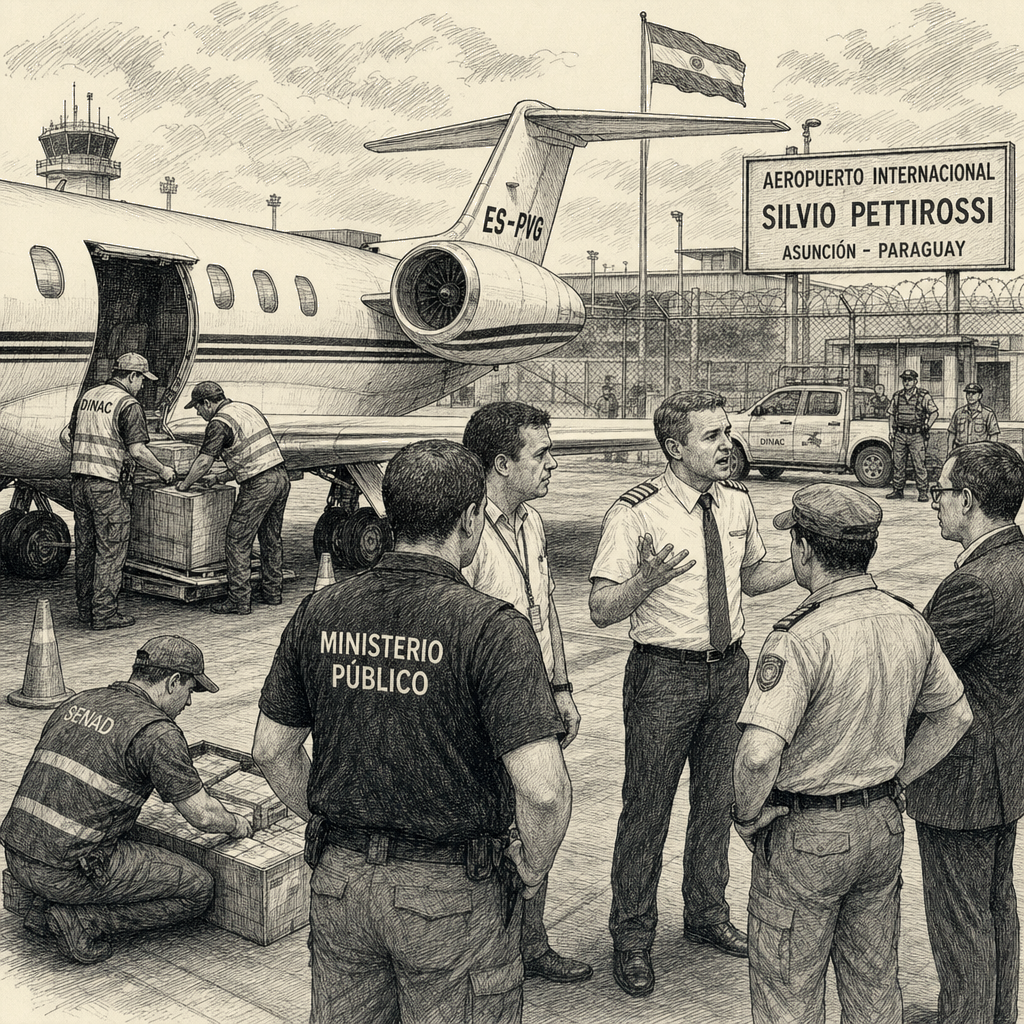
Estonian pilot Keith Siilats, who is subject to an arrest warrant in Paraguay after authorities found $3.6 million worth of hashish and marijuana aboard a private jet he was flying, denied any involvement in the smuggling and questioned airport security in the South American country.
Speaking from the United States, Siilats told Paraguayan media outlets La Tribu 650 AM and Radio Ñanduti that the Bombardier Challenger 604 does not belong to him, that he was unaware of the cargo and that his return flight had already been scheduled before the investigation began.
“I had another flight I needed to take on Sunday, so I had a flight back to the U.S. that morning after landing in Paraguay. I provided that information to the authorities. I found out about the drugs when I was already back in Miami,” Siilats said.
Paraguayan anti-drug agents discovered the drugs — 577 pounds of hashish and premium marijuana — hidden inside the aircraft after it landed on the night of May 30. The drugs’ total street value made the case one of the largest recent air-related seizures in the country.
Prosecutor Ingrid Cubilla charged the three U.S. passengers — identified as David Thomas Wise, Troy Anthony Vasquez and Marisol Rivas — with international drug trafficking and unauthorized possession of narcotics. They remain in pretrial detention at Paraguayan correctional facilities.
Siilats, co-founder of Bolt Mobility and Bytelogics, said he was hired solely to operate the flight after the regular pilot became unavailable. He said the passengers boarded carrying only one suitcase. According to Siilats’ account, he later learned that Wise had hired an interior design company to perform overnight work on the aircraft while it was parked in Florida.
“My theory is that the drugs were put on board the night before we took off from Miami,” Siilats said.
Siilats questioned why no authorities physically inspected the interior of the aircraft after it landed in Paraguay.
“In most countries where I fly, especially in Latin America, police officers and drug-sniffing dogs routinely inspect private aircraft after landing. There was nobody to check the airplane here,” he said.
National Anti-Drug Secretariat Minister Jalil Rachid rejected the criticism, arguing that the seizure itself demonstrated that existing controls were functioning.
Rachid said Paraguay has increasingly become a destination country for illicit drugs rather than merely a transit point for regional trafficking. Investigators’ working hypothesis holds that Paraguay was a transit point and the drugs’ final destination was Brazil.
Siilats said one circumstance that later appeared suspicious to him was that the passengers remained at the airport after landing.
“People who travel on private jets are usually very conscious of time because every minute costs money. They normally leave right away, but these passengers stayed at the airport,” he said.
The pilot said he tried to contact Paraguayan anti-drug prosecutor Ingrid Cubilla to offer cooperation but received no response. Siilats has hired an attorney in the United States, who advised him to attempt to arrange a meeting with U.S. federal authorities.
“I have no legal representation in Paraguay, but I hired a lawyer here, and he recommended that I go into the FBI office in the U.S. So I’ve been trying to set up that meeting,” he said.
Meanwhile, prosecutors are seeking to preserve testimony from U.S. citizen Jabari Stephan Brown, who was part of the flight crew. Judge Rosarito Montanía authorized a pretrial evidentiary hearing so Brown can testify as a witness, as he may soon return to the United States. Prosecutors said Brown may provide information about the hiring of the crew, flight planning, stopovers and interactions among the aircraft’s occupants.
Siilats said the case reflects scenarios private pilots often discuss.
“These are things that can happen. We talk about it all the time as pilots. I’ve flown many times with the co-pilot, and I think he got the worst part of it because he spent a night in jail,” he said.
The investigation began Saturday morning when one of the passengers returned to the airport to retrieve luggage that had been left inside the aircraft, raising suspicions among airport agents and leading to the drug discovery.