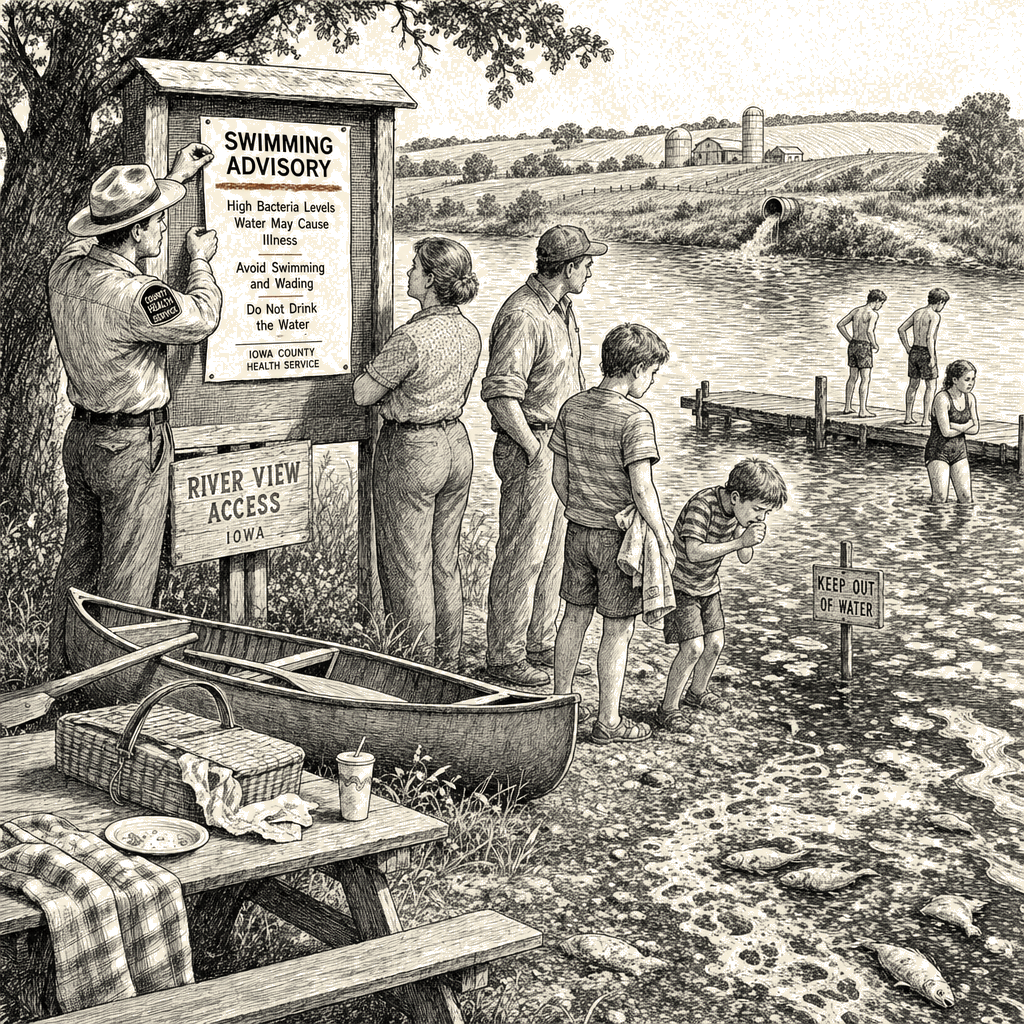
A recent Associated Press report examined how agricultural runoff polluting Iowa’s rivers is making people sick and interfering with summer recreation. The story centered on Hannah Ray J Childs, a whitewater kayaker who spends her days performing acrobatics on the Maquoketa River near Manchester.
Childs told the AP that she loves the “feeling of flying” she gets from flipping her kayak in the rapids, and that the river is where she found community — she first spotted her husband when he was flipping his kayak in violent water, and he later taught her the sport. But the same water that gives her joy has also made her ill. She now wears nose and ear plugs to protect herself.
“People’s first response when I tell them that I like to kayak and be upside down in the river,” Childs said, “is, ‘Ew, that’s disgusting. Why would you do that?’”
The AP report detailed how Iowa’s rivers and lakes are contaminated by fertilizer and manure runoff from farmland, which fuels harmful algae blooms and bacterial growth. The pollution poses health risks to people who swim, boat or fish in the water, and it has forced the closure of some public beaches during summer months. The state has long struggled to balance its powerful agricultural industry with water quality, a tension that residents and visitors confront each warm season.
Childs said she is not deterred by the pollution, but the need for precautions like ear plugs is a constant reminder of the problem. “It’s a risk I’m willing to take,” she said, “but it shouldn’t have to be.”
The report comes as Iowa officials, including Gov. Kim Reynolds and Agriculture Secretary Mike Naig, have faced criticism over the pace of voluntary water-quality programs. Environmental groups and some farmers have called for stronger regulations on fertilizer application and more funding for conservation practices to reduce runoff.