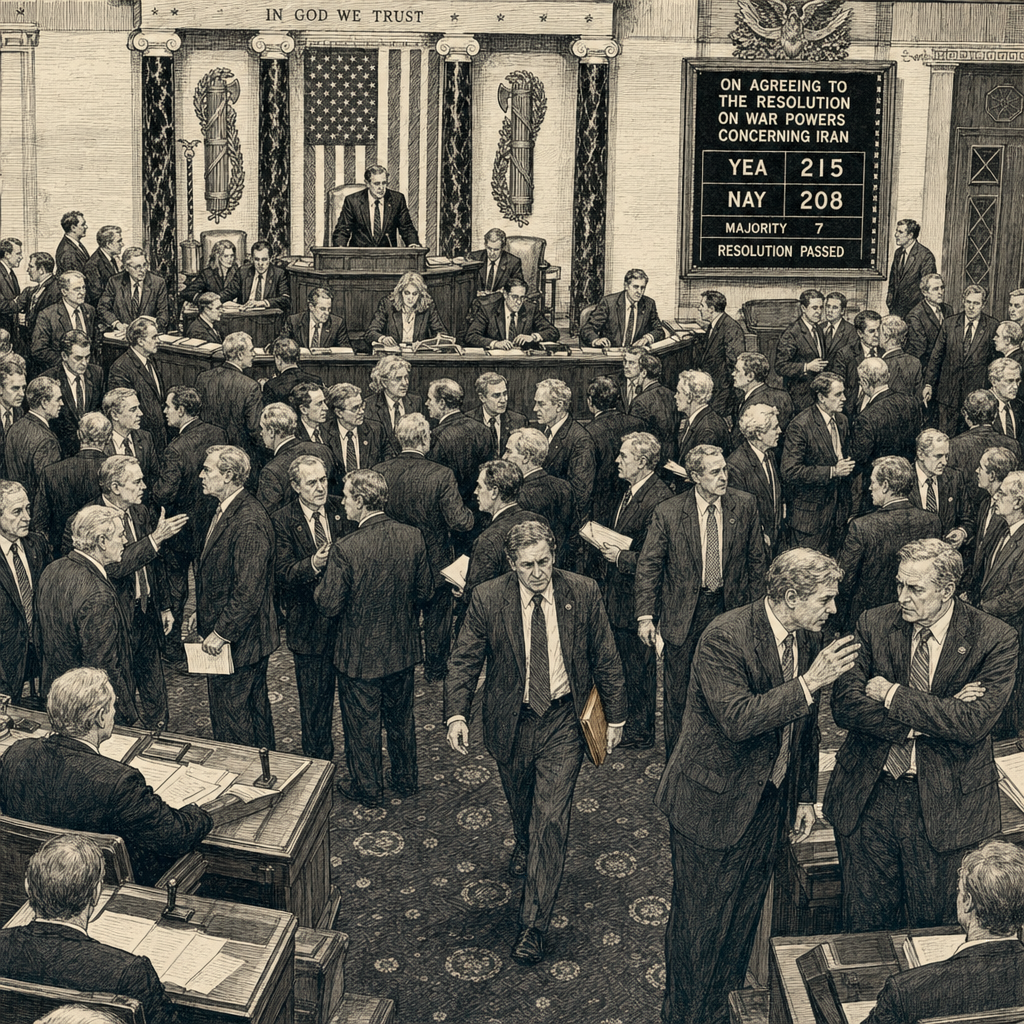
The House approved the war powers resolution on Wednesday in a 215-208 vote, marking the first time a chamber of Congress has passed legislation to constrain President Donald Trump’s authority to conduct military operations against Iran. The conflict, now in its fourth month, has continued without explicit congressional authorization, and the resolution asserts that Trump must obtain approval from Congress or withdraw forces.
Four Republicans broke ranks to support the measure: Thomas Massie of Kentucky, Brian Fitzpatrick of Pennsylvania, Warren Davidson of Ohio and Tom Barrett of Michigan. Their defections provided the margin of victory after House Republicans had canceled an earlier scheduled vote on May 21, citing an insufficient number of votes to defeat the resolution.
Under the War Powers Act, the Senate must promptly take up the House-passed measure. A similar Senate resolution advanced last month when four Senate Republicans defected to join Democrats in a procedural vote. The Senate is expected to consider the House version in the coming days.
The vote comes as diplomatic efforts to end the conflict have not yielded a negotiated settlement. Trump and senior administration officials have repeatedly stated that Iran is “desperate” to reach a deal and that an agreement is nearly concluded, but no such agreement has materialized.
Other developments
In other news from the Trump administration this week:
Intelligence leadership. Trump appointed Bill Pulte, the current head of the Federal Housing Finance Agency and a major Republican donor with no intelligence experience, to serve as acting director of national intelligence after Tulsi Gabbard left the role. The move has thrown last-ditch efforts to renew a critical surveillance program into doubt, according to the Guardian.
White House ballroom funds. Senate Republicans formally abandoned a proposal to spend $1 billion on security improvements for Trump’s White House ballroom, after it became clear that the president’s demand for the money could jeopardize long-term funding for immigration enforcement.
Federal grant vetting. The White House unveiled a set of policy changes that would require Trump-appointed officials to vet every public grant issued to universities and nongovernmental organizations based on their fidelity to “American values” as defined by the president, triggering widespread concern.
Tariff threats. Trump threatened tariffs of 10% to 12.5% on 60 trading partners including the UK, the European Union and Australia over alleged forced labor failures. The EU responded by saying it expected the United States to respect the tariff deal reached in July 2025, arguing that stealth tariffs would breach that agreement’s spirit.
Military promotions. Defense Secretary Pete Hegseth stripped nine Navy officers — including women and Black service members — from a promotion list last month, according to a person familiar with the matter. The resulting slate of 22 nominees for one-star admiral is all-male and overwhelmingly white.
Epstein ties. Ben Black, head of a little-known government investment agency funded by billions in taxpayer dollars, had personal and business ties to convicted sex offender Jeffrey Epstein, according to emails and business filings released by the Department of Justice.
CBS firing. Scott Pelley, the longtime “60 Minutes” correspondent fired by CBS News on Tuesday, issued a public statement accusing the network’s new management of silencing employees and instructing him “to inject falsehoods and bias” into his reporting.
California primary. The key race for California governor remained deadlocked as vote counting continued following Tuesday’s primary elections, in a midterm year expected to favor Democrats.
Federal workers survey. Federal workers laid off by the Trump administration reported experiencing mental health effects including PTSD-like symptoms, according to a new survey.
Datacenter ban. Residents of Monterey Park, California, became the first in the U.S. to vote on a permanent ban on datacenters, with early results showing a resounding victory for the prohibition.