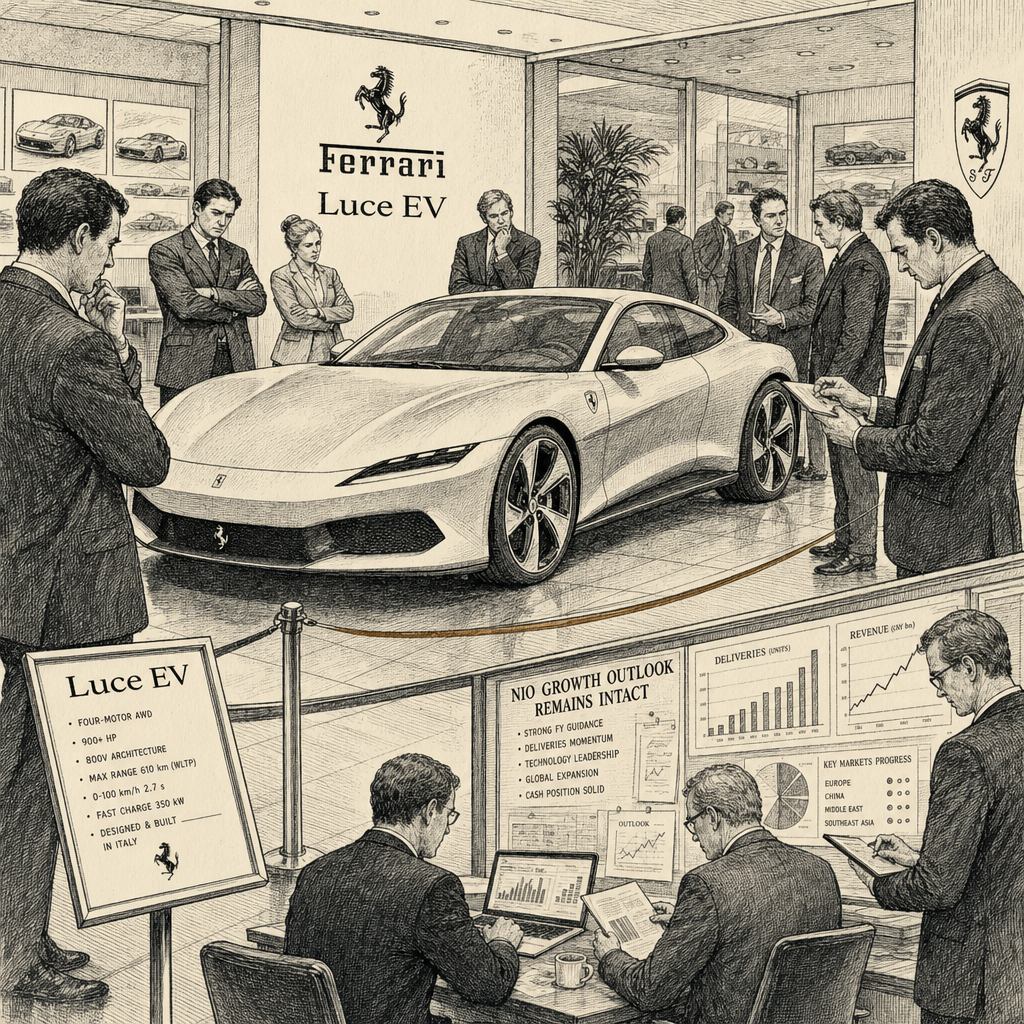
Berenberg analysts wrote in a note Wednesday that Ferrari dealers have framed the new Luce EV as a low-volume, compliance-driven addition to the Italian automaker’s lineup that does not threaten its core franchise. The bank said feedback from dealers points to exceptionally strong demand for special models and core combustion-powered cars, and moderating declines in hybrid residual values, with one dealer describing the collector market as “insane.”
Reception of the Luce styling and pricing is poor across every region, but early order intake feedback suggests it should meet the market’s volume expectations, the analysts said. Berenberg said it has greater conviction that Ferrari intends to introduce a combustion engine successor to the 296, which would reinvigorate the core customer base. “On balance, this leaves us confident in our buy rating,” the bank wrote. Ferrari shares fell 0.7%.
Macquarie analysts said NIO will likely sustain its profit and growth momentum this year thanks to a robust product cycle and continued cost improvements. Multiple SUV launches, including the ES9 flagship and the L80, will drive deliveries in the second quarter, while a dual-flagship strategy should help preserve product mix, they said. Strong adoption of NIO’s battery-swapping system and economies of scale will strengthen its competitive moat, they added. The carmaker aims for 40% to 50% volume growth this year. Macquarie maintains an outperform rating with a target price of $7.00. NIO ADRs last closed at $5.75.
Macquarie analysts also wrote that China’s auto market will stay in a “fight-for-survival” mode that is likely to be sustained for at least two to three years. The recent Greater Bay Area Auto Show featured a wide variety of EV products and highlighted intense competition in the sector, despite the event not being as closely followed as the ones in Beijing and Shanghai, they noted. One challenge for companies is differentiation, with multi-purpose vehicles emerging as a new battleground, with several new players targeting the 300,000 to 500,000 yuan range. This is likely to pressure vehicles like Voyah, Denza and Buick, further intensifying competition in large premium vehicles into the second half of this year.
Fitch Ratings on Wednesday lowered its 2026 outlook for the global airline sector to “deteriorating” from “stable,” as conflict in the Middle East has led to an increase in the price of jet fuel. In addition, Fitch said the sector faces a rising risk of demand destruction driven by higher ticket prices, and macroeconomic pressures. Jet fuel prices have risen from the $2.30 to $2.40 per gallon range before the conflict to about $3.50 per gallon currently. However, the impact on the sector is uneven, Fitch added. “The impact is more severe for carriers with direct exposure to the region or weak financial profiles before the rise in jet fuel costs,” Fitch said.
In other analyst notes, Wedbush Securities analysts wrote that SpaceX and Tesla could merge in 2027 after SpaceX’s IPO, describing the groundwork as already in place for both operations to become one organization. “This listing represents the first major test for public markets after years of muted IPO activity with SpaceX paving the way for AI giants Anthropic and OpenAI to follow soon after,” Wedbush added.
Jarden analysts said Qantas Airways could be winning share of Australia-North America routes, with the carrier’s share projected to reach 42% by late 2026 compared with an average of 41% over the past three years. Separately, supply issues are denting car parts retailer ARB’s earnings outlook, according to Ord Minnett, which downgraded its earnings forecasts by 4.2% in FY26 and by 3.6% for FY27.
A step-up in trade between Europe and South America risks lifting complexity for trading businesses, Jan Harnisch, CEO of the Air & Ocean business at logistics group Rhenus, said. The European Union is putting into place a long-awaited free-trade pact with the Mercosur group of South American economies, partly in response to disrupted trade with the U.S. under President Trump. “The real challenge will be managing complexity across the entire chain,” Harnisch said.