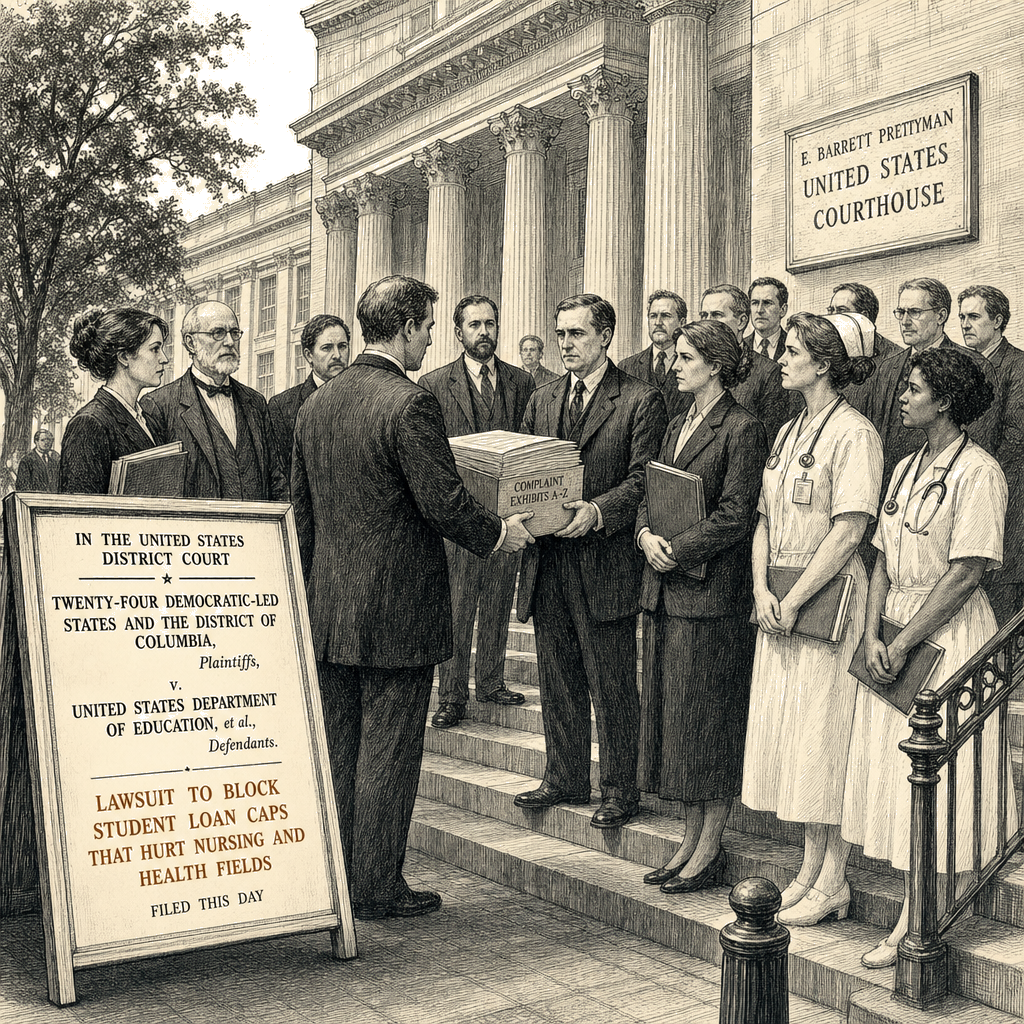
Twenty-four Democratic-led states and the District of Columbia filed a lawsuit this week seeking to block new federal caps on student loan borrowing for graduate degrees in nursing, medicine and other health professions, arguing the limits will worsen a national nursing shortage that is already acute in rural areas. The rules, set to take effect July 1, were approved by Congress as part of the One Big Beautiful Bill Act and are defended by the Trump administration as a measure to curb rising tuition costs.
The caps limit graduate students pursuing what are classified as “professional” degrees — medicine, dentistry and law — to borrowing $50,000 per year with a maximum of $200,000. Other graduate students, including those seeking to become nurses, physical therapists and nurse anesthetists, face tighter limits: $20,500 per year and a total of $100,000.
“We cannot afford fewer nurses, fewer providers or fewer opportunities for working people to enter these essential fields,” New York Attorney General Letitia James, a plaintiff in the lawsuit, said in a press release, adding that the rule “will shut talented people out of critical professions.”
The Trump administration argues the restrictions will slow the rapid rise in graduate school tuition. Since 2000, the average cost of earning a graduate degree has more than tripled, according to a 2024 Georgetown University report. The U.S. Department of Education stated that graduate students have been able to borrow up to the full cost of attendance, “enabling colleges and universities to raise tuition and fees with few constraints while shifting the financial burden on to students.”
Beth Akers, a senior fellow at the right-leaning American Enterprise Institute, which supports the new limits, said it seems reasonable that institutions could reduce costs as borrowing limits fall. But she acknowledged that there is no direct evidence caps will lower tuition, because “we have never gone in this direction with policy.”
Critics say the opposite could happen. Jennifer Zhang, a policy analyst at the consumer advocacy group Protect Borrowers, argued that cuts to Medicaid and the Supplemental Nutrition Assistance Program in the same bill are forcing states to trim higher education funding. “Students at public institutions are going to actually see their tuition and cost of attendance likely increase,” Zhang said.
The financial impact on prospective students is significant. A recent study in the journal Health Affairs Scholar found that among advanced practice nurses — nurse practitioners and nurse anesthetists — who took out loans, more than a quarter had balances exceeding the $100,000 limit.
Students will increasingly rely on private loans, Zhang and others say. While federal graduate loans carry a 7.9% interest rate, private loans can reach nearly 18%, according to the Education Data Initiative.
Coby Rodriguez, who will soon graduate with a master’s in nursing from Johns Hopkins University, wants to become a certified registered nurse anesthetist and practice in his home state of Washington. He already has about $70,000 in student loan debt from his current degree, and the anesthesia program would cost at least $100,000. Because he does not have a co-signer for private loans, the caps now mean he expects to work three to four years as an ICU nurse before starting the program.
Rodriguez said the loan limits are already causing some of his classmates to reconsider advanced nursing careers. “The interest rates on private loans, as well as just taking out more money in general, it might not be worth it for some of these salaries,” he said.
The nursing shortage is especially pronounced in rural areas. A report in the journal Medical Care found that in urban areas there were about 98 registered nurses per 10,000 people in 2022, compared with 64 per 10,000 in rural areas. Nebraska, a largely rural state, faces a shortage of nearly 6,700 nurses, or 21% of demand, according to the Nebraska Center for Nursing.
“The decision to move in this direction really indicates a lack of understanding of the impact on the primary care provider workforce,” said Lepaine Sharp-McHenry, dean of the University of Nebraska Medical Center College of Nursing.
Despite the caps, the Nebraska nursing school is expecting a 19% increase in graduate enrollment for fall 2026 compared with fall 2025, driven by an aggressive marketing campaign highlighting the value of graduate education. Sharp-McHenry said school officials have been in contact with private financial institutions to offer loans that would be “very attractive” to prospective students.