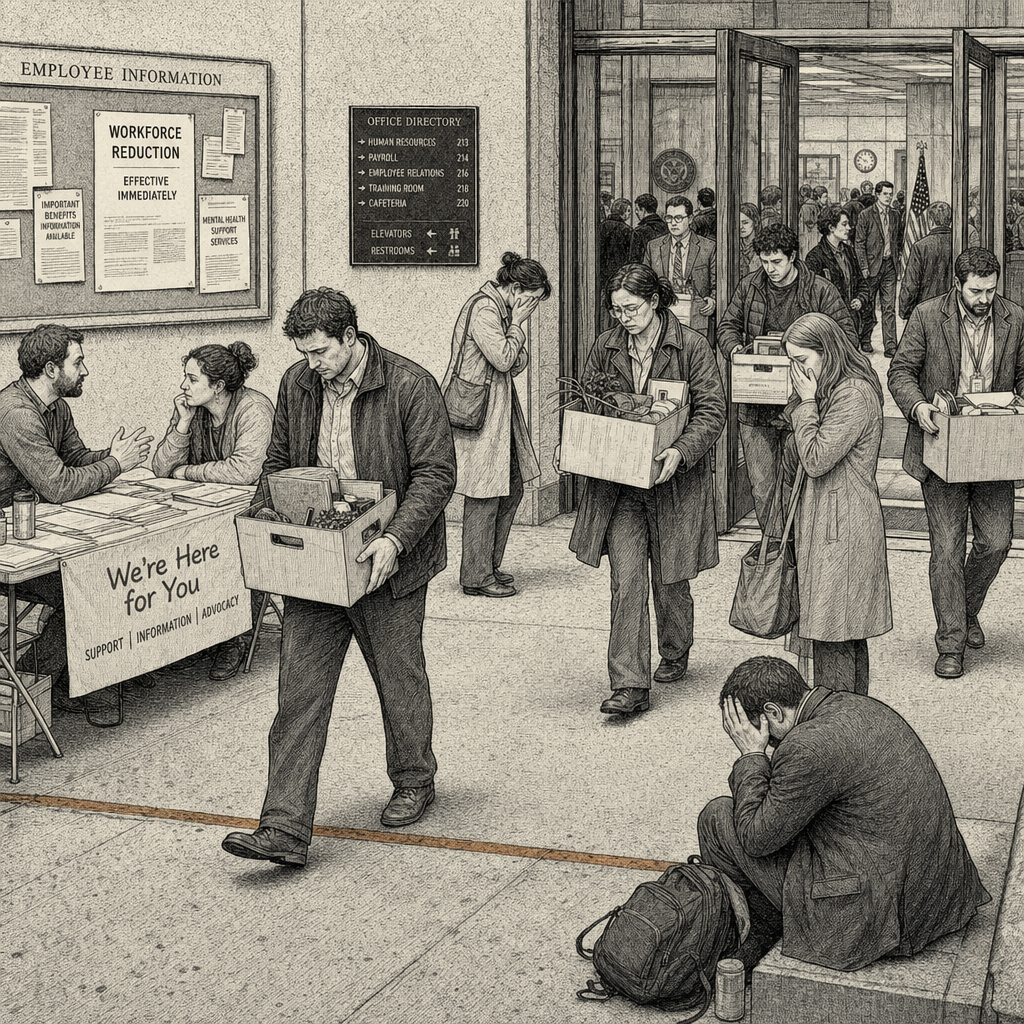
Federal probationary employees fired during Donald Trump’s second term are experiencing widespread and lasting mental health effects, including PTSD-like symptoms, according to a new survey conducted by 27UNIHTED, a network of former National Institutes of Health employees. Of more than 300 respondents who were abruptly terminated — part of a wave that saw over 25,000 probationary workers let go — 95% reported ongoing mental health consequences, nearly half described symptoms consistent with PTSD, and a quarter said they had begun taking new medications to manage their conditions. The survey, published Wednesday, drew participants from 43 states and the US Virgin Islands who had worked across 12 federal departments in 15 agencies, bureaus, and subgroups.
The firings were part of a broader reshaping of the federal workforce. Since Trump began his second term, more than 300,000 federal workers have been laid off or pushed to resign or retire. Probationary employees — those who had started their positions within the previous year or two — were a primary target, with more than 25,000 dismissed in the middle of their probationary period.
A federal judge ruled in September 2025 that the termination of probationary employees was unlawful. However, the judge declined to order reinstatement, citing concerns that the Supreme Court would overturn such relief. Several court cases related to the firings remain ongoing, and workers have filed appeals with the Merit Systems Protection Board.
Brier Ryver, a former park ranger at the Crystal River National Wildlife Refuge in Florida — the state’s only wildlife refuge for manatees — was fired along with other probationary employees. She was temporarily reinstated in March 2025 but ultimately fired again that May.
“I love that job, so I went back to it, but the instability was very apparent,” Ryver said. “Even now, still talking to people who are still reinstated, it still feels like they’re waiting for the other shoe to drop.”
Ryver said the firings have set a precedent that could allow the federal government to fire employees on a whim despite civil service protections.
“These unlawful terminations that should have never happened in the first place have had deep personal impacts,” Ryver said. “I still have PTSD-like symptoms in my own life that are impacting my ability to work, and although I’m in a different role now, it’s still at the back of my mind, what happened to us.”
Christa Reynolds worked as a contractor for the NIH for eight years before taking a direct role at the agency as a program analyst. She said she received strong performance reviews and an award — then was terminated without warning.
“I felt like I was doing really well. I got an award from my department, I got really good performance reviews,” Reynolds said. “Then just like out of nowhere, this illegal firing took place.”
Reynolds, who helped conduct the 27UNIHTED survey, said she was disappointed by the September ruling, noting that federal workers are not supposed to be employed at the whim of a presidential administration. She recalled a comment Russell Vought made privately in 2024, before he was appointed head of the Office of Management and Budget: “We want the bureaucrats to be traumatically affected.”
“It just seems like a terrible thing to say. You’re targeting people who have dedicated their careers to helping the country,” Reynolds said.
The White House deferred comment to the Office of Personnel Management, which did not respond to multiple requests for comment.
The survey also documented significant economic fallout. One in five respondents reported being unemployed as of January 31, 2026. Of those who had found new jobs, 49% said they were earning significantly less. Only 11% had secured another role in the federal government. Those findings contradict a claim Trump made in January that fired federal workers are “getting sometimes twice as much money, three times as much money” and “much better jobs and much higher pay.”
Dr. Whitney Behr started working as a biologist with the US Fish and Wildlife Service in June 2024. She was fired in February 2025 while traveling for a work training event.
“I moved out of my apartment immediately after being fired because I knew I couldn’t afford it anymore, and moved in with family a few hours away,” Behr said.
Though she was temporarily reinstated after a court order, she said “it also seemed like they were going to fire us again.” By May 2025, when several agencies began firing probationary employees once more, Behr had already accepted a job in the UK. According to an analysis by Science, more than 10,000 doctoral-trained experts in science and related fields have left the United States since Trump began his second term.
“There are a lot of PhD-level scientists that the government lost,” Behr said. “There are species going extinct right now and there’s just nothing we can do about it. There are projects that were paid for that are not getting completed.”
Behr said she continues to “rage at the open theft” of American taxpayers who are paying into a dysfunctional federal government.
“I would like people to be aware of what has been stolen from them, and not just our careers,” she said. “I would like people to understand that they are being stolen from in ways that may not be able to be repaired.”