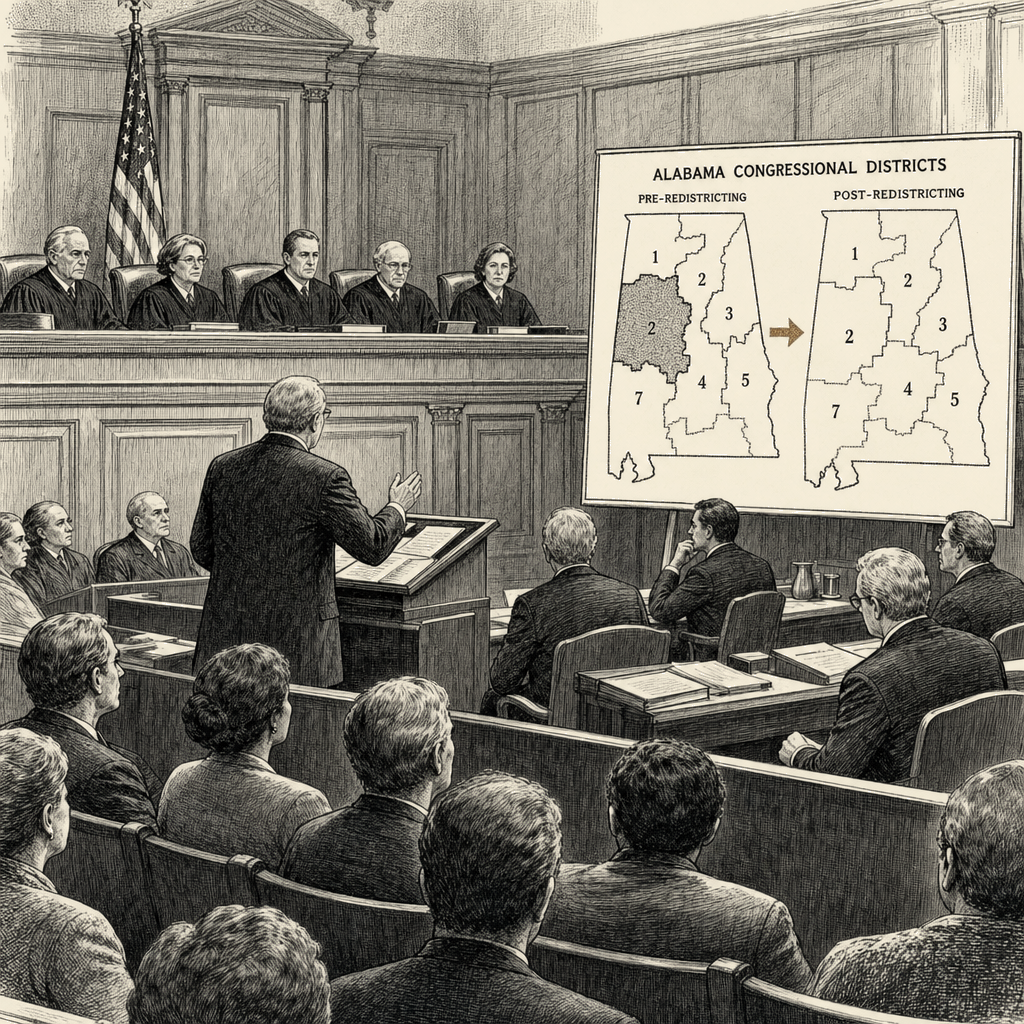
The Supreme Court granted Alabama’s request to employ the contested map for upcoming congressional races, ending a prolonged legal dispute over the state’s electoral boundaries. The 6-3 emergency order reverses a May 26 decision by a federal three-judge panel that kept a special-master-drawn map with two majority-Black districts in place for 2026. The lower court had repeatedly blocked Alabama’s 2023 plan, concluding state lawmakers enacted it to dilute Black voting power in deliberate opposition to the Supreme Court’s own 2023 mandate.
The unsigned majority opinion cited the Court’s late April ruling in Louisiana v. Callais, which established a strict new threshold for Voting Rights Act claims requiring proof of intentional discrimination. The conservative justices concluded the lower court had failed to apply this precedent, noting the panel “gave no presumption of good faith” to the Alabama Legislature. The majority further asserted the lower panel ignored a requirement from Callais that plaintiffs offer alternative maps performing as well on neutral redistricting criteria, such as preserving communities of interest along the Gulf Coast. The Court remanded the case for reconsideration under these standards.
Alabama had sought to revert to the 2023 map after the Callais decision, moving primary dates and arguing the prior mandate had been superseded. The state successfully held several congressional primaries earlier this year, though Republican Governor Kay Ivey delayed four contests until August to await the Court’s resolution. The latest ruling permits election officials to proceed with district lines that effectively return the state to a configuration of six Republican-leaning districts and one Democratic district.
The three liberal justices issued a sharp dissent, framing the majority’s intervention as a destabilizing force. Sotomayor, joined by Kagan and Brown Jackson, wrote that the majority “disregards both democratic values and the rule of law” by approving a map that has never been used and was enacted in “unashamed defiance” of previous court orders. The dissent highlighted the logistical burden on election administrators, noting the map will force the modification of voter registrations for hundreds of thousands of residents on an accelerated timeline.
Alabama’s congressional map has undergone four years of litigation beginning after the 2020 Census. A three-judge panel originally found the state’s post-2020 plan unlawful because it contained only one majority-Black district despite Black Alabamians comprising nearly 27 percent of the population. In 2023, the Supreme Court upheld that finding in a 5-4 decision, compelling the legislature to adopt a second majority-Black district. When Republicans passed a plan that year complying neither with the order nor the Court’s ruling, a special master intervened to draw a compliant map used in the 2024 elections. Both majority-Black districts returned Black Democratic representatives that cycle.
The ruling represents the most significant voting rights action since the Callais decision, which eliminated a core operational mechanism of the Voting Rights Act’s protections against racial gerrymandering. The Alabama case and similar litigation in other southern states demonstrate how Republican majorities have seized upon the new judicial landscape to dismantle districts designed to ensure Black voters an equal opportunity to elect their candidates of choice.