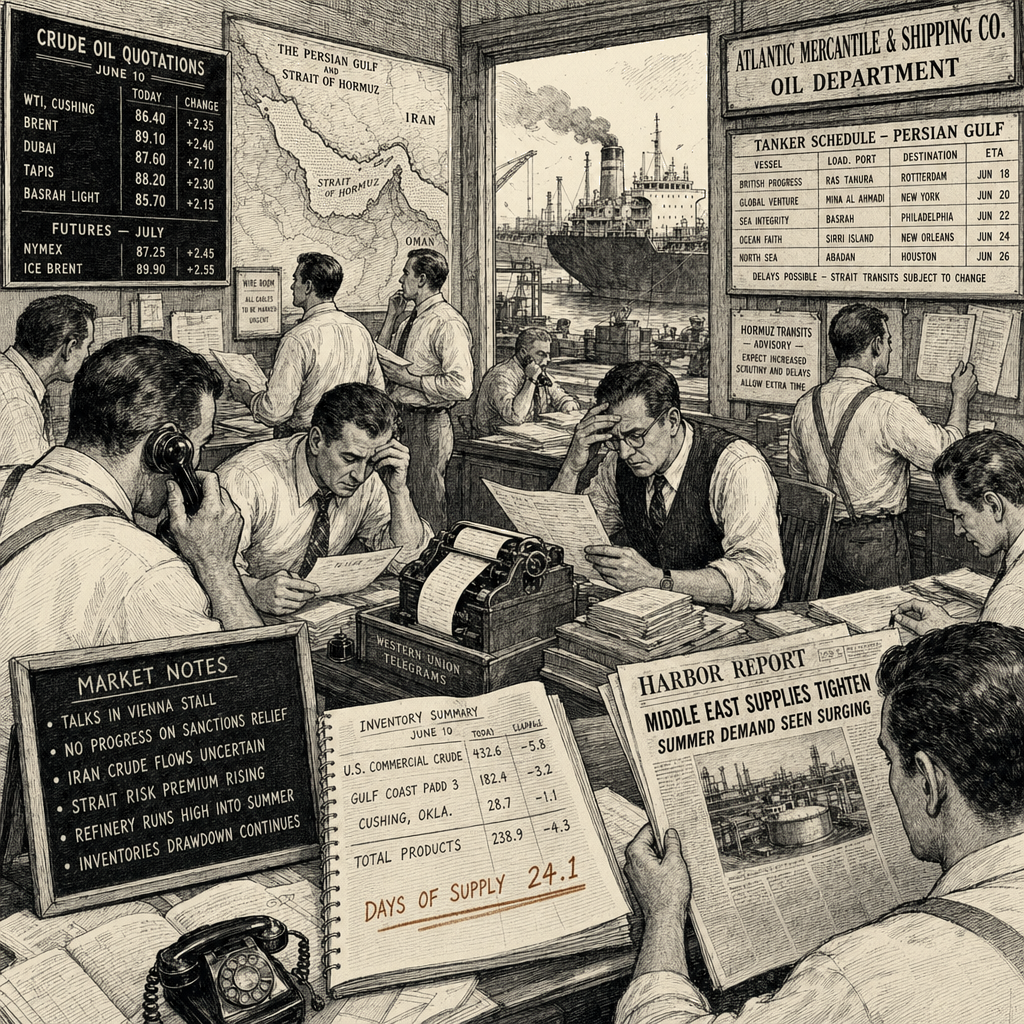
Oil futures climbed Wednesday, adding to the prior day’s gains, as traders weighed renewed uncertainty over the path of U.S.-Iran negotiations and the risk that the Strait of Hormuz remains functionally constrained through the peak summer-demand months. West Texas Intermediate crude for July delivery settled up 1.7%, or $1.57, at $93.76 a barrel on the New York Mercantile Exchange. Brent crude, the global benchmark, rose 1.1%, or $1.04, to $96.00 a barrel on ICE Futures Europe.
Shares of Gulf Development, a Thai energy company, also drew analyst attention Wednesday in a separate market note, but the dominant narrative across trading desks was the fragile state of diplomacy between Washington and Tehran.
The threat of a broader regional conflict has kept traders on edge for weeks. ANZ Research analysts said Wednesday that Hezbollah has signaled it will not accept a partial ceasefire with Israel — a stance that Iranian officials have cited as a precondition for any wider peace agreement. Failure to resolve that issue, the analysts said in a research report, raises the risk that “Iran’s proxy militant groups may turn to disrupting oil supplies in the Red Sea.” That waterway, which carries approximately 5 million barrels per day from Saudi Arabia, would take a “significant hit” to supply if disrupted, the analysts added.
President Trump posted that negotiations have been ongoing continuously for the past five days, including Wednesday, and repeated his call for Iran to reach a deal. The administration has not disclosed the specific terms being discussed or whether talks are happening through intermediaries.
Baron Lamarre, former head of trading at Petronas, said the supply situation remains manageable for now but warned that rising summer demand in July and August will tighten the market. “The cry is that they want a deal right now because if they don’t have it three months from now, there will be a disaster,” Lamarre said.
“The failure to achieve a diplomatic breakthrough comes at a time when global oil inventories are critically low and dangerous, on the eve of the summer travel season and high demand,” Samer Hasn of XS.com said in a note. Hasn also pointed to the lack of a near-term prospect for a comprehensive Israel-Hezbollah agreement, which he said could threaten the stability of any truce with Iran.
Dennis Kissler of BOK Financial said in a note that “traders remain focused on the Strait of Hormuz ship traffic, and lightened traffic will continue to equate to higher crude prices.”
Oil prices swung during the session, briefly turning lower in midday trading as the market weighed conflicting accounts of how the U.S.-Iran talks are progressing. WTI dipped as low as $91.14 a barrel intraday before recovering to settle near session highs.
The Dow Jones Industrial Average closed at 51,307.79 on Wednesday, according to data from the Federal Reserve Bank of St. Louis.
In a separate development, CGS International analyst Rasmiman Sermprasert said in a research report that Gulf Development is likely to post a record second-quarter core net profit, supported by strong electricity demand in Thailand and a hike in the country’s electricity tariff to 3.95 baht per unit in the second quarter from 3.88 baht in the first. The brokerage raised its 2026-2028 earnings-per-share forecasts for the company by 4.1% to 10.3% and lifted its target price to 72.50 baht from 66.00 baht with an unchanged add rating.