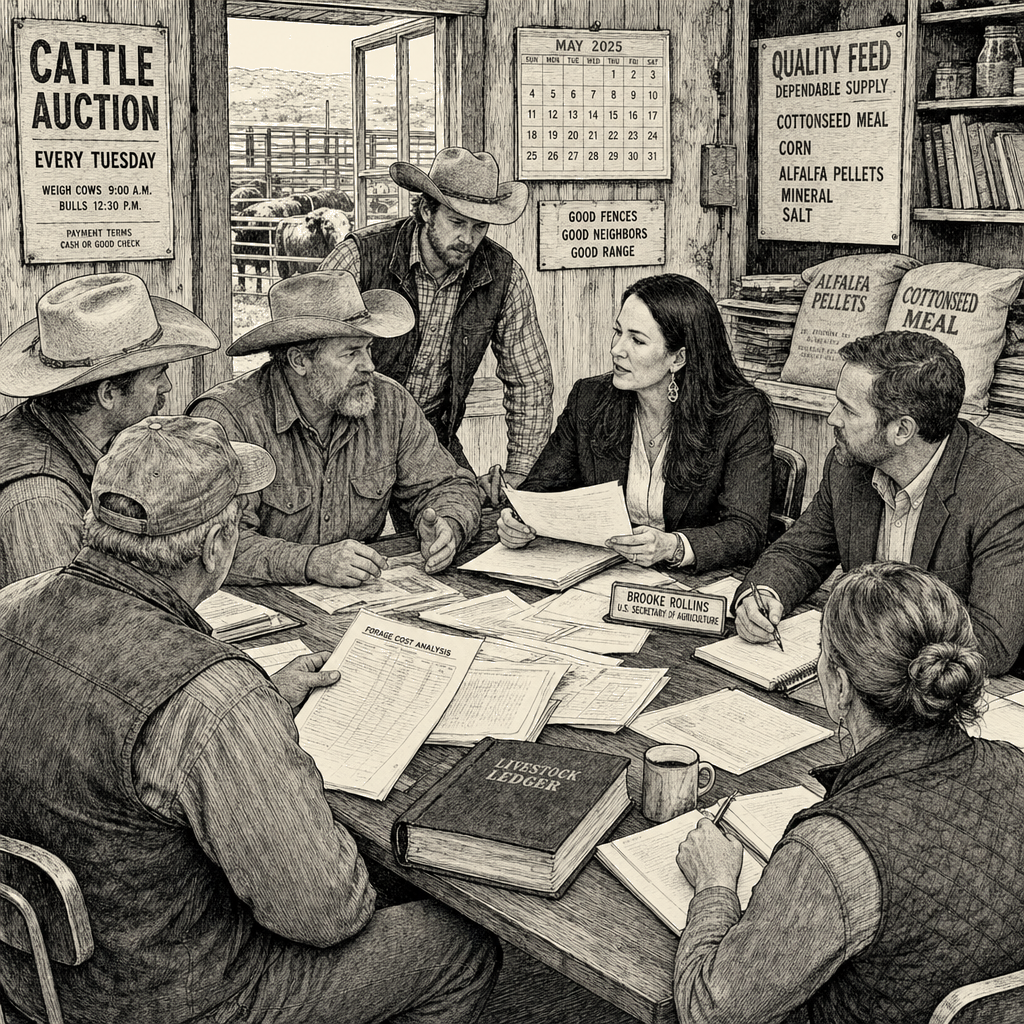
When top Trump administration officials decried the market power of America’s largest meatpacking companies last month, they were joined by Shad Sullivan, a Colorado rancher who hosts a niche podcast for cattlemen. Sullivan, a fifth-generation rancher and member of the Ranchers-Cattlemen Action Legal Fund, United Stockgrowers of America, known as R-Calf, stood alongside Agriculture Secretary Brooke Rollins and acting Attorney General Todd Blanche as they announced an update on the Justice Department’s antitrust probe into the “Big Four” packers — Tyson Foods, JBS, Cargill, and National Beef.
“Where there is beef, there is freedom,” Sullivan said at the event, which marked a high point for R-Calf’s yearslong effort to gain a seat in Washington policymaking. The group, long dismissed by the beef industry as radical and fringe, has found a receptive audience in the Trump administration, particularly with Rollins, who has shown willingness to break with the powerful agriculture lobby that has shaped federal farm policy for decades.
R-Calf’s agenda includes breaking up the large meatpacking companies, mandating country-of-origin labels on beef, loosening certain federal regulations on ranchers — such as electronic ear-tag requirements — and tightening restrictions on beef imports and exports. The beef industry has historically argued these policies are unworkable and would raise consumer prices. Derrell Peel, a professor of agricultural economics at Oklahoma State University who has studied the industry for nearly four decades, said the ideas have been around for years but have never gained this level of executive-branch support.
“There have been times when they’ve had some sympathy in some quarters in Congress and a little bit in the administration, but nothing like this,” Peel said.
Ranchers are currently enjoying what Peel called “boom times,” with estimates placing per-animal profits close to $1,000, while meatpackers are losing roughly $300 per animal processed. Industry officials attribute high beef prices to a shortage of cattle, not packer consolidation, and blame R-Calf for distracting the administration from that reality.
The Trump administration has advanced several R-Calf-supported policies. It has said it will open federal lands to cattle ranching and provide financial support for new, smaller beef processing plants. An executive order that would have eased ear-tag requirements — which opponents call invasive and burdensome — was delayed in May as the administration finalized details and considered suspending tariffs on imported beef to lower prices, a move Rollins has resisted in alignment with R-Calf, according to industry officials.
Rollins and Deputy Secretary of Agriculture Stephen Vaden have appeared multiple times on Lonesome Lands, a podcast Sullivan co-hosts, and the show has recorded from USDA headquarters. “I do not think I’ve driven any policy, but I’ve given them something to think about,” Sullivan said.
Bill Bullard, a former rancher who runs R-Calf from Billings, Montana, said the group has yet to achieve its signature goal — mandatory country-of-origin labeling — but feels heard. “I genuinely believe they’re listening and weighing our recommendations,” he said.
A USDA spokesman said that Rollins “believes credibility does not come from being the largest company or the loudest voice in the room, but from sitting down with the people living these challenges every day and actually listening to them.”
R-Calf’s influence extends beyond agriculture policy. Health Secretary Robert F. Kennedy Jr., a proponent of regenerative farming practices, has also embraced alternative agricultural voices. In early May, Kennedy attended the American Regeneration conference at Sovereignty Ranch in Bandera, Texas, where Mollie Engelhart and her brother practice regenerative methods — avoiding pesticides and tilling, rotating livestock, and making their own compost. “Our goal is to be the ripple effect and have more people understand that food, the way nature or God created it, is what creates health,” Engelhart said.