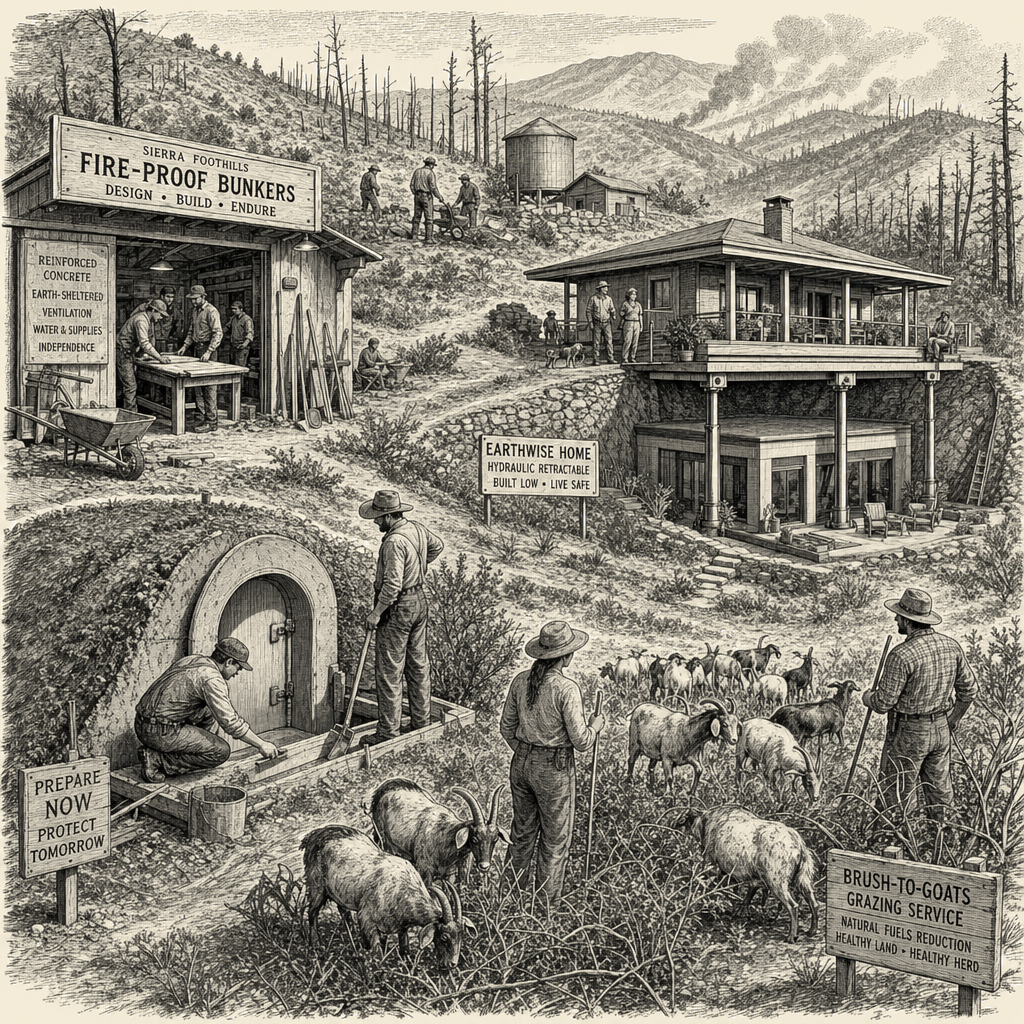
Survivors of major California wildfires have created new businesses — fire-proof bunkers, hydraulically retractable homes, and goat-grazing services — as extreme fire activity worsens across the western United States, according to a BBC News report that documented the entrepreneurs’ efforts.
Linda Cantey, an aerospace engineer who lived through the 2017 Atlas Fire in Napa, said her neighborhood was devastated when the fire killed six people and destroyed 783 structures, burning more than 51,000 acres. One elderly couple died because the power failed and they could not open their garage door. “We were sound asleep when that thing came ripping through our neighbourhood,” Cantey recalled. “By the time somebody called our home phone and woke us up… the entire canyon was full of flames, and we could see across the canyon that every single house over there was already on fire.”
Cantey said she reached out to a mining company she consults for that specializes in underground refuge chambers. The resulting above-ground product, called Fort, is a shed-like bunker with fire-proof doors and materials designed to hold up to eight people and their valuables, with breathable air for four hours. It has been tested in real fire conditions with firefighters on standby. Josh Behling, president of Wildfire Safety Systems and one of the Fort’s inventors, told the BBC: “If it wasn’t for Linda, we wouldn’t have built this, I don’t think.”
The Fort is meant as a last resort — no official advises staying put when flames approach — but the company hopes it will save lives when escape is impossible. The bunker starts at $60,000, and the company anticipates about 150 orders per year, manufactured in Utah and shipped about five weeks after order.
Holden Forrest, whose area near Malibu was devastated by the 2018 Woolsey Fire, said he sketched the idea for a retractable home on the back of his nine-year-old daughter’s homework and expected an architect to reject it. Instead, years of development followed, and HiberTec Homes appeared on Shark Tank in April 2026. Forrest estimated a 1,000-square-foot prototype at $1.2 million, with the first unit available by 2030. “It’s become now a mission, and I think that it’s why I was put on the planet,” he told the BBC. He said he sold his house and all possessions to pursue the technology.
Lower-tech approaches are also expanding. In Colorado, Kimberly Jones has grown her goat-grazing business, Goat Mowers LLC, from 25 to 250 animals over seven years. She said home owners are “really afraid” and demand has increased with dry conditions. She described a property where her goats cleared undergrowth and a wildfire swept through 17 days later, stopping 100 yards from the cleared line.
In California, Tim Arrowsmith’s Western Grazers and Blue Tent Farms have grown from 10 to 5,000 goats, serving clients including the U.S. Forest Service and Pacific Gas & Electric. Arrowsmith said he receives about 10 requests per week from homeowners once the grass begins to turn. Prices for goat grazing range upward of $3,000 per day.
The entrepreneurs are motivated not only by profit but by personal loss. “It’s therapy for all of us, because what we’ve witnessed, and what we’ve experienced, we wouldn’t want anybody else to go through,” Cantey said. “But it’s going to keep happening.”