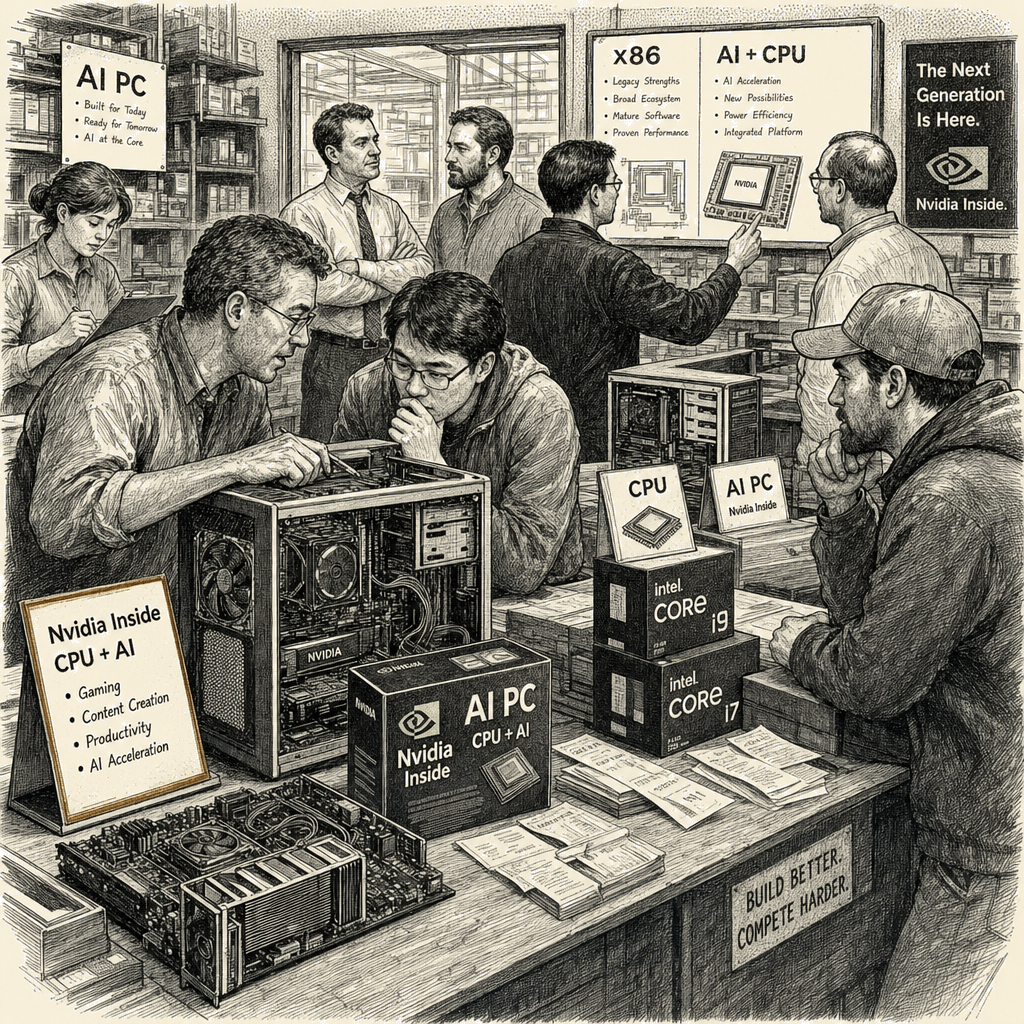
Nvidia is betting that its powerful brand association with artificial intelligence can succeed where Intel’s decades-old “Intel Inside” campaign once did: making its chips the default choice for personal computers. The company detailed a new line of PC chips that combine a central-processing unit with its widely used AI-computing hardware, which the company said would be inside Windows-based computers launching later this year.
The announcement, made at a trade show in Taiwan, sent Nvidia’s shares up more than 6% on Monday. Microsoft shares rose more than 2%. Shares of PC makers Dell Technologies and HP both surged more than 8%. Arm Holdings, which licenses the fundamental chip blueprints Nvidia uses, jumped more than 15%. Intel shares fell about 4.7% and AMD shares fell about 1.2%.
Nvidia is not new to the PC market — its graphics chips have been a fixture for decades, prized by videogamers for producing sharper images. What is new is the company’s entry into the central-processor market, where x86-based chips from Intel and AMD have dominated for roughly five decades. Intel, according to Mercury Research, held about 64% of the CPU market for traditional Windows PCs in the fourth quarter of 2025.
The new chips arrive at a moment of weakness for Intel. The company has struggled to convince consumers and businesses to buy new computers based on the AI capabilities of its chips. That has contributed to a sluggish PC market: about 270 million PCs were sold last year, according to Gartner, up about 9% from 2024 but still well below the Covid-era peak of about 340 million in 2021.
Industry observers said that most sales of AI-enabled PCs so far have been driven by default rather than demand. Computer makers have been adding neural-processing chips that enable some on-device AI functions across higher-performing product lines, leaving consumers with little choice.
“The buyers choosing AI PCs today aren’t necessarily doing so for the AI,” Jitesh Ubrani, an analyst at market research firm IDC, said in the Wall Street Journal report. “They’re doing so because, at a certain performance tier, there’s no alternative.”
Nvidia’s PC-related revenue jumped 41% in the fiscal year ended January to a little over $16 billion, thanks in part to the introduction of new videogaming chips under the Blackwell brand. Total PC unit sales during the calendar year grew about 8%, according to IDC data.
The direct financial impact of Nvidia’s PC push on its overall business is likely limited, analysts said, given that the company’s core business is selling AI chips for data centers. But the move positions Nvidia to accelerate the market for AI-enabled computers and further challenge the remaining advantages of the x86 architecture that Intel made dominant.
The biggest obstacle for Nvidia’s new chips, analysts said, is software. Most programs in Windows PCs have been written for the x86 architecture used by Intel and AMD. Software must be adapted to run well on the Arm-based architecture Nvidia’s chips use. Microsoft now has a version of Windows for Arm-based chips, and more developers have been writing for the platform, but it remains at a disadvantage in areas such as gaming. Analysts said Nvidia’s entry is likely to accelerate the erosion of the x86 advantage.