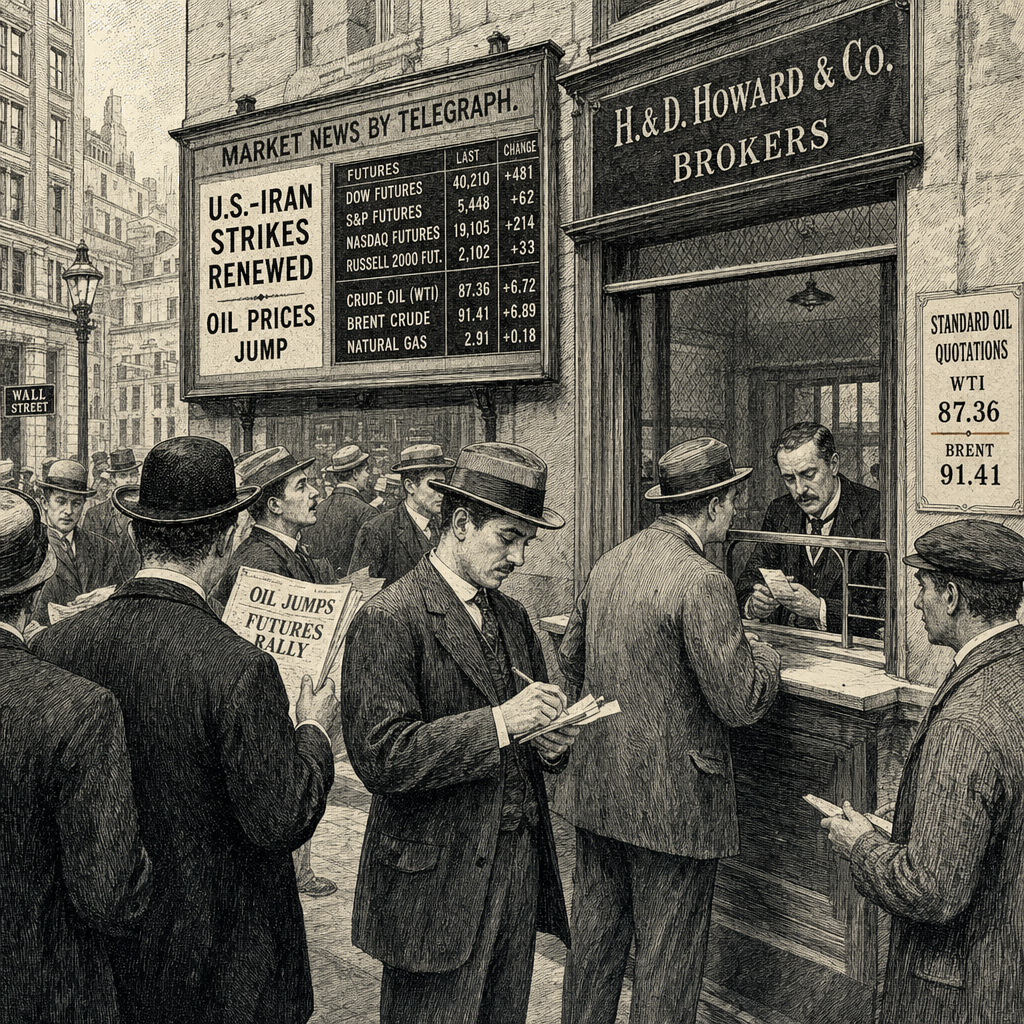
U.S. stock futures pointed higher across the three major indexes on Monday, extending May’s record-setting rally even as oil prices jumped on a fresh exchange of military strikes between the United States and Iran. Futures for the S&P 500 rose 0.2%, the Nasdaq climbed 0.2% and the Dow Jones Industrial Average added 0.05%.
Brent crude rose 3.1% to $93.95 a barrel after the U.S. said it struck Iranian air-defense sites in retaliation for Tehran’s downing of an American drone. West Texas Intermediate futures rose 3.5% to $90.40 a barrel. The gains came after Brent had closed last week at its lowest level since mid-April.
“Global oil reserves are falling fast, and markets are not pricing an extended closure of the Strait of Hormuz, meaning that upside risks to oil prices loom,” Ipek Ozkardeskaya, senior analyst at Swissquote, said.
Israel expanded its ground invasion of Lebanon during the weekend, further complicating diplomatic efforts to reach a memorandum of understanding between Washington and Tehran that would remove blockages in the Strait of Hormuz — the chokepoint through which roughly a fifth of the world’s oil supply passes daily.
Despite the military escalation, technology stocks continued to drive gains across equity markets. In Asia, South Korea’s Kospi 200 index extended a historic rally, gaining 4.25% as memory chip maker Samsung Electronics jumped 10%. Japan’s Nikkei 225 rose 0.9%, boosted by a 14% surge in SoftBank shares — making the SoftBank Group the most valuable company in the benchmark index.
Chinese markets moved in the opposite direction. The Shanghai Composite fell 0.3% after China’s State Council announced the government would prohibit the unauthorized export of state-restricted goods, technology, services and data. Hong Kong’s Hang Seng index rose 0.7%.
European blue-chip indexes were mixed at the open. Tech stocks and oil majors gained, but energy-intensive companies and miners weighed on the broader market. The Europe-wide Stoxx 600 fell 0.2%, with London’s FTSE 100 down 0.2% as miners and industrials declined. Paris’s CAC 40 was flat, and Germany’s DAX edged 0.1% higher as software maker SAP rose 2.1%.
The dollar rose as escalating U.S.-Iran tensions supported safe-haven assets. The DXY dollar index added 0.1% to 99.011 after falling to a two-week low of 98.751 on Friday, when hopes for a diplomatic deal had briefly boosted risk appetite.
U.S. Treasury yields rose, with the sharpest increases in the short and intermediate segments as traders reassessed inflation expectations. The two-year yield rose 1.9 basis points to 4.032%, the 10-year yield gained 1.6 basis points to 4.468%, and the 30-year yield added just 0.1 basis point to 4.993%, reflecting near-term uncertainty over the conflict’s inflationary path.
Gold futures fell 1.2% to $4,536.90 a troy ounce in New York as the firmer dollar and climbing oil prices raised concerns about potential interest-rate hikes. Bitcoin slipped 0.7% to $73,104.
The first week of June builds to Friday’s publication of U.S. nonfarm payroll data for May, which will help shape market expectations for the trajectory of Federal Reserve monetary policy at a time when geopolitical risk and energy costs are adding fresh uncertainty to the inflation outlook.