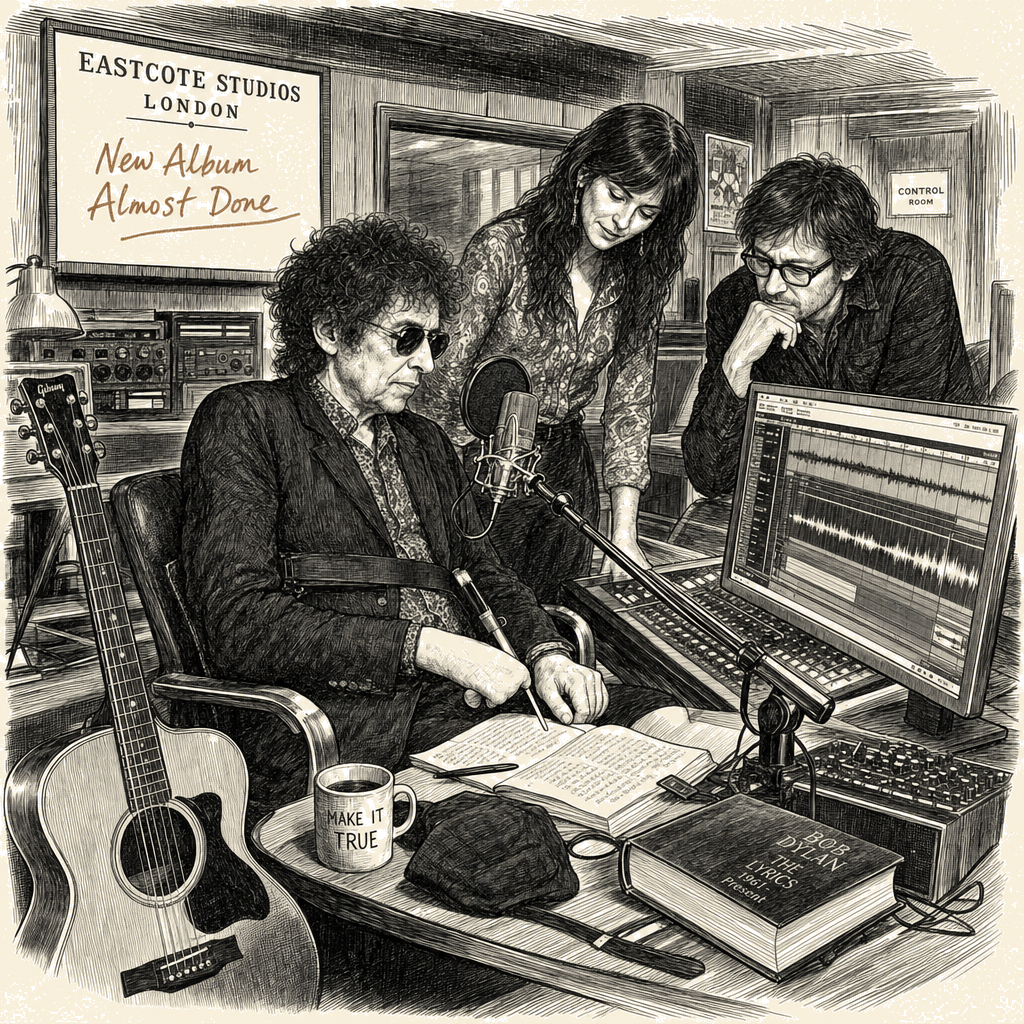
London singer-songwriter Samuel Smith spent years writing and performing songs with a guitar in his hands. Now he is using artificial-intelligence music-generation tools to keep making Americana music after a neurological disease largely took away his ability to play, demonstrating a practical accessibility workflow for performing artists whose motor-function capacity declines.
Smith released his second studio album, “The Art of Letting Go,” recently after more than a year of work. He was diagnosed with Parkinson’s disease in 2020, and the progressive disorder brought tremors, stiffness, and fatigue that steadily eroded his guitar playing during the album’s production, he said.
For one of the eight tracks on the record — an instrumental piece titled “Horizon” — Smith relied on song-generation AI platforms to create demo arrangements he could then bring into a recording studio. He hummed rough melodies into his phone, uploaded the recordings into platforms including Suno and Udio, and let the tools produce musical drafts based on his input.
The AI-generated demos served as communication tools, not as the finished product, Smith said. He used them to convey his musical vision to the session musicians who ultimately recorded the final studio version of “Horizon.” The demos were not mixed into the released track.
The workflow separates the creative-direction function of AI from the audio-in-production function that has fueled most of the public debate about generative music tools. Platforms like Suno and Udio have drawn scrutiny from the recording industry over copyright, artist compensation, and the prospect of fully automated song production replacing human performers. Smith’s approach — using AI to sketch arrangements for human musicians to interpret — positions the technology as an assistive instrument rather than a substitute artist.
Parkinson’s disease is a progressive disorder that affects movement control through dopamine depletion in the brain. The condition typically causes tremors at rest, muscle stiffness, slowed movement, and fatigue, all of which interfere with fine motor coordination. For musicians whose craft depends on precise finger placement and timing, the disease often forces retirement or instrument changes when medication and physical therapy can no longer compensate.
Smith’s use of generative music software to bridge the gap between his compositional intent and his diminished instrumental capacity follows a pattern already appearing in other fields where motor impairment limits traditional work methods. AI song-generation platforms accept audio or text prompts and produce multi-instrumental arrangements within seconds, making them usable by someone who can vocalize a melody but cannot execute it on a fretboard.
The album “The Art of Letting Go” is an eight-track Americana record. The AI-assisted workflow was used on the instrumental track “Horizon” specifically, according to Smith’s account. The remaining seven tracks were produced through conventional means, he said.
Suno and Udio are among the most prominent AI music-generation platforms operating in 2026. Both have been the subject of ongoing licensing negotiations with record labels, publishing companies, and performer unions over the training data used to build their models and the revenue-sharing arrangements for commercially released AI-assisted tracks. The platforms’ terms of service and the legal status of recordings that incorporate AI-generated material remain unsettled in most major markets.
Smith’s approach does not raise the same commercial-displacement concerns that full AI-generated releases do, because the AI audio in his workflow never appears on the commercial recording — the demos are internal pre-production materials only. The session musicians who recorded “Horizon” performed the parts themselves, using the AI demos as reference tracks in the same way arrangers have historically used MIDI mockups or rough band recordings to communicate ideas to studio players.
The story of a musician whose disease ends his instrumental career but not his compositional life is not itself new. Adaptive instruments, session-musician collaborations, and digital audio workstations have enabled performers to continue writing and arranging for years after their primary-technique capacity fails. What distinguishes Smith’s case is the use of generative AI as the bridge between the melody in his head and the arrangement he could hand to other musicians — a task that previously required either a collaborator who could read notation or significant time learning new accessible software.
AI song-generation tools are being tested in a wide range of professional contexts beyond entertainment. MSI has previously reported that overworked special-education teachers are turning to AI writing assistants to draft individualized education plans, as documented in May coverage of the practice. In healthcare settings, AI is being used for fraud detection, patient-care coordination, and diagnostic support. In each case, the question of where the tool assists and where it replaces remains the central policy and ethical debate.
Smith’s account makes clear where he draws that line. The AI did not replace the musicians on “Horizon”; it replaced the guitar he could no longer play well enough to arrange the parts with his own hands. The demos he created were scaffolding, not structure. The released recording is the work of human performers reading the arrangement he built with their help.