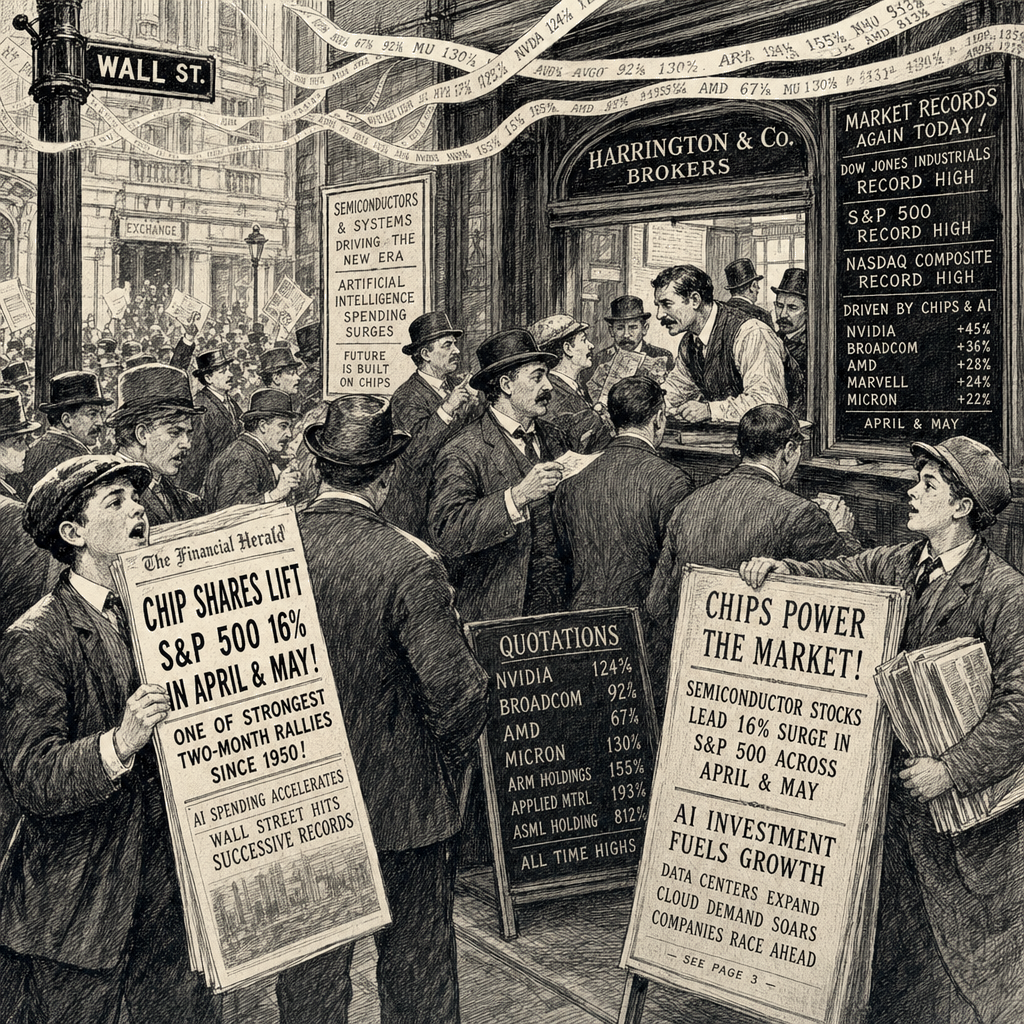
Chip stocks powered the S&P 500 up 16% across April and May, according to Dow Jones Market Data, driving the broad index to its strongest two-month advance in decades. Historical data shows the index closed higher six months later during each of the four previous occurrences matching this pace, rising by a median 17%, the data provider reported. The sustained rally is pushing Wall Street benchmarks to a series of new records as corporate spending on artificial intelligence accelerates across global technology markets.
The advancing trade spans from memory-chip manufacturers in Idaho to semiconductor conglomerates in South Korea. Micron Technology, a Boise-based memory-chip maker, increased roughly 10-fold in value over the past 12 months to reach a market capitalization above $1 trillion. Intel has tripled in 2026, notching its first record high since 2000, while Cisco Systems and Qualcomm have both surged approximately 50%.
In South Korea, Samsung is up around 465% over the same period, and the PHLX Semiconductor Index posted its strongest performance through the first 100 trading days of any year on record. Wall Street analysts are lifting their outlooks to reflect the upward momentum, and investors appear increasingly comfortable holding positions despite geopolitical volatility.
Analysts at Goldman Sachs raised their year-end target for the S&P 500 to 8,000 from 7,600, implying a 5.5% rise over the rest of the year on top of the 11% gain since the end of December. Recent surveys from Bank of America show fund managers reduced their cash levels by the most in a month since 2024, holding significantly more stocks than their benchmarks.
“The AI train is moving forward,” said Joe Tanious, chief investment strategist for North America at Northern Trust Asset Management. “You don’t necessarily want to try to stop it or sit on the sidelines.”
Corporate earnings are providing the fundamental backing for the price gains. Companies in the S&P 500 traded Friday at around 22.5 times their projected earnings over the next 12 months, a slightly lower valuation than at the start of the year because earnings projections have grown significantly.
AI startup Anthropic, which is expected to go public later this year, posted explosive sales growth and its first operating profit in the second quarter, powered by corporate adoption of its coding tools. The company recently closed a funding round at a $965 billion valuation.
“We are squarely in the acceleration phase of the AI era,” said Kevin Shea, senior equity strategist at BNY Wealth. “You take a look at the revenue growth from some of these large language models, it’s faster than anything we’ve seen before.”
Jason Pride, chief of investment strategy and research at the wealth-management firm Glenmede, estimated that 75% to 80% of the rally over the past two months “has been fundamental in nature,” fueled by hopes for a resolution to the Iran conflict and strong earnings reports. Pride noted the rally has become “a little bit stretched” over the past week as investors try to chase returns, but added there is every reason to think stocks can continue rising.
Inflation remains the most significant potential threat to the market advance. Consumer prices have climbed much faster than expected this year due to energy-supply disruption in the Middle East and overwhelming demand for AI hardware like memory chips, said Angelo Kourkafas, senior global strategist at Edward Jones.
If the Federal Reserve moves toward raising interest rates in response, Kourkafas said, the yield on the 10-year U.S. Treasury note could potentially climb back up toward 5%. That shift, Kourkafas said, could create “more indigestion or volatility.”
Even investors with historical perspective are reluctant to short the market. In late 1996, Federal Reserve Chairman Alan Greenspan famously warned of “irrational exuberance” in the stock market, yet the Nasdaq Composite Index tripled over the following three years.
George Vanderheiden, a former Fidelity portfolio manager, shunned tech stocks in the late 1990s anticipating a bubble burst and retired in February 2000 after performance slumped. Vanderheiden wrote “Tulip bulbs for sale” on his office whiteboard as a reminder of 17th-century speculation.
“You try to manage the portfolio for risk,” he told The Wall Street Journal at the time. “But the market hasn’t rewarded you for it. The market has no fear.”
Northern Trust’s Tanious acknowledged uncertainty but emphasized the immediate momentum. “Who knows what’s going to happen in three, four, five years from now with these data centers, but at least in the immediate term…it doesn’t seem like it’s going to slow down anytime soon,” he said.