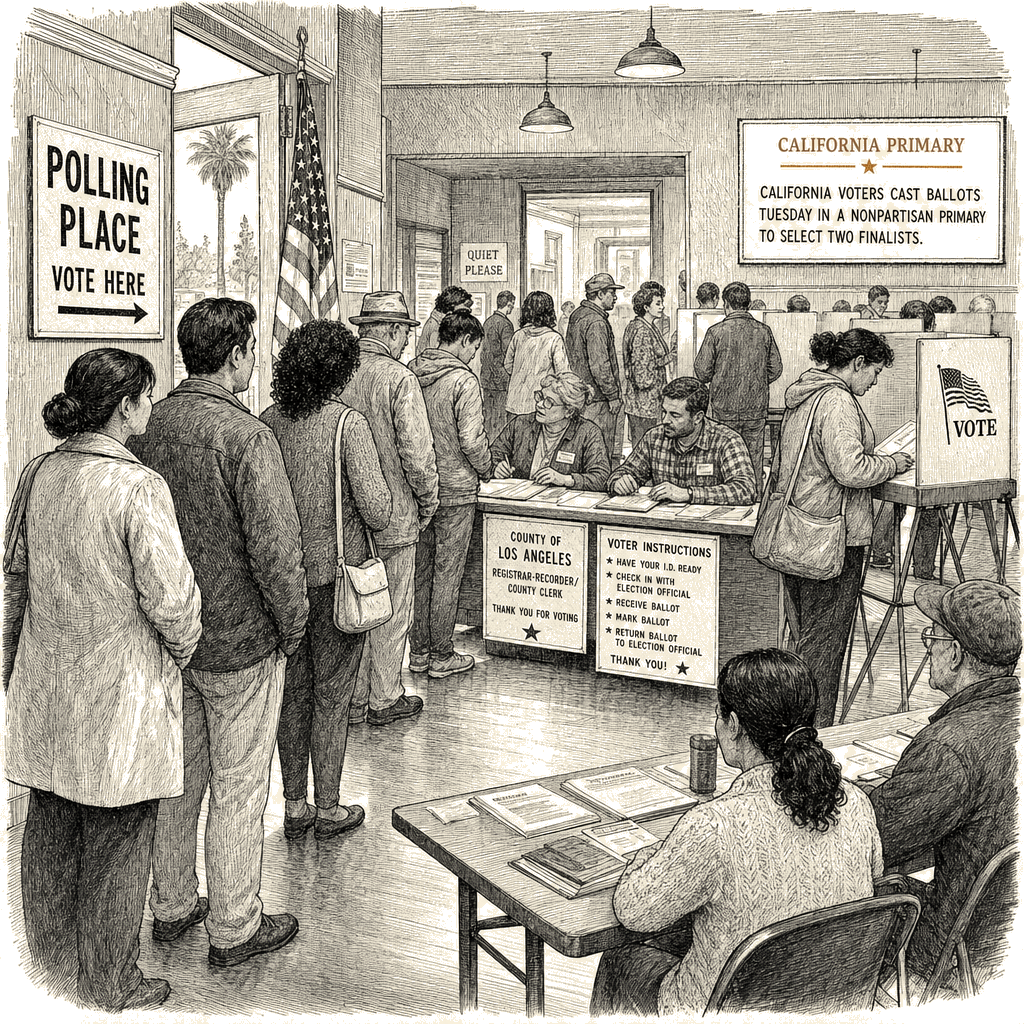
California voters cast ballots Tuesday to select two candidates who will compete for the governorship in the November general election, a primary that will determine the next chief executive of the nation’s most populous state.
“One of the country’s messiest and most consequential governor’s races is hurtling toward an inflection point on Tuesday,” the Associated Press reported, framing a contest that will decide the political successor to Democratic Gov. Gavin Newsom. The race will set the leadership of a state government that operates as a testing ground for progressive policy and has emerged as a frequent political foil for Republican President Donald Trump.
California conducts gubernatorial primaries under a system voters adopted in 2010, which eliminated traditional partisan primaries in favor of a “jungle primary.” Under this format, all registered voters receive a single ballot listing every declared candidate irrespective of party. The two candidates who receive the highest vote totals advance to the general election, even if both share the same party registration.
The primary dynamics were fundamentally altered in April with the withdrawal of Rep. Eric Swalwell. Swalwell had been consolidating support among establishment Democrats before he was accused of sexual assault, the incident prompting his exit from the race. The departure abruptly upended the primary’s early alignment and opened the field to the remaining field of contenders.
The governor’s office controls the executive branch of a state that commands one of the world’s largest economies. California’s scale extends beyond its population to its economic and cultural influence. The state’s policy decisions frequently precede broader national legislative shifts, and its demographic and industrial makeup — encompassing Central Valley agriculture, Silicon Valley technology hubs, and the entertainment sector — positions its leadership decisions as national bellwethers.
The election also takes place against a backdrop of sustained federal-state friction. Newsom’s administration has repeatedly positioned California in opposition to the Trump administration’s policy agendas, establishing the state’s executive offices as both a launchpad for progressive legislation and a primary target for Republican opposition research. California voters elected to shield their state’s election infrastructure from federal interference.
Under the top-two system, Tuesday’s results will determine whether the November general election features two Democrats, two Republicans, or a single candidate from each major party. The pair who advances will face the statewide November electorate to decide who assumes the executive office in early 2027.