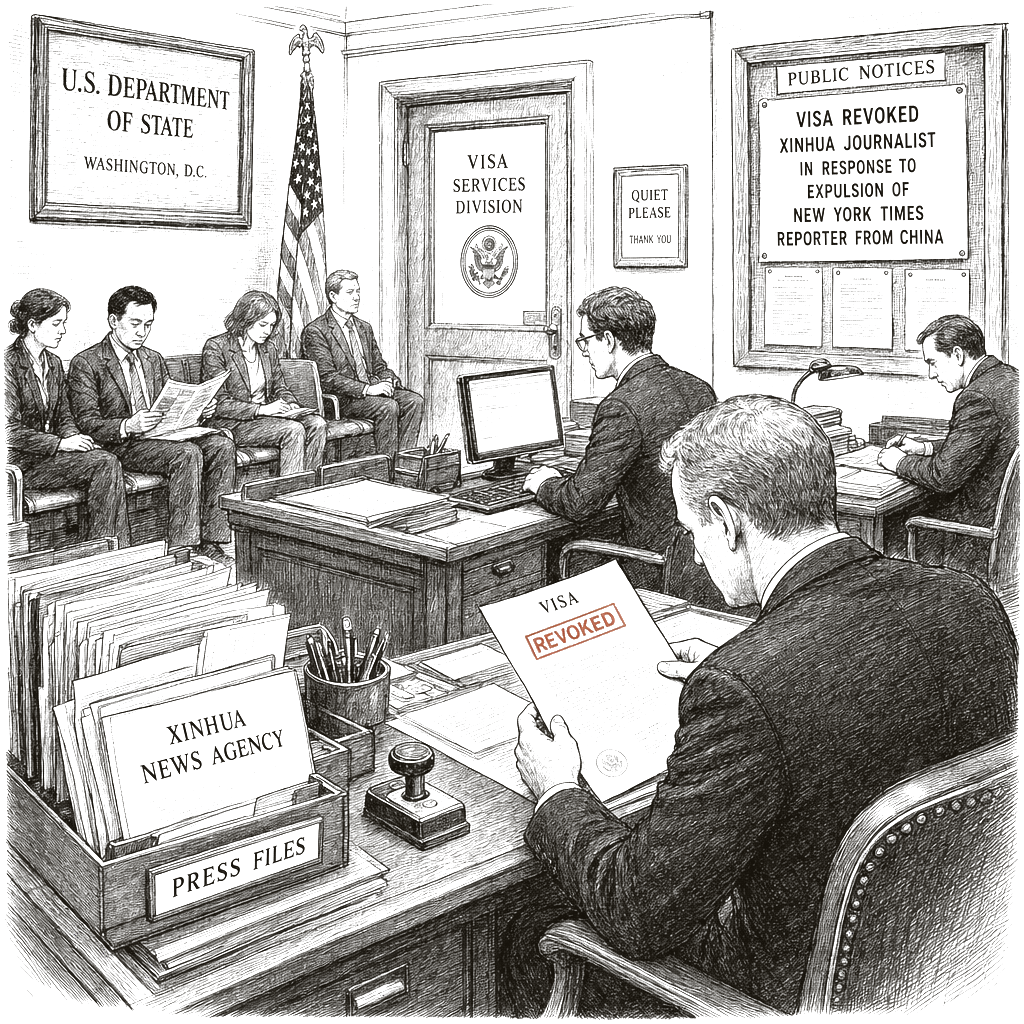
The Trump administration has revoked the visa of a Chinese national working for the Xinhua state news agency in the United States, a person familiar with the matter and a State Department official confirmed Friday. The move is an apparent reciprocal act following Beijing’s expulsion of Vivian Wang, a China correspondent for The New York Times, and comes days after President Donald Trump’s summit with Chinese leader Xi Jinping in Beijing.
Beijing expelled Wang apparently because of the appearance of Taiwan’s leader at a DealBook conference hosted by the Times. The newspaper has said Wang played no role in the event and was not involved in the decision to feature the Taiwanese leader. The expulsion marked a rare instance of China directly targeting an American journalist’s press credentials.
The Trump administration’s reciprocal visa revocation targeting a Xinhua journalist represents an unusual case of the U.S. government directly retaliating against Beijing’s treatment of American reporters. The person familiar with the matter spoke on condition of anonymity because the matter involves visa privacy. A State Department official separately confirmed there was a plan to revoke the visa.
The Times issued a statement Friday calling for Wang to be reinstated as a credentialed journalist in China. “The Times does not ask governments to revoke media credentials or otherwise interfere with the work of any journalist,” the paper said, urging both Washington and Beijing to “reverse this deterioration in journalist access.” The Times first reported the reciprocal move by the Trump administration on Friday.
The journalist expulsions follow Trump’s May 14–15 visit to Beijing, where he met with Xi for talks covering Taiwan, trade, and the ongoing war in Iran. The trip included an explicit warning from Xi over the “Taiwan question,” though the summit concluded with both sides describing the discussions as constructive. MSI previously covered the summit and Xi’s direct warning that U.S.–China relations risked “clashes” over Taiwan.
The expulsions add to a pattern of deteriorating press conditions between the two countries. China expelled several American journalists in 2020 during a previous round of tit-for-tat restrictions, and press freedom organizations have documented a steady decline in foreign correspondent access in both directions over the past decade. The Committee to Protect Journalists has long ranked China among the world’s most restrictive environments for the press, while the United States has itself faced criticism in recent years for visa revocations targeting foreign journalists.