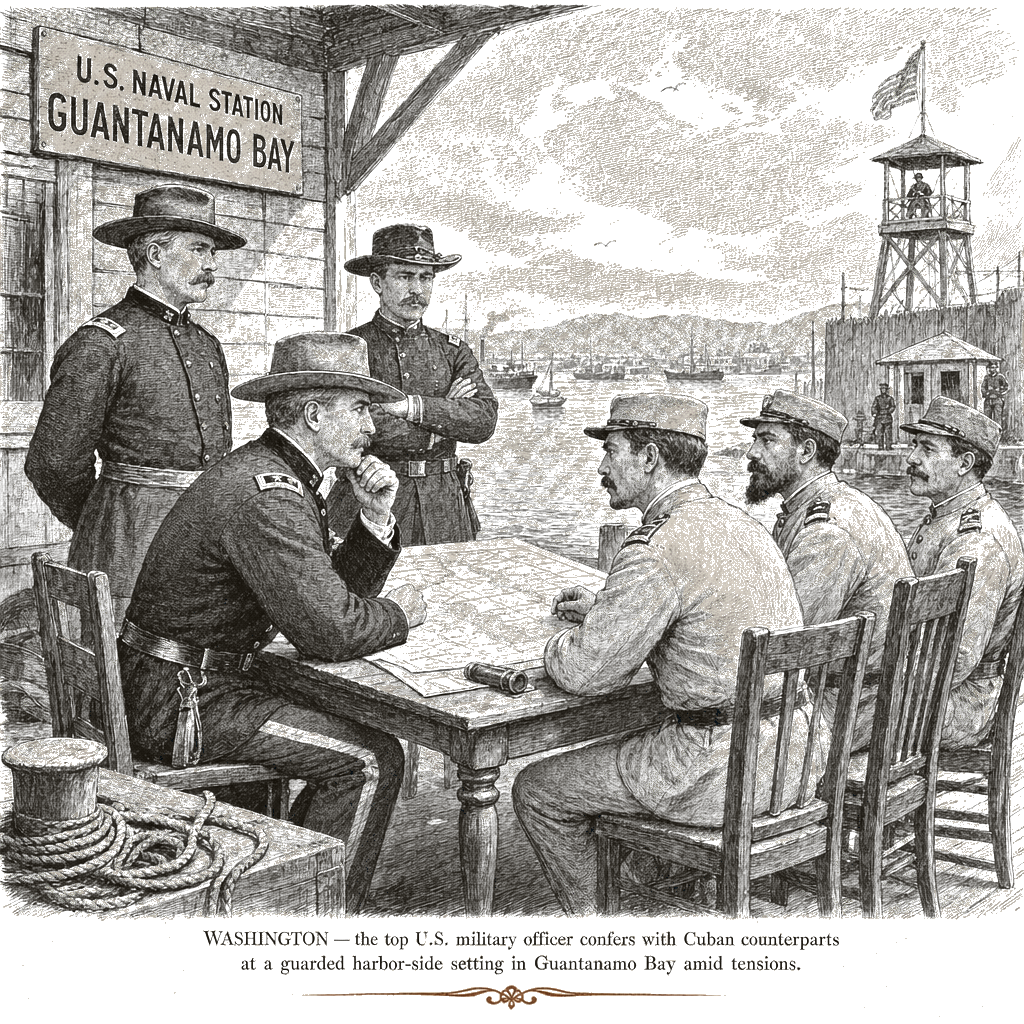
WASHINGTON — Gen. Francis Donovan, the top U.S. military commander for Latin America and the Caribbean, met with Cuban military officials Friday in a rare face-to-face discussion near the U.S. Navy base at Guantanamo Bay, a direct military-to-military contact that unfolded as President Donald Trump intensifies economic and diplomatic pressure on the island nation.
The meeting, described by the U.S. military as a “brief exchange on operational security matters,” brought Donovan together with Lt. Gen. Roberto Legrá Sotolongo, a senior figure in Cuba’s Revolutionary Armed Forces, and other Cuban military officials. It occurred at the perimeter of the Guantanamo base, a 45-square-mile territory the United States has held under a lease dating to 1903 that the Cuban government has long regarded as illegally occupied.
Cuba’s Revolutionary Armed Forces issued a statement confirming the meeting and striking a measured tone. Both sides viewed the encounter “positively because it addressed security issues along the perimeter separating the military enclave,” the statement said, adding that the two commands “agreed to maintain communication between the two military commands.” The Pentagon did not immediately release its own readout of the discussion.
The session is the latest instance of high-level contact between the two governments during a period of acute tension. Trump has repeatedly signaled a more confrontational posture toward Cuba since taking office, warning earlier this year that the island “is next” after U.S. forces captured Venezuelan President Nicolás Maduro in a January raid. In the months since, the administration has imposed an oil blockade aimed at cutting off fuel shipments, maintained a visible warship presence in the Caribbean, and secured a federal indictment against former Cuban President Raúl Castro on charges related to the 1996 shootdown of two civilian aircraft operated by the exile group Brothers to the Rescue.
The meeting also follows a series of diplomatic and intelligence contacts. CIA Director John Ratcliffe met in Havana this month with a grandson of Raúl Castro, and a U.S. delegation visited the island in April as Trump signaled a potential shift in focus toward Cuba after military operations elsewhere. The Cuban government has repeatedly demanded that the United States lift its economic embargo as a precondition for normalized relations.
By maintaining a direct military communication channel even as political tensions rise, both sides appeared to signal an interest in preventing miscalculation along the boundary of the Guantanamo base. The agreement to sustain communication between military commands suggests that, for now, operational predictability at the perimeter remains a shared priority, even as the broader relationship remains deeply adversarial.