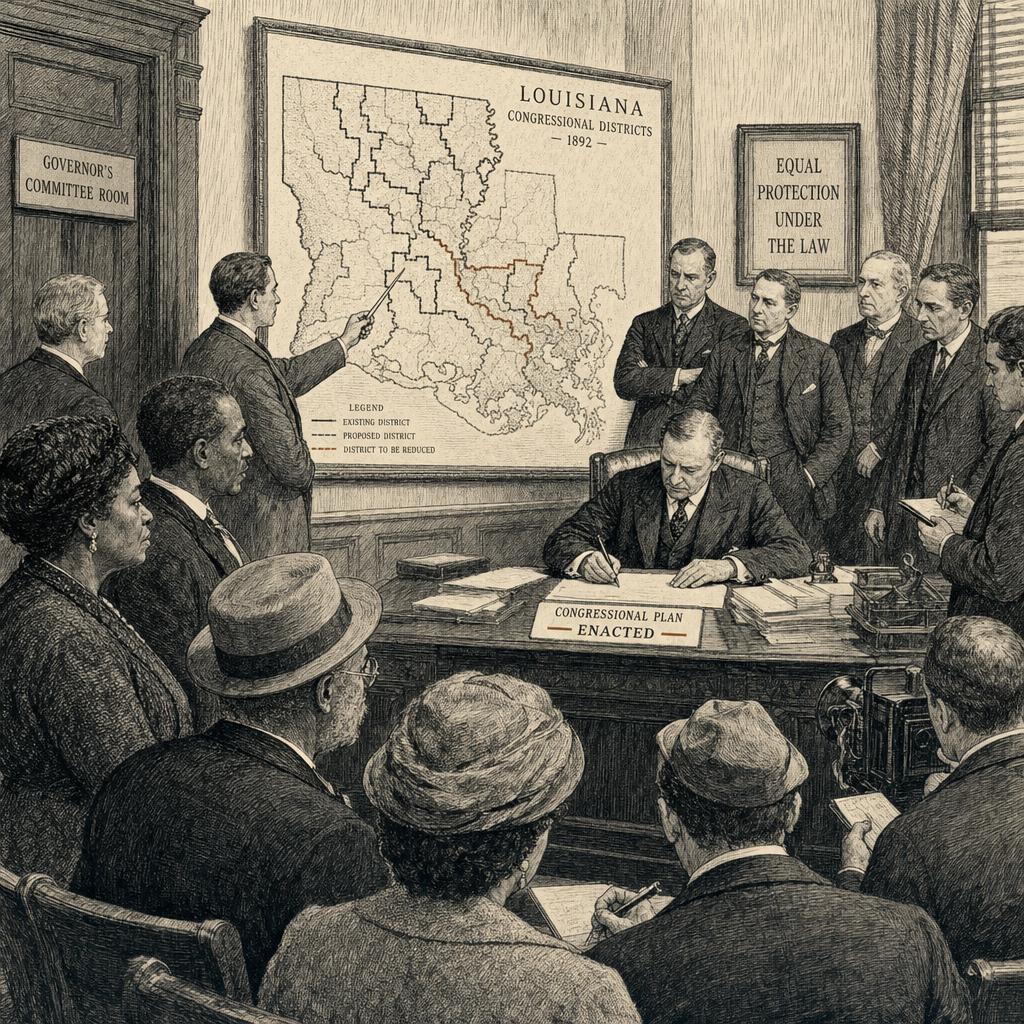
Republican Gov. Jeff Landry signed Louisiana’s new congressional map into law Friday, hours after the state’s Republican-controlled Legislature passed it in an overwhelming vote, enacting a plan that eliminates one of the state’s two majority-Black House districts and is intended to give the GOP a net gain of one seat in the U.S. House.
The map redraws Louisiana’s six congressional districts following an April U.S. Supreme Court decision that struck down the state’s existing plan, which created two majority-Black districts. The court ruled that the previous map constituted an illegal racial gerrymander, a decision that weakened a key enforcement provision of the landmark 1965 Voting Rights Act.
Both of Louisiana’s current majority-Black districts are represented by Democrats — Rep. Troy Carter and Rep. Cleo Fields. The new map retains a single majority-Black district, which Carter or Fields could represent, while creating a fifth district drawn to favor Republican candidates. Under the current map, Republicans hold a 4-2 majority in Louisiana’s House delegation; the new map aims to expand that to 5-1.
The enactment accelerates a national redistricting battle that has intensified since the Supreme Court’s April ruling, with several Southern states now redrawing congressional maps to help Republicans protect their slim U.S. House majority in the 2026 midterm elections. Louisiana’s move follows a pattern that has unfolded in Alabama, Tennessee, and other states where GOP-led legislatures have moved quickly to adopt new maps following the court’s decision.
MSI previously reported that the Louisiana House of Representatives had advanced the redistricting plan on May 28, one day before the full Legislature’s final vote, as part of a coordinated push among Southern Republican lawmakers to reshape congressional boundaries before the midterm campaign cycle begins in earnest. Read that prior coverage.
President Donald Trump has pushed to protect Republicans’ House majority through the redistricting process, according to AP reporting. Louisiana’s new map is one of several being advanced in GOP-controlled states as part of that broader effort.
The plan was written and passed with unusual speed. State Sen. Jay Morris, a Republican who sponsored the bill in the Senate, said the map was drawn to comply with the Supreme Court’s ruling while maximizing Republican electoral advantage. Democratic lawmakers in both chambers opposed the plan, arguing that eliminating a second majority-Black district dilutes Black voting strength in a state where Black residents make up about one-third of the population.
Sen. Royce Duplessis, a Democrat from New Orleans, said during debate that the map was a partisan gerrymander that targeted Black representation. Rep. Sam Jenkins, the Democratic leader in the Louisiana House, said the map “chooses partisan gain over fair representation.”
The new map is expected to face legal challenges from voting rights groups, who are likely to argue that it violates Section 2 of the Voting Rights Act by diminishing the ability of Black voters to elect candidates of their choice. The previous map had been defended by the state as a remedy for just such a violation before the Supreme Court struck it down.