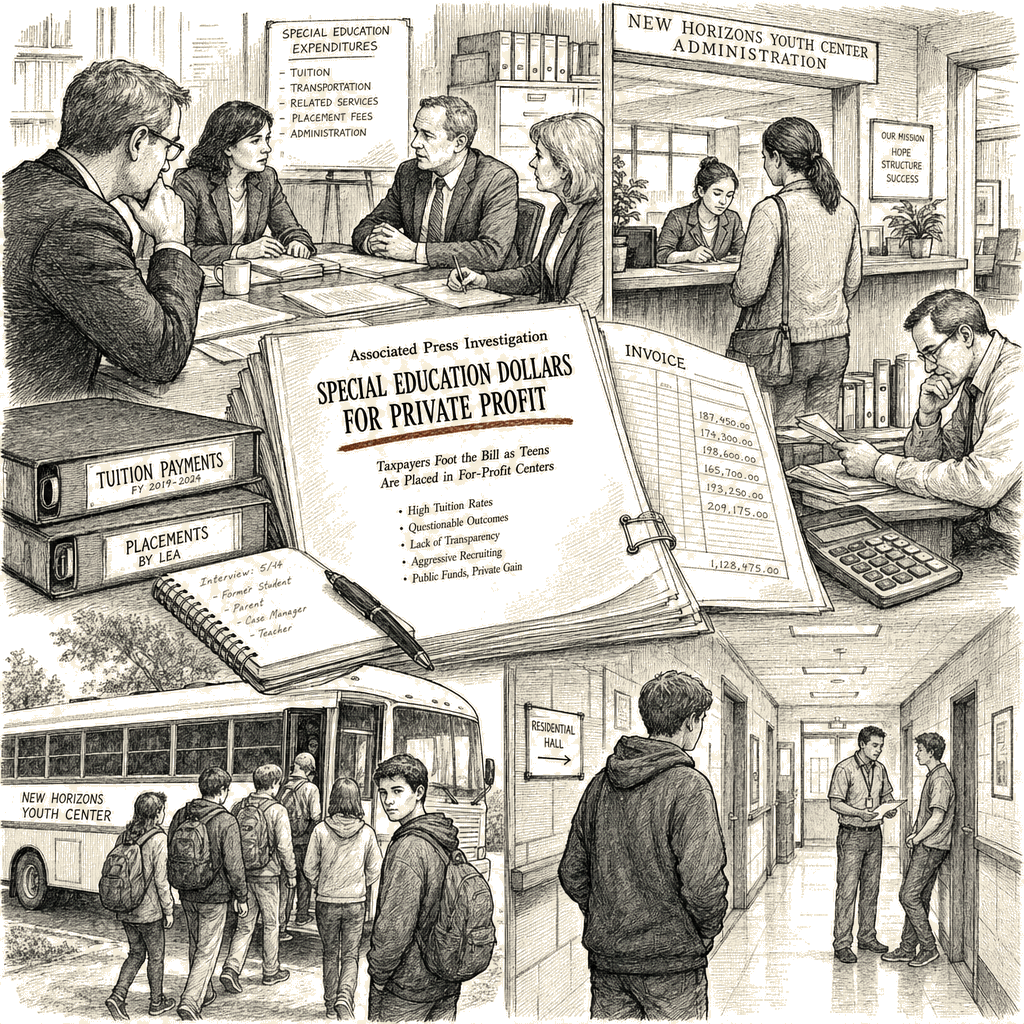
The nation’s special education system, designed to ensure students with disabilities receive the support they need, is quietly financing a network of for-profit residential centers that house teenagers with severe behavioral and emotional challenges, an Associated Press investigation released Thursday reveals.
The AP’s findings, drawn from a review of records from 31 facilities across 18 states, show that these centers contract individually with local school districts — often across state lines — to access millions of dollars in federal special education funds, while operating largely outside the reach of federal oversight.
Under the Individuals with Disabilities Education Act, public school districts are required to provide every student with a disability a “free appropriate public education.” When a district cannot meet that mandate with its own programs, it may pay a private facility to do so. But because contracts are negotiated one by one, with each district acting independently, no central repository tracks how many students are placed or how much public money the private centers collect.
The AP investigation found that the industry has become adept at capitalizing on a catch-all disability label. The vast majority of students placed in these centers are classified under “emotional disturbance,” a broadly defined category that advocates said can sweep up children whose primary challenges are behavioral rather than academic. Once labeled, those students become eligible for intensive residential services that districts must fund.
A shadow network of educational consultants also steers families toward particular facilities. The AP reported that some of these consultants receive commissions from the programs to which they refer clients, a practice that critics said creates a financial incentive to recommend costly out-of-state placements rather than community-based alternatives.
The sums involved are significant. AP’s review of state and local records for the 2023–2024 school year found per-pupil costs that routinely topped $100,000 a year, with some centers billing more than $200,000 annually per child. The Missouri-based Calo program, which has drawn complaints of abuse and neglect from former residents, charges about $216,000 per student each year, and between 50% and 80% of its revenue comes from special education dollars, according to program records and a former employee cited by AP.
No federal agency tracks