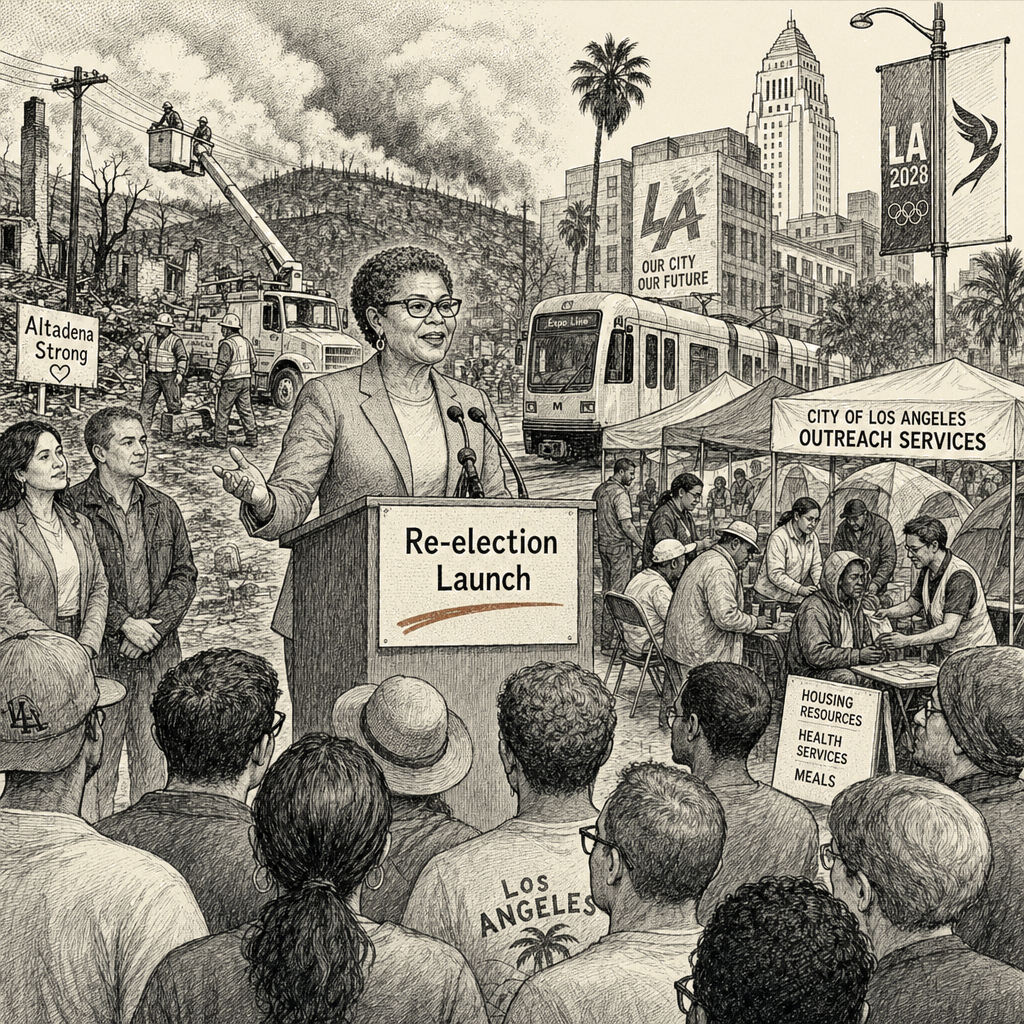
Karen Bass, the first Black woman to serve as mayor of Los Angeles, stood before reporters Friday with a reelection challenge unlike any the city has seen in decades: a governing record shadowed by the Palisades Fire, which burned while she was more than 7,000 miles away, and a potential celebrity opponent whose own home was among the thousands lost.
“I haven’t always got it right,” Bass said, acknowledging the difficulties of her tenure. But she insisted that a second term is warranted by measurable improvements: homicides are down, street homelessness has decreased, and rebuilding from last year’s wildfires is underway. “There’s more work to do,” she added.
Those claims will be tested against a backdrop that includes the 2028 Summer Olympics, an event that will shine a global spotlight on a city of nearly 4 million that is still wrestling with housing affordability and disaster recovery. The Palisades Fire, which ravaged entire neighborhoods, exploded while Bass was in West Africa as part of a U.S. presidential delegation — a trip that her critics have seized on to question her crisis management. She has since acknowledged the absence, but the episode remains a central liability as she asks voters for another four years.
Adding a volatile, celebrity‑churned layer to the race is Spencer Pratt, the reality‑TV star whose Palisades home was lost to the flames. Pratt has transformed from a figure of Hollywood gossip into a sharp‑tongued voice for fire survivors, publicly hammering the mayor’s response. He has not ruled out a campaign, telling reporters he is weighing a challenge. The prospect of a candidate who mixes fame, personal grievance, and fire‑victim advocacy is uncommon even for Los Angeles, a city accustomed to unconventional politics.
Bass, a Democrat who previously served in Congress, has so far drawn no major primary opponent, and she retains support from party heavyweights such as former House Speaker Nancy Pelosi and former Vice President Kamala Harris. Veteran Democratic strategist Garry South, who managed the 2022 campaign of Bass’s rival Rick Caruso, said her record would face scrutiny but that the mayor still enters the race in a strong position. “She’s done some things right and some things wrong, but she’s the incumbent in a city that doesn’t typically fire its mayors,” South said.
The mayor’s aides point to data showing a reduction in the unsheltered homeless population and a drop in the homicide rate as evidence that her policies are working, even as they concede that the fire’s aftermath remains a painful, unfinished chapter. Rebuilding permits have been issued, but many homeowners in the burn zone say insurance delays and regulatory hurdles have kept them from re‑starting their lives.
The 2028 Olympics, which Los Angeles last hosted in 1984, have become a recurring motif in Bass’s pitch. She argues that the city needs experienced leadership to navigate the crush of infrastructure projects, security coordination, and international attention that accompany the Games. “I’m running because I know this city and because I know what it takes to bring it through the tough moments into the moments of celebration,” she said.
With the primary still months away, the race is already shaping up as a referendum not only on Bass’s performance but on whether a city scarred by disaster wants continuity or change.