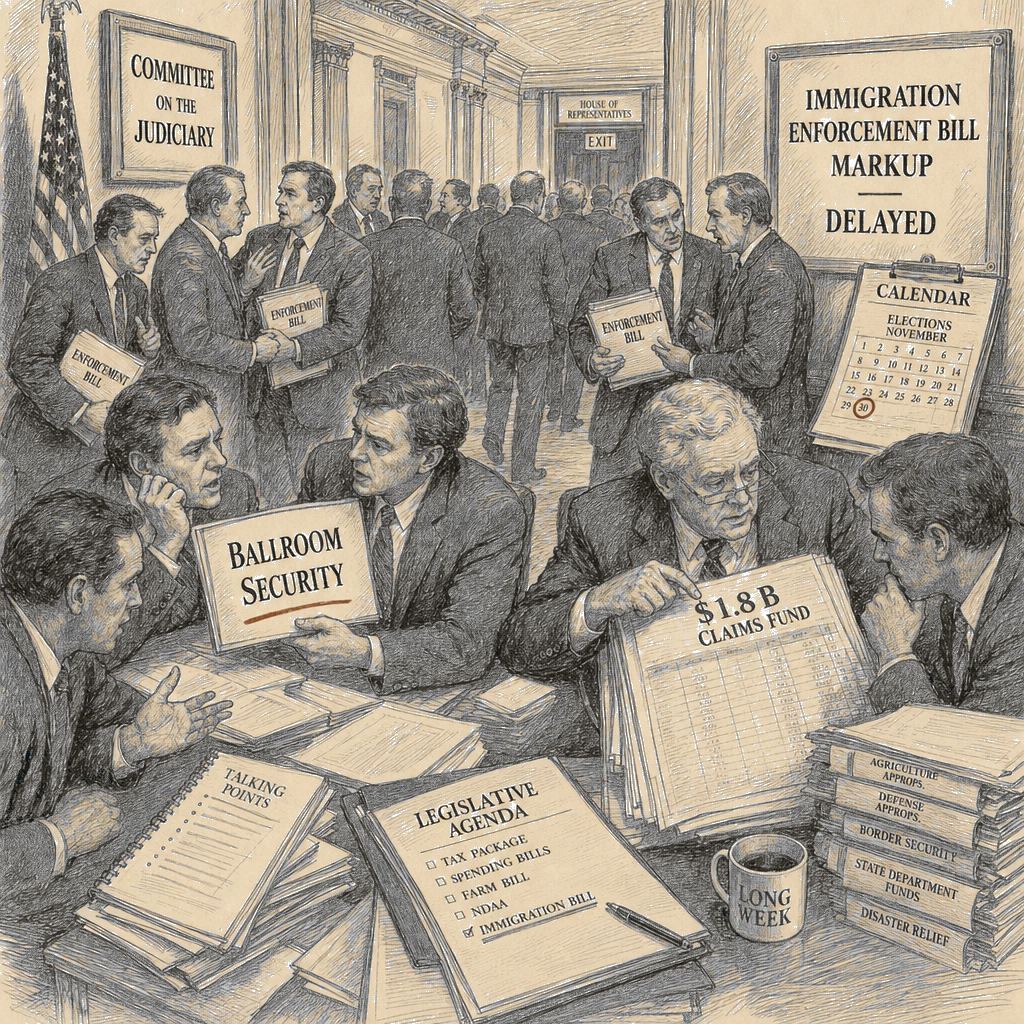
A roughly $70 billion bill to fund immigration enforcement through the remainder of President Donald Trump’s term has stalled in Congress, the Associated Press reported Wednesday, as internal Republican disputes over White House ballroom security funding and a proposed $1.8 billion government-mistreatment claims fund have delayed what party leaders had expected to be one of the GOP’s easier legislative wins.
The delay is not only holding up a top Republican priority but is now prompting questions about whether the party can deliver on the broader legislative agenda it is assembling as a closing argument to voters heading into the 2026 midterm elections, according to the AP.
At the center of the impasse are two provisions that have drawn objections from within Republican ranks. The first would direct funding toward security for the White House ballroom. The second would create a $1.8 billion fund to finance claims of government mistreatment. Both provisions have drawn scrutiny from Senate Republicans in recent weeks, and efforts to resolve the disagreements have so far failed to produce enough support to advance the bill.
Republicans have spent recent weeks laying the groundwork for a third party-line reconciliation bill — referred to in Washington as “Reconciliation 3.0” — which the party hopes will serve as a final sales pitch to voters going into the midterms, the AP reported. The immigration bill’s stall has raised doubts about whether the GOP caucus can hold together on that larger package.
House Speaker Mike Johnson and House Budget Committee Chair Jodey Arrington, a Texas Republican, have been central to the reconciliation planning. Senate Republicans including Bill Cassidy of Louisiana, Thom Tillis of North Carolina, John Thune of South Dakota, and John Cornyn of Texas have been involved in the negotiations over the immigration bill’s contested provisions, though a path forward remained unclear as of Wednesday.
The bill was intended to sustain immigration enforcement operations for the duration of Trump’s current term. Its delay marks the latest in a series of legislative hurdles for the GOP majority, which has struggled at times to maintain unity on spending bills that carry politically sensitive add-ons.