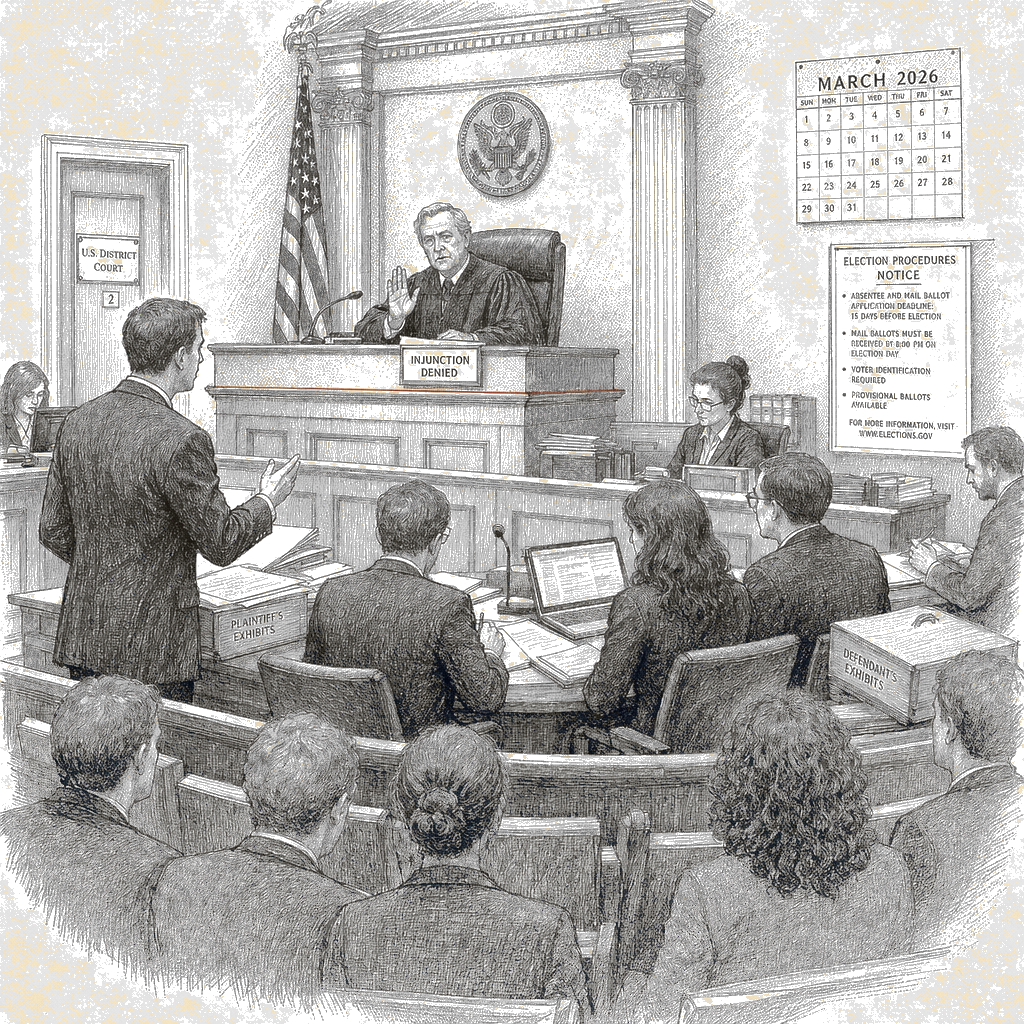
A federal judge in Washington on Wednesday declined to block President Donald Trump’s executive order establishing a national voter list and limiting mail voting, allowing the administration to proceed with a directive that could reshape how U.S. elections are run just months before the 2026 midterm elections.
U.S. District Judge Carl Nichols, whom Trump appointed during his earlier term, rejected a request from Democratic Party committees, nonprofit groups, and civil rights organizations for a preliminary injunction that would have halted the order’s implementation. Nichols sided with the Justice Department’s argument that the legal challenge was premature because the order has yet to be carried out, and therefore any potential harm remained speculative.
The order, signed earlier this year, directs federal agencies to assemble a centralized roster of eligible voters and imposes new restrictions on mail-in balloting. Trump and his allies have long claimed, without providing evidence of widespread fraud, that mail voting is vulnerable to manipulation. A previous lawsuit that sought to block the order was filed shortly after it was issued.
In Wednesday’s ruling, Nichols did not address the plaintiffs’ core constitutional claim — that the order violates the Elections Clause, which reserves for states and Congress the authority to set the times, places, and manner of congressional elections. Instead, he noted that any injunction would have to wait until the administration takes concrete steps that cause demonstrable harm. The judge also left open the possibility that future challenges could succeed once the order begins to be enforced.
The order remains the subject of a separate suit filed in Boston, where a different group of plaintiffs is also seeking to invalidate it. No hearing dates have been set in that case.
Because the Trump administration has not outlined when it intends to implement the order, no voting-changes are expected during the remaining primary elections, which continue into next month. However, the ruling means the order remains in effect as the general-election season approaches, raising the prospect of significant federal intervention in a domain traditionally run by local and state officials.