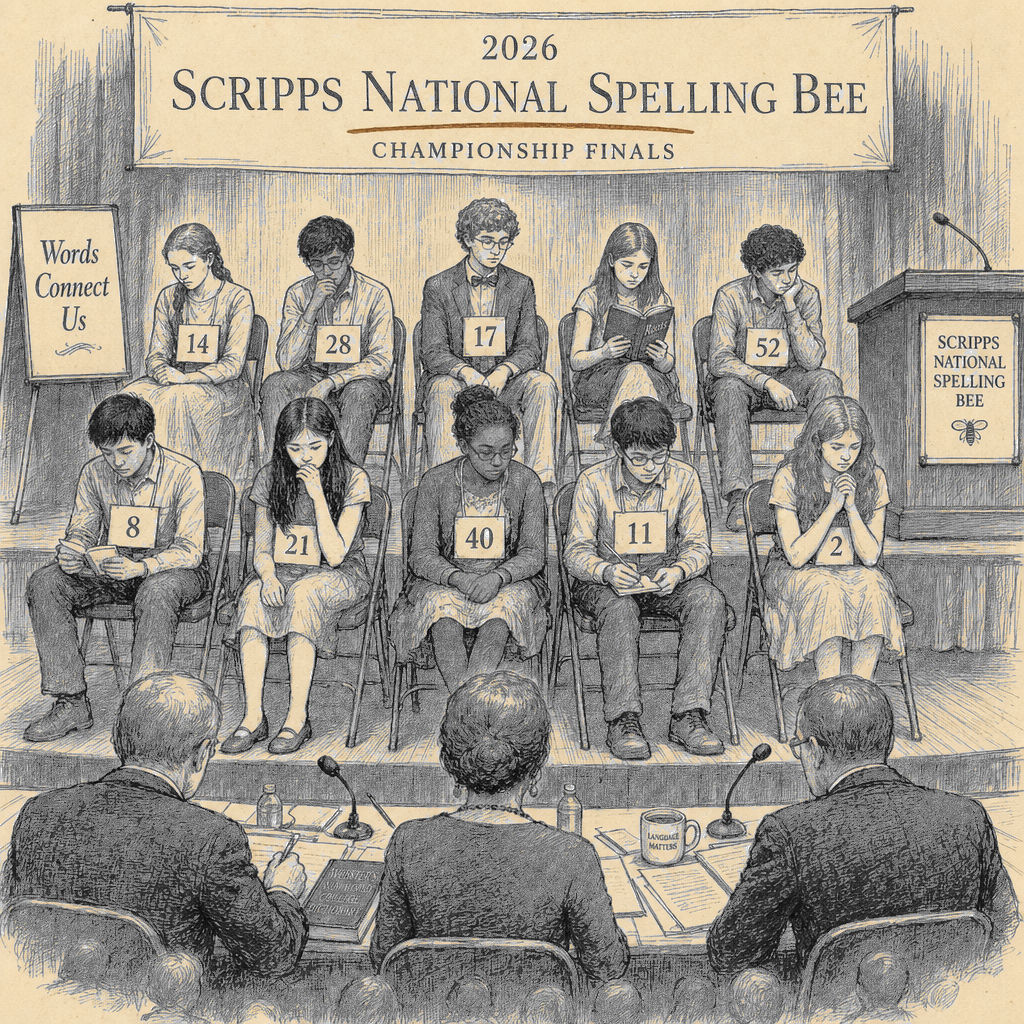
The 2026 Scripps National Spelling Bee finals Thursday night will feature nine spellers who survived Wednesday’s semifinals, but their paths to the microphone could hardly be more different. The opposing strategies have revived a good-natured but sharp debate in spelling circles: Is it better to master the roots and patterns of language, or to commit the dictionary to memory?
Shrey Parikh, 14, finished third in the 2024 bee and then suffered a stunning early exit from his school bee last year when he blanked on the word “calipers” while sick with a fever. Now in his final year of eligibility, he has fully committed to a mastery-based approach. He works with three coaches, pays for word lists and study guides, and competes year-round in online bees.
“At the end of finals, most of the words aren’t going to have a really clean-cut language pattern or rule that you can pull from. So I think memorization is really important,” said Sam Evans, who coached each of the past two champions. “Sometimes it gets a bad reputation, but you have to do it.”
Shrey uses an interactive, AI-assisted platform called Onyma that offers personalized learning and competition with other spellers. The platform was launched this month by his coach Sohum Sukhatankar and Evans. He also uses SpellPundit, an online resource that the company says has been used by every champion since 2019.
Sarv Dharavane, a 12-year-old sixth-grader from Dunwoody, Georgia, represents the opposite pole. He has no coach, does not participate in online bees, and his only study guide is the source for every word in the competition: Merriam-Webster’s Unabridged dictionary.
“The book is my coach,” Sarv said.
Sarv finished third in the 2025 bee as a relative unknown. He said he saw no reason to change his strategy after making the finals again this year. “I used to read the dictionary and set aside difficult words to study later,” he explained. “I did it a lot, so I got a lot of words and it was really easy just to go through them. I’ve always been able to remember pretty well, and I can read through long lists without getting tired, so this strategy works pretty well for me.”
2023 champion Dev Shah advocates an artistic approach — mastering roots and language patterns so that a speller can figure out a word never seen before. “The skill of guessing is everything,” Shah wrote in a Washington Post op-ed after his victory.
In an interview Wednesday, Shah said memorization was still important, especially for words with obscure origins, and that the best spellers found a balance. Sohum Sukhatankar, who coaches Shrey, said top spellers must maximize efficiency. “When you’re at the highest level, you have to be prepared for hundreds of thousands of words,” he said. “You want to do as little memorization as possible to avoid the chance that you just forget it.”
Shrey said his fever and blank on “calipers” in last year’s school bee left him devastated. It took months before he was motivated to start studying again. Once he did, he added Sukhatankar to his coaching team and learned to slow down at the microphone after a 2023 experience where he rushed through a word and was ruled incorrect.
Evans said there is no barrier to learning every possible word. “There’s a common joke among spellers that says everything’s in the dictionary, so it’s all ‘on-list,’” he said. “The dictionary is the most basic thing that spellers need to know.”