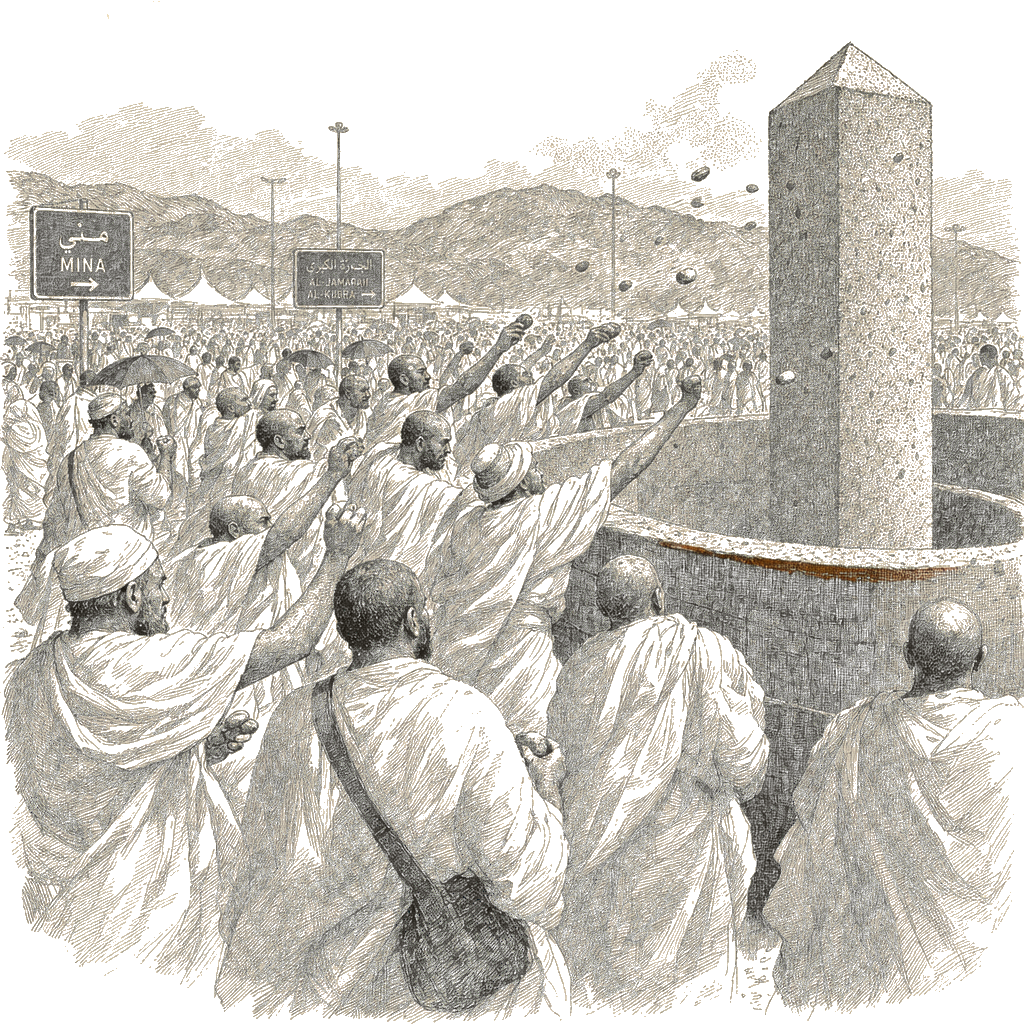
Huge crowds of pilgrims in Saudi Arabia hurled pebbles at a pillar in Mina on Wednesday in the ritual known as the stoning of the devil, a symbolic act commemorating the Prophet Ibrahim’s rejection of temptation. The ceremony unfolded on one of the final days of the Hajj as temperatures climbed above 107 degrees Fahrenheit (42 degrees Celsius), according to the Associated Press. Saudi Arabia’s National Center of Meteorology reported the high temperatures. Pilgrims poured water over their heads and carried umbrellas to cope with the heat as they moved through the sprawling Jamarat complex after arriving from Muzdalifah, following a day of worship and prayer at Mount Arafat on Tuesday.
The stoning ritual, in which pilgrims chant “Allahu akbar” (“God is great”), is seen as a rejection of evil. For many, the act carries personal meaning. Aamar Shakur, a pilgrim from Pakistan, told the AP he saw it as confronting his own struggles, “throwing the stone to my own devil.”
The Hajj, required once in a lifetime of every Muslim who can afford it and is physically able, brought together more than 1.5 million pilgrims from abroad this year, a Saudi official said Friday. The physically demanding pilgrimage, performed over several days, is considered a deeply moving spiritual experience and an opportunity to seek God’s forgiveness. Its final days also include circling the cube-shaped Kaaba in Mecca.
This year’s Hajj coincides with Eid al-Adha, the “Feast of Sacrifice,” which marks Ibrahim’s willingness to sacrifice his son. Muslims traditionally slaughter sheep or cattle and distribute part of the meat to the poor. The holiday is typically joyous, marked with communal prayers, food and festive gatherings. But conflicts and economic pressures across the Middle East are dampening celebrations in several places.
In the Gaza Strip, where a fragile ceasefire between Israel and Hamas took effect on Oct. 10, Palestinians observed a subdued Eid al-Adha. Worshippers gathered for prayers in Khan Younis and Gaza City amid destroyed buildings and with few signs of celebration. “There’s no Eid. My children were killed,” Ayda Al-Banna, a displaced woman from Gaza City, told the AP while praying with her granddaughter. “Eid is only for the people who lost no one.” Mahmoud Saqer, a displaced man from Khan Younis, said, “This is not Eid … we’re dead.” Israel’s military offensive in Gaza has killed more than 72,803 Palestinians, according to Gaza’s Health Ministry, which is part of the Hamas-led government. The ministry’s casualty records are seen as generally reliable by U.N. agencies and independent experts, though it does not distinguish between civilians and militants. Hamas-led militants killed about 1,200 people, mostly civilians, and took 251 hostages on Oct. 7, 2023, triggering the conflict. Deadly Israeli strikes have repeatedly disrupted the ceasefire despite its nominal continuation.
In Lebanon, a separate conflict between Israel and the Hezbollah militant group has displaced thousands. “There is no Eid for us. We are displaced, forced to leave our land, our homes, our livelihoods, while our memories are being destroyed,” said Rabee Khreis, who fled the village of Khiyam. A U.S.-brokered ceasefire in the Israel-Hezbollah conflict appears increasingly fragile, complicating broader peace efforts.
The joyous occasion of Eid al-Adha, meant to unite Muslims of diverse races and socioeconomic classes, is thus overshadowed this year for many who are mourning, displaced, or living under the threat of renewed violence.