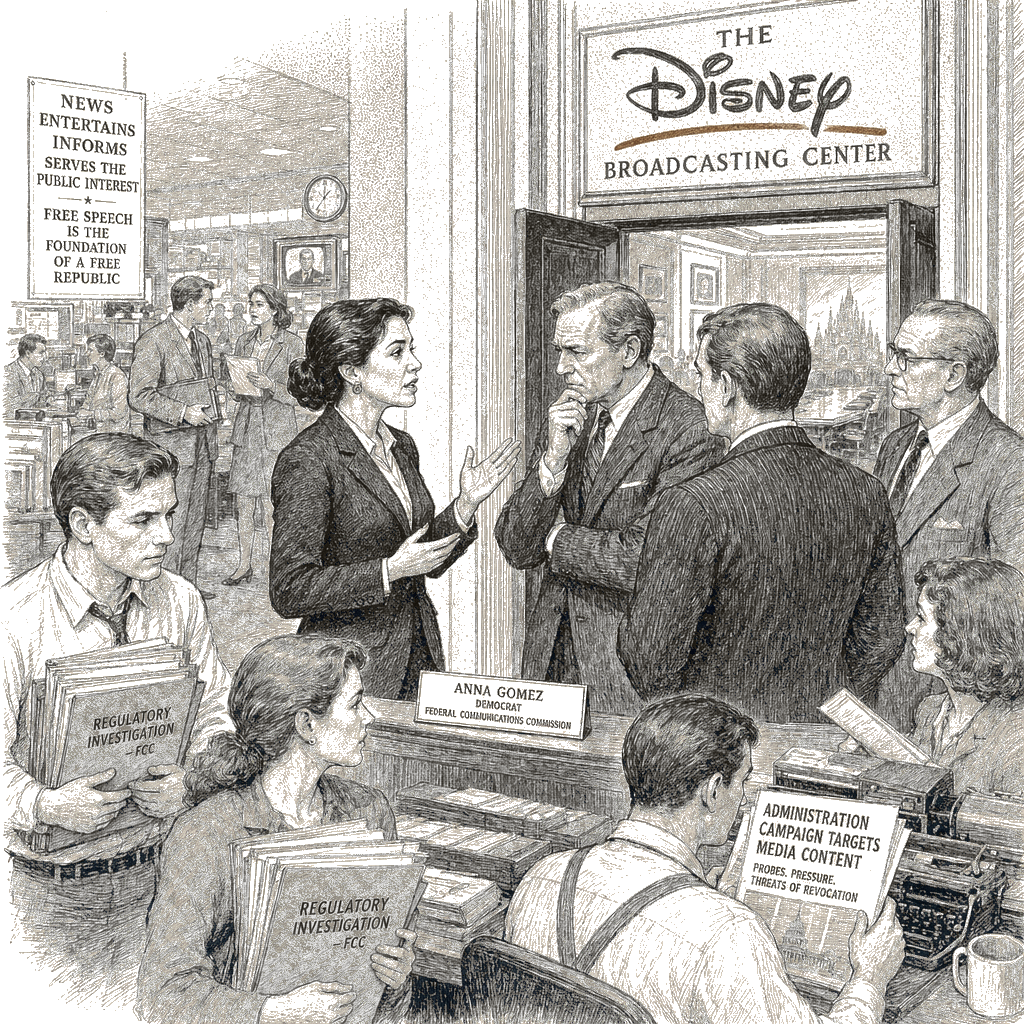
WASHINGTON — Anna Gomez, the sole Democrat on the Federal Communications Commission, has taken the unusual step of publicly confronting the agency’s Republican leadership over what she describes as a politically motivated campaign to pressure media companies into adjusting their editorial content. In an interview with the Associated Press, Gomez said she starts each day by checking whether she has been fired — a reflection, she indicated, of the precarious position of independent voices within the Trump administration’s regulatory apparatus.
Gomez’s most visible move came earlier in May, when she sent a four-page letter to Disney CEO Josh D’Amaro. The letter, which the AP obtained and reported on, outlines what Gomez described as the FCC’s “sustained, coordinated campaign of censorship and control” against the entertainment conglomerate. Disney is the parent company of ABC News, ABC’s daytime talk show “The View,” and the network’s late-night program “Jimmy Kimmel Live!” — all targets of administration criticism or FCC inquiry.
The investigations Gomez cited, launched under FCC Chairman Brendan Carr, who was appointed by Trump, cover a range of subjects. They include the FCC’s probe into Disney’s diversity, equity, and inclusion practices; scrutiny of ABC’s moderation of a 2024 presidential debate between Trump and then-Vice President Kamala Harris; the booking decisions and on-air commentary of “The View”; and, according to Gomez, the administration’s calls for Kimmel to be fired over his monologues. MSI previously reported that ABC had accused the FCC of trying to chill free speech in the dispute over “The View.”
Gomez told the AP that her mission is increasingly urgent. She said she is pressing media companies to more forcefully combat what she views as an administration crackdown on free speech, conducted through the regulatory powers of the commission. The FCC, an independent agency, has authority over broadcast licensing and spectrum allocation — powers that, Gomez and media-law experts have warned, can be wielded to create a chilling effect even without formal enforcement actions.
The commissioner’s decision to write directly to a regulated company’s CEO is a departure from the FCC’s customary practice, in which commissioners deliberate internally and issue decisions through votes and public notices. A commissioner publicly accusing the chair of running a censorship campaign is, by the accounts of former agency officials, exceedingly rare. Gomez, who was confirmed to the FCC in 2023, is serving a term that runs through 2027. As the sole Democrat on the five-member commission, she holds no power to block Carr’s agenda but can use her platform to draw public attention to actions she considers overreach.
The broader pattern of media pressure has been documented across the administration. MSI has tracked FCC actions against broadcasters, the administration’s efforts to shape coverage of the Iran conflict, and disputes over press access at the White House. Gomez’s letter to Disney adds a new, formal dimension to that record — a sitting commissioner putting in writing her assessment that the agency on which she serves is engaged in a censorship campaign against a media company, and urging that company not to bend.