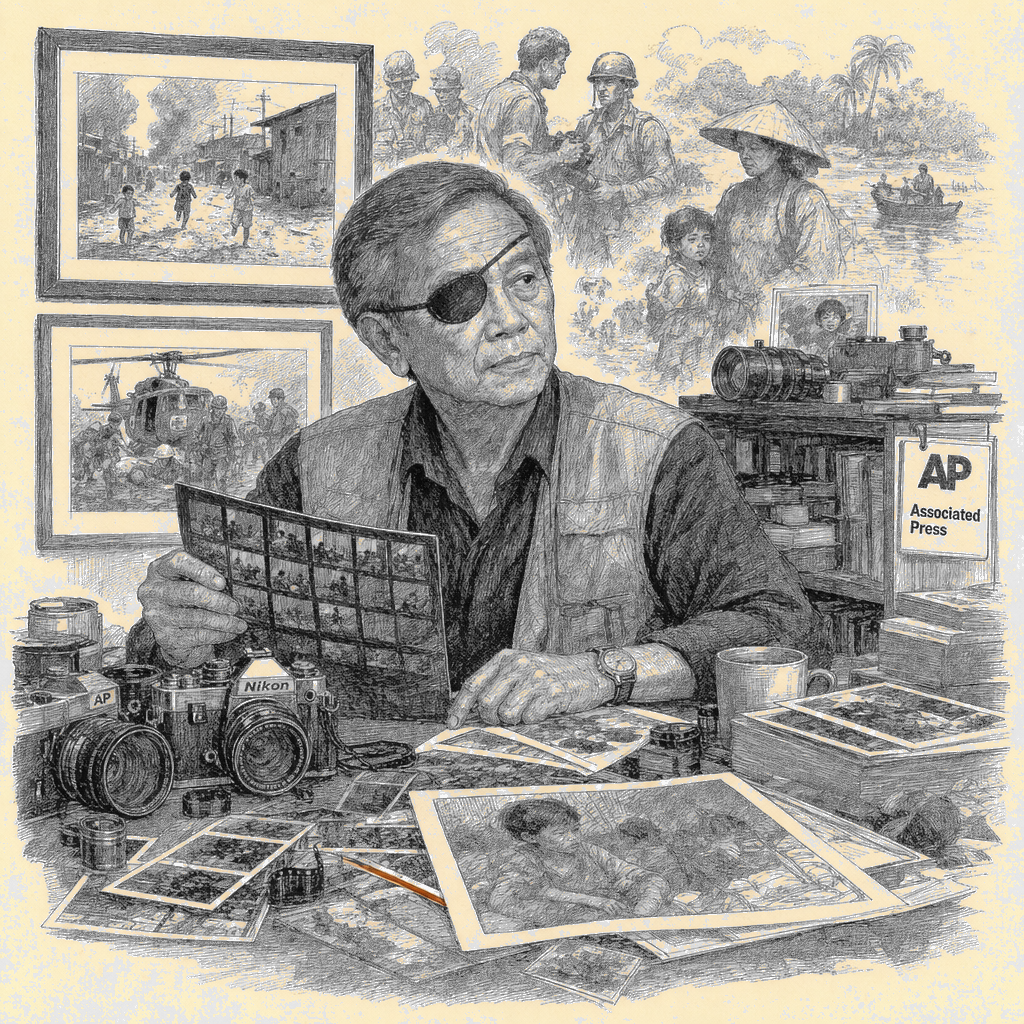
Phuoc died Saturday in Southern California after collapsing suddenly, his nephew, Van Nguyen, said.
Phuoc had been an Associated Press combat photographer during the Vietnam War and became known for repeatedly returning to the field even after injuries. AP reported that he was wounded at least five times during roughly a decade in Vietnam, with the first injury coming only months after he was hired.
AP said Phuoc was hired in 1965 by Horst Faas, then AP’s photo chief, to replace another local hire who had been killed on assignment. In Vietnam, Phuoc developed a reputation with other journalists and with U.S. and South Vietnamese troops for his ability to position himself near the front lines, AP said, and he was nicknamed the AP’s “secret weapon” by his boss.
AP reported that Phuoc was wounded in multiple incidents, including a grenade explosion that left shrapnel in his chest and leg but did not keep him from returning to cover the conflict. In 1968, AP said he sustained a concussion after being hit in the head by a rocket while covering street fighting in Saigon, and that he also took steps to help save a wounded U.S. soldier while under sniper fire, receiving a commendation from the Ninth U.S. Army Infantry Division.
One injury, AP said, permanently changed how he worked. AP reported that Phuoc lost his right eye in a 1969 grenade explosion while on patrol with a Ranger battalion south of Da Nang, on Vietnam’s central coast, and that he learned to shoot with one eye and returned to his assignments. In a 2011 interview for AP’s archives, AP said Phuoc described the difficulty of looking through the camera while also watching for silent hand gestures from the soldiers he patrolled with.
AP also described how Phuoc’s interest as a photographer was not limited to combat scenes. In the 2011 interview, AP reported that he compared himself to a “small grain of sand” who used his pictures to bring civilians’ stories to the world, and that colleagues saw him as fearless and resourceful in the field. In particular, AP reported that Huỳnh Công “Nick” Út, a colleague in AP’s Saigon bureau, described Phuoc as a fearless and resourceful partner and said that after hearing of his death, he cried, “My brother, he’s gone.”
AP said that when Saigon fell in 1975, Phuoc fled with his family, initially taking only clothes and a bottle of milk. AP reported that the family was rescued from a refugee camp in Guam with help from AP reporter Linda Deutsch, who was covering the tent city, and that they were later flown to Camp Pendleton.
After leaving AP, AP reported that Phuoc worked briefly for the wire service in Hong Kong before settling permanently in Southern California. AP said he became a professional portrait photographer in Orange County, where there is a large South Vietnamese refugee community, helped train young photographers, and served as a civilian volunteer for the Los Angeles County Sheriff’s Department, earning a county volunteer-of-the-year honor in 1994.
AP said Phuoc’s family remembered him not only for his Vietnam War work but also for the portraits he took in later years, including images of his great-nephew, Kim Nguyen. Kim Nguyen, AP reported, looked back at those portraits and described bringing his own son to see Phuoc’s work on display in Vietnam.