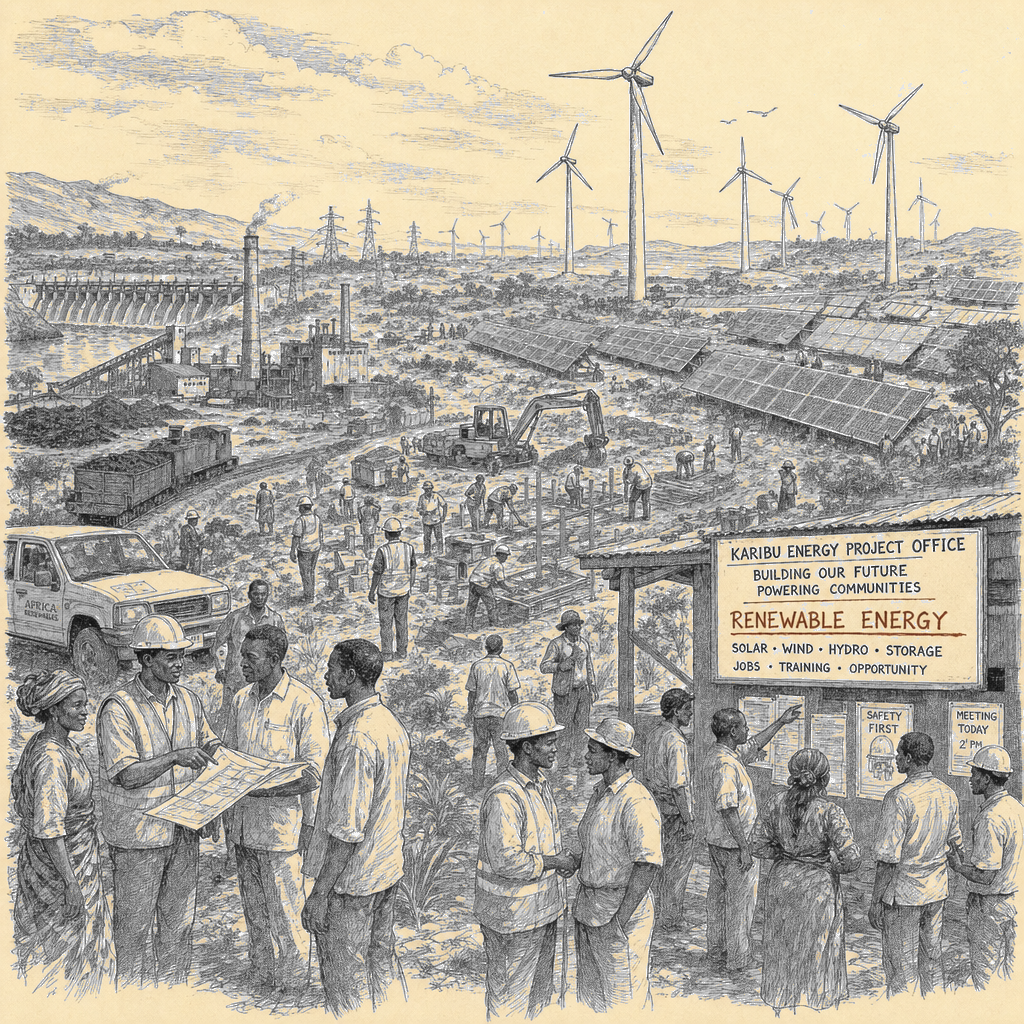
Solar and wind have overtaken coal and large hydropower as the dominant sources of new electricity generation across Africa, driven by plunging technology costs, rising fuel import bills and policy reforms that are reshaping how the continent powers its growing economies. Of the 322 energy projects announced in Africa during 2025, 173 were solar, 46 hydropower, 34 wind, 22 gas and 14 hybrid — a shift that industry leaders say marks a structural break from the big-dam and coal-plant era.
The trend is part of a global pattern in which renewables have already surpassed coal in total power capacity, as MSI previously reported. In Africa, the economics are especially stark: utility-scale solar costs have dropped roughly 90% since 2010, onshore wind costs about 70%, making them the cheapest new electricity source in many markets. The International Renewable Energy Agency said the continent added a record 11.3 gigawatts of renewable capacity in 2025, more than triple the year before, with South Africa, Egypt and Ethiopia accounting for most of the growth.
“Africa is not on the periphery of the global energy transition, it is sitting at its center,” said Mugwe Manga, climate finance lead at FSD Kenya. “The continent holds the world’s best renewable resources, and the economics have now decisively turned in favor of clean energy.”
A $1.5 billion energy deal between China and Zambia announced in early May includes three 300-megawatt projects — one solar, one wind, one coal-fired — underscoring the continent’s still-unresolved need for stable baseload power. But investors are increasingly favoring renewable projects because they generate returns faster and carry less exposure to global fuel price shocks, which have worsened since the Iran war drove energy costs higher across import-dependent economies.
“Renewable energy is now unequivocally the fastest, cheapest, and most bankable way to connect people, companies and economies to the megawatts they need to grow,” said Matt Tilleard, CEO of CrossBoundary Energy, which invests in African renewable projects. At the Kamoa-Kakula copper complex in the Democratic Republic of Congo, CrossBoundary is building a 233-megawatt solar-and-battery plant that Tilleard said moved from contract signing to more than 80% completion within a year. Coal-fired plants can take up to 12 years; large hydropower projects often require a decade or more.
Much of the growth is occurring outside national utility systems. Olamide Niyi-Afuye, CEO of the Africa Minigrid Developers Association, said the continent is undergoing a structural shift toward distributed solar and battery systems installed at mines, factories, telecom towers and homes. “Most official statistics still measure the energy transition the old way, by counting megawatts connected to national grids,” Tilleard said. “But solar and batteries don’t need central utilities.”
Data from the Africa Solar Industry Association shows 23.4 gigawatts of operational solar projects tracked across the continent by the end of 2025. Chinese export figures, however, indicate that 58.1 gigawatts of solar panels have been shipped to African countries since 2017, suggesting solar adoption may be growing far faster than official figures capture — much of it installed behind the meter and never recorded in grid statistics.
Policy changes are accelerating the shift. Ethiopia became the first country to ban imports of internal combustion engine vehicles, driving faster electric-vehicle adoption. South Africa relaxed limits on private power generation, opening the door to a surge in industrial renewable projects. Still, major obstacles remain. Many African utilities are financially strained, making lenders wary of long-term power purchase agreements. Financing costs for renewable projects in Africa are up to triple those in advanced economies because of perceived country risk, according to the International Energy Agency.
Development finance institutions including the African Development Bank and the International Finance Corporation are helping bridge the gap with concessional loans, guarantees and risk-sharing structures. “What remains is not a question of technology or cost,” Manga said. “It is a question of finance, political will and preparing bankable projects that will drive demand for power on the continent.”