Body
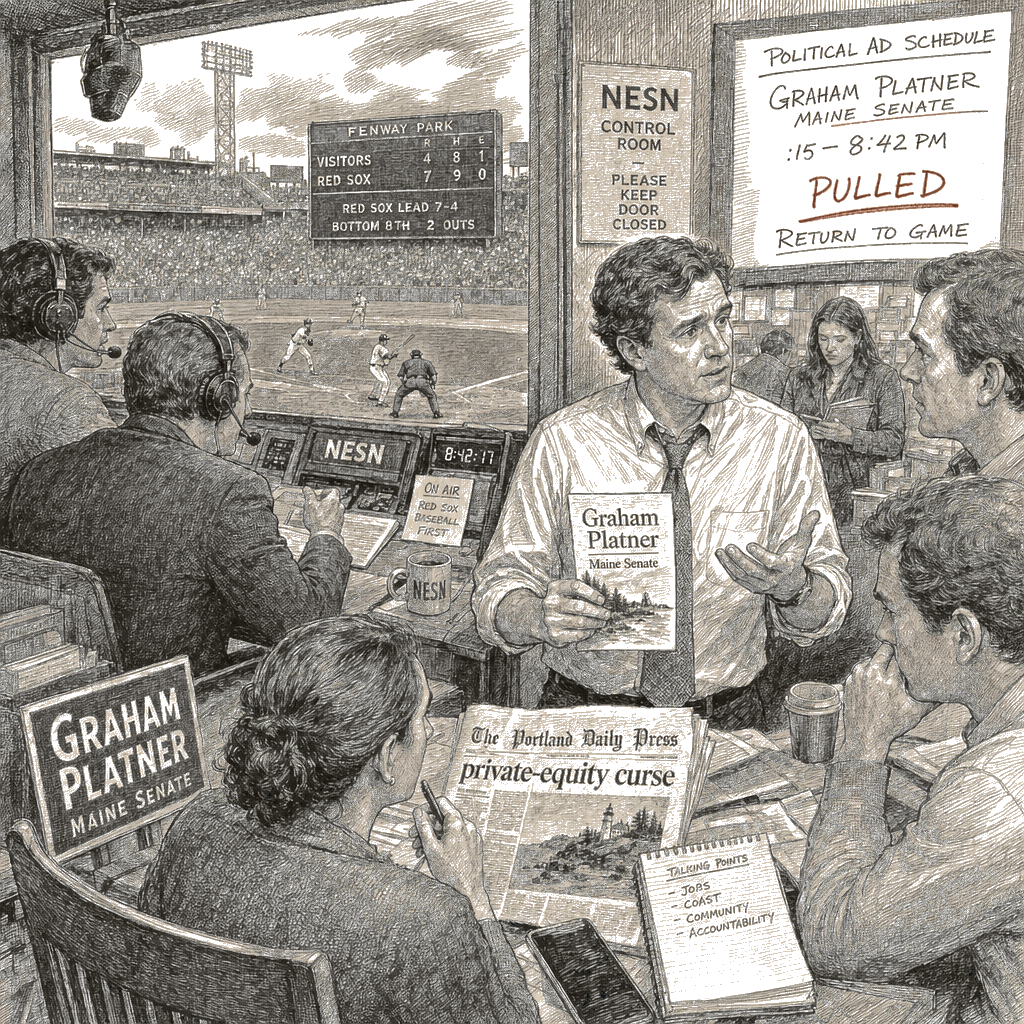
Graham Platner, the Democratic challenger seeking to replace longtime Republican Sen. Susan Collins in Maine, aired a short political spot during a Boston Red Sox game on Memorial Day weekend. The 15‑second ad featured an oyster farmer promising to “reverse the private equity curse” if elected, and it accused the team’s owners of “buying up our homes, our sports and our lives.”
“We ran an ad during last night’s Red Sox game exposing how private equity is making everything in our lives worse, and it got pulled midway through the game by a station owned by Red Sox ownership,” Platner said in a statement on Saturday. “And of course, the Red Sox blew a 4‑0 lead to lose the game.”
The ad was removed by New England Sports Network, which is largely owned by Fenway Sports Group, the conglomerate that also controls the Red Sox and the Premier League’s Liverpool. NESN issued a statement: “NESN removes advertisements when credible concerns arise regarding the use of intellectual property. The advertisement in question was removed because the creative included unauthorized use of third‑party intellectual property and did not comply with NESN’s advertising standards.”
Platner’s message draws on a March 2021 Axios report that RedBird Capital Partners, a private‑equity firm, holds an 11% stake in Fenway Sports Group. The ad also alluded to the bitterness many Boston fans feel after the 2020 trade of star outfielder Mookie Betts, a move that still haunts the franchise. Since the RedBird deal, the Red Sox have slipped to a 22‑30 record, sitting at the bottom of the AL East, and fans have begun chanting “sell the team” during games.
Collins’ campaign counters that Platner’s criticism of the Red Sox is a diversion from questions about his own judgment and character. The campaign highlighted Platner’s past social‑media posts on women, police, veterans and rural Americans, as well as a tattoo he once had that was associated with Nazi imagery—a tattoo he later covered up and for which he apologized, saying he was unaware of its meaning when he got it after a night of drinking.
The controversy underscores how political candidates are increasingly using sports‑team ownership disputes to rally populist sentiment, while also reviving scrutiny of private‑equity influence in professional athletics.