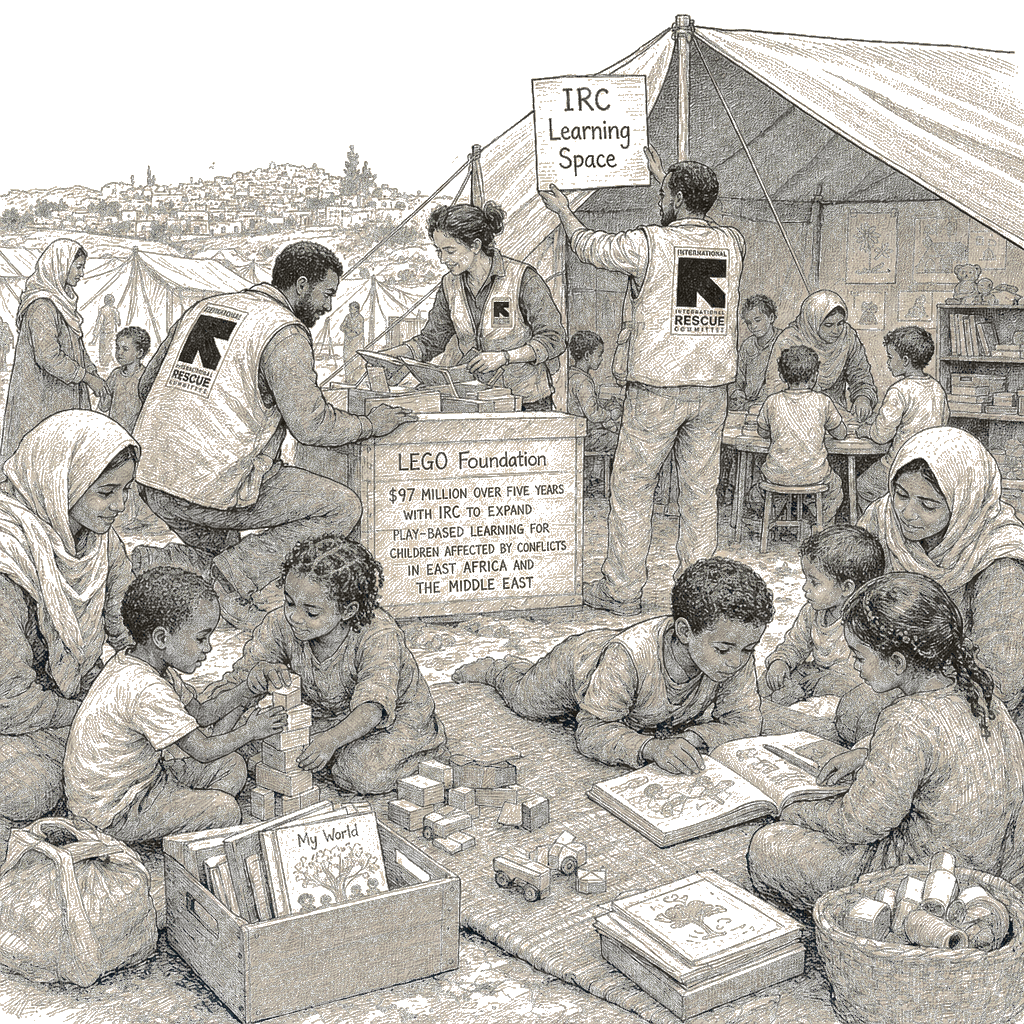
Global conflicts ranging from South Sudan’s political crisis to the United States’ recent war with Iran are placing more children at risk of suffering, the LEGO Foundation and the International Rescue Committee said as they announced a new five-year partnership aimed at education support in conflict settings. Under the agreement announced Wednesday, the LEGO Foundation committed $97 million to expand IRC programs that use play-based learning for children affected by crises. IRC President David Miliband said children “born in conflict” have their childhood “stolen,” and argued that returning “a bit of their childhood” can help them make use of it.
The partnership is designed to reach 5 million children across East Africa and the Middle East, Miliband said. LEGO Foundation chief executive Sidsel Marie Kristensen said which children they serve would change as conflicts evolve, and she said the funding would focus on children in “the most dire contexts.” The LEGO Foundation and IRC said they are planning an “agile” approach, rather than tying money to place-based grants that might expire or become mismatched if conditions change quickly.
Kristensen said the framework is built for uncertainty, arguing that “nobody knows honestly what is happening tomorrow or in two months.” She said that flexibility is needed because humanitarian crises can reshape who requires services and what classrooms and materials are required. The IRC’s officials said refugee class sizes can expand rapidly in emergencies, which can change classroom space and create additional needs such as sanitation and nutrition that are not always counted under education alone.
A central element of the effort is a program the IRC leads called PlayMatters, which the organizations said provides training for teachers of children ages 3 to 12. The partners said the training is intended to help educators integrate what they describe as “playful learning” into lessons without prescribing what teachers must teach. Program leaders also work at the national level, engaging government officials to embed materials into curricula, according to the announcement.
IRC officials described the classroom approach as a way to support children’s recovery while keeping them engaged in schooling. In Uganda’s Nakivale settlement, the IRC said, PlayMatters helped reduce absenteeism at a primary school serving refugees, and Sister Kasingye Secunda said teachers worked to help students “feel at home” while dealing with language differences between local languages and the language used in classrooms. The IRC said children learned concepts such as colors through games and built confidence through classroom presentations and group activities.
The announcement also described digitally delivered lessons used alongside in-person programming. From Ethiopia to Tanzania, the IRC said, a radio show helps children name emotions through episodes offered in multiple languages with characters familiar to audiences. The program director, Martin Omukuba, said the radio component is expanding so the IRC can remotely reach schools in South Sudan that have been inaccessible due to flooding for months at a time.
In interviews connected to the announcement, IRC officials emphasized that the LEGO Foundation’s funding approach gives them room to reallocate resources during shifting emergency conditions. Omukuba said the organization needed to first ensure children are alive and that education could be introduced when children are stabilized.
The partners said they have worked together before, and they framed Wednesday’s commitment as part of broader efforts to build trust among governments and donors as humanitarian budgets shrink. They said the LEGO Foundation committed $100 million in 2019 to “Ahlan Simsim,” an educational programming initiative launched by the IRC and Sesame Workshop with support from the MacArthur Foundation for children affected by the Syrian refugee crisis and other regional conflicts. Kristensen also said the LEGO Foundation recently announced a separate $30 million partnership with Co-Impact to support locally led solutions focused on learning and wellbeing for children impacted by conflict and crisis.
Miliband and other aid leaders tied the education push to concerns that cuts to development and humanitarian funding have stretched systems and worsened consequences for public health and other services. Miliband cited the Ebola outbreak in Congo as an example of how aid cuts can undermine the ability to detect and respond to outbreaks, and he said that education interventions also face similar marginalization pressures. Patty McIlreavy, president and CEO of the Center for Disaster Philanthropy, said education has often been treated as underfunded even before wealthy countries cut aid budgets, describing a narrow definition of “life saving” that excluded “life sustaining” efforts such as children’s education.
McIlreavy said the LEGO Foundation and IRC announcement shows how donors can support education in complex conflicts even when there may not be a clear end point in sight. She said philanthropy does not need to “fix what’s broken in a country” and that the group’s role can still include offering “six months or a year of education” for children as communities endure crises.