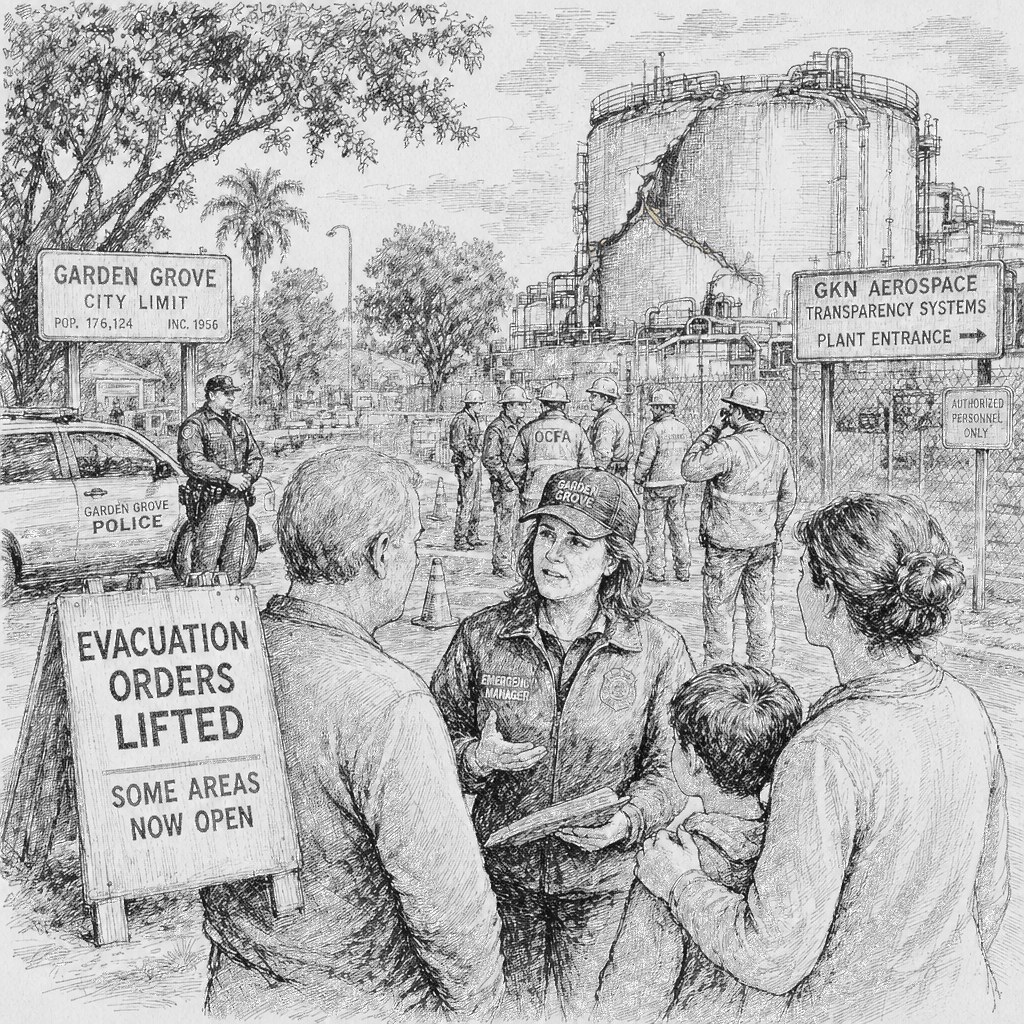
Emergency officials on Monday lifted an evacuation order for some residents near a damaged chemical tank at the GKN Aerospace Transparency Systems plant in Garden Grove, a city in Orange County near Los Angeles, after temperatures inside the tank dropped enough that officials said a catastrophic explosion was no longer expected. Orange County Fire Authority division chief Craig Covey said emergency crews will still continue work to address other hazards, even as the immediate worst-case scenario faded.
Officials began ordering residents of Garden Grove to evacuate their homes on Thursday after the tank overheated, and by the weekend about 50,000 residents had been told to leave. On Monday, officials described the change as the result of cooling progress inside the tank and an overnight evaluation of its pressure conditions.
Covey said the tank’s interior had cooled to 93 degrees Fahrenheit (33.9 degrees Celsius) by Monday, down from 100 degrees Fahrenheit (37.7 degrees Celsius) a day earlier. He said the overnight assessment of the tank — which held 6,000 to 7,000 gallons (22,700 to 26,500 liters) of methyl methacrylate, a highly flammable chemical — found a reduction in pressure inside the container after a crack was discovered Sunday.
Even with the evacuation order being lifted for some households, Covey said the incident was not fully resolved. He told reporters, “It’s not over yet. We still have work to do,” and he added that crews still had to mitigate a fire and a very small explosion concern, as well as address spill potential.
Orange County Health Director Regina Chinsio-Kwong sought to reassure residents returning home that the situation did not involve chemical contamination. She said officials found “There was no contamination. There were no fumes. There were not vapors that came from this incident,” and she added, “There was not a leak. So it should be, you should feel comfortable going home even if you’re across the street from that new zone line.”
Authorities have not defined the exact threshold for a “catastrophic” explosion, but they said Monday that the worst-case scenario was off the table. Officials also said about two-thirds of evacuated residents — roughly 34,000 people — could return home after the latest assessment, according to Covey.
Environmental concerns, however, remain part of the response plan. Andrew Whelton, a Purdue University engineering professor who has studied environmental contamination, said the tank might eventually cool enough for crews to safely stabilize and drain the remaining material without triggering a spark or ignition. He cautioned that significant risk could continue while methyl methacrylate remains hot and reactive, and he said temperatures need to fall closer to ambient levels of roughly 60 to 70 degrees Fahrenheit (15.6 to 21.1 degrees Celsius).
Whelton said rising tank temperatures can cause methyl methacrylate to convert from liquid to gas, increasing pressure and the risk of an explosion. He also said some of the material may already have hardened into a stable plastic similar to plexiglass, which he said could reduce the risk inside the tank.
In Orange County, officials said the air will be monitored for several months and that the Environmental Protection Agency will check sewer and storm drains. Orange County Supervisor Janet Nguyen said the South Coast Air Quality Management District would oversee air monitoring, and officials have previously said the chemical is easy to smell and that residents might notice it over a broad area without being harmed.
After hearing the update that the “worst has passed,” Kim Yen, a retiree who said she evacuated her Garden Grove home and lives two blocks from the plant, said she felt relieved but remained cautious about returning. Yen said she was ready to go back but wanted to confirm it was safe, and she added that she was worried about the crews and called them “really our heroes.”
The response took place amid holiday weekend activity in nearby areas, with a parking lot at a large park in Fountain Valley filling on Monday as people sought shelter or set up tents, while others gathered in the park to enjoy Memorial Day. GKN Aerospace also said it had removed external insulation from the tank to help cool its contents, according to a statement released Monday by the company.
GKN Aerospace Transparency Systems owns the Garden Grove plant and is a British company that makes cockpit windows, canopies and windshields for military and commercial aircraft. The operation reopening date remained unclear, and the company said it apologized for disruption while prioritizing a safe resolution so residents could return as quickly as possible.
Officials said the incident also highlighted how disruptions at facilities producing specialized aircraft components can be difficult for the aerospace industry to absorb because supply chains are concentrated and already strained. Richard Aboulafia, managing director of the aerospace consulting firm AeroDynamic Advisory, said aerospace manufacturing differs from many other industries because aircraft production rates are relatively low, leaving only a small number of suppliers for many specialized parts and systems. He said, “There’s just not a lot of margin in the system.”