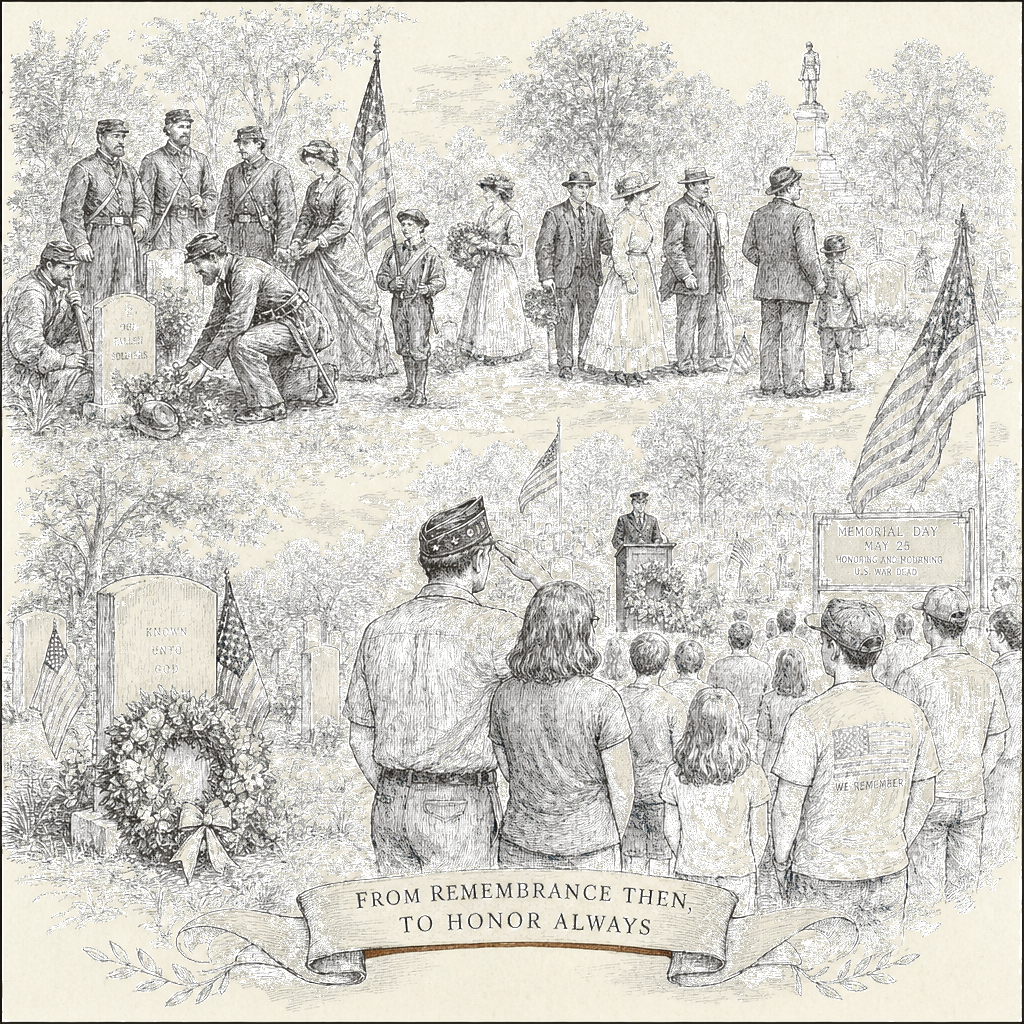
The origins of Memorial Day are often described as a national act of mourning, but its development spans cemeteries, speeches and arguments over what the day should mean—and, eventually, the rhythm of leisure and commerce that arrives with late-spring travel. This year’s Memorial Day lands on Monday, May 25, and federal observers are also urged to pause at 3 p.m. for a National Moment of Remembrance, according to the Congressional Research Service as summarized by the Associated Press.
The Associated Press traced Memorial Day’s calendar and purpose to a series of Decoration Day practices that grew from the Civil War, when the conflict killed more than 600,000 service members from both the Union and the Confederacy between 1861 and 1865. The AP reported that the first national observance, then called Decoration Day, took place on May 30, 1868, after an organization of Union veterans called for decorating war graves with blooming flowers, following a practice that was already underway in multiple communities.
In the postwar years, local ceremonies were also described as preceding or running alongside later national observances. The Associated Press reported examples including Waterloo, New York, which began a formal observance on May 5, 1866, and was later proclaimed to be the holiday’s birthplace, along with Boalsburg, Pennsylvania, which traced its first observance to October 1864, according to the Library of Congress. The AP also cited accounts that women in some Confederate states decorated graves before the war ended.
A timeline of competing “firsts” also appears in accounts of remembrance events in Charleston, South Carolina, which Ben Railton and other historians used as reference points for the way different communities participated in burial practices. The Associated Press said David Blight, a Yale history professor, pointed to May 1, 1865—when as many as 10,000 people, many of them Black, held a parade, heard speeches and dedicated graves of Union dead in Charleston. The AP said 267 Union troops died at a Confederate prison and were buried in a mass grave, and that Black churches later buried them in individual graves.
Contestation over what the holiday should emphasize emerged early as well. The Associated Press reported that as early as 1869, The New York Times wrote that the holiday could become “sacrilegious” and no longer “sacred” if it focused more on pomp, dinners and oratory. In an 1871 Decoration Day speech at Arlington National Cemetery, abolitionist Frederick Douglass said he feared Americans were forgetting the Civil War’s impetus: enslavement, and the AP quoted Douglass’s warning that “We must never forget that the loyal soldiers who rest beneath this sod flung themselves between the nation and the nation’s destroyers.”
Later historians highlighted how those questions evolved into debates about who was centered in remembrance and how the national narrative changed. The Associated Press reported that Ben Railton said the holiday in many communities would essentially become “white Memorial Day,” especially after the rise of the Jim Crow South. The AP also described how Railton tied other changes in the holiday’s public character to broader social shifts, and it cited other historians discussing how the holiday also became more mixed with public life and leisure.
The Associated Press also reported that in 1880s-era anecdotes, then-President Grover Cleveland was said to have spent the holiday going fishing and that “people were appalled,” according to Matthew Dennis, an emeritus history professor at the University of Oregon. The AP further said that when the Indianapolis 500 held its inaugural race on May 30, 1911, an AP report at the time made no mention of the holiday or controversy, reflecting how the day’s public profile could vary by place.
Over the 20th century, the holiday’s meaning continued to shift as other commemorations were added and the holiday calendar changed. Dennis told the Associated Press that Memorial Day’s potency diminished somewhat with the addition of Armistice Day, marking the end of World War I on Nov. 11, 1918, which became a national holiday by 1938 and was renamed Veterans Day in 1954. The AP reported that in 1971 Congress changed Memorial Day from every May 30 to the last Monday in May, and that Dennis described the decision as creating a three-day weekend that recognized how Memorial Day had transformed into a more generic remembrance of the dead as well as a day of leisure.
Even as some businesses occasionally opened during Memorial Day, the Associated Press said leisure activities were already part of the holiday’s trajectory, including in the 19th century when grave ceremonies were followed by picnicking and foot races, Dennis said. The AP also reported that the holiday evolved alongside developments such as baseball and the automobile, and with the workweek and summer vacation. In later decades, the Associated Press said Memorial Day also became intertwined with sales and travel, describing it as the unofficial start of summer and a long weekend, with red, white and blue decorations appearing in public places as Americans mark the holiday and the warmer-weather season.
When Memorial Day is observed now, the Associated Press reported, it sits at the intersection of formal mourning and changing public practice—one that has long carried arguments over meaning since the Reconstruction era and has continued to evolve as the nation’s calendar and culture shifted. For many families, the day still includes paying respects at ceremonies, attending parades and spending time outdoors, even as the holiday’s national identity has broadened and diversified in how Americans participate.